
Eco Friendly Antifouling NZ: The 2026 Hull Protection Guide

Can an eco friendly antifouling NZ coating genuinely keep your hull clean in local waters without relying on toxic biocides? For decades, boaties have depended on heavy copper leach to poison marine growth before it takes hold. But eco-friendly antifouling succeeds through hull hydrodynamics and ultra-slick surfaces rather than chemical toxicity.
You probably worry that ditching traditional biocide paint means sacrificing protection. Nobody wants to risk failing Auckland Council's strict Clean Hull Plan rules or getting turned away at marina berths because of heavy fouling. It is completely fair to wonder whether non-toxic foul release coatings can truly endure the harsh fouling conditions of the Hauraki Gulf over the long haul.
This guide explains how modern non-toxic coatings defend your vessel whilst preserving New Zealand's delicate marine ecosystems. We cover the crucial mechanical differences between biocide-free barriers and conventional paints, regional biosecurity standards, and the meticulous preparation required to guarantee lasting performance.
Table of Contents
Why Eco Friendly Antifouling Matters for New Zealand Waters
Every time a boat rests in a slip or cuts through the harbour, its underwater surfaces interact directly with delicate marine habitats. Selecting an effective eco friendly antifouling nz solution is no longer just an environmental preference; it represents a fundamental operational requirement for responsible boaties across Aotearoa. Non-toxic and low-biocide coatings are engineered to deter marine life from attaching without releasing persistent chemical poisons into our waterways.
For generations, standard anti-fouling paint has relied on heavy metals like cuprous oxide and chemical booster biocides to kill fouling growth on contact. While this keeps running gear relatively clean, the ecological fallout on coastal marine reserves and the wider Hauraki Gulf Marine Park is severe. Modern hull coatings solve this dilemma by providing robust defence against weed and barnacles whilst eliminating persistent chemical pollution.
The Environmental Impact of Traditional Biocidal Coatings
Ablative paints work through constant degradation. They continuously slough away micro-layers of copper, zinc, and active chemical toxins directly into calm marina basins:
Seabed sediment build-up: Heavy metals do not break down. They settle into benthic silt across sheltered anchorages, creating long-lasting dead zones beneath marina pontoons.
Damage to filter-feeders: Settled copper accumulates in native shellfish, scallops, and cockle beds, disrupting local food chains and threatening coastal fauna.
High-density contamination: Enclosed waterways with low tidal flushing suffer severe metal concentrations that compromise broader harbour water quality.
New Zealand Biosecurity and the Clean Hull Rules
Coastal biosecurity enforcement has tightened dramatically across regional boundaries. Vessels travelling between Auckland, Northland, the Bay of Islands, and the Coromandel now face rigorous hull inspections to halt the spread of non-indigenous pests like Mediterranean fanworm (Sabella spallanzanii) and Australian droplet tunicate.
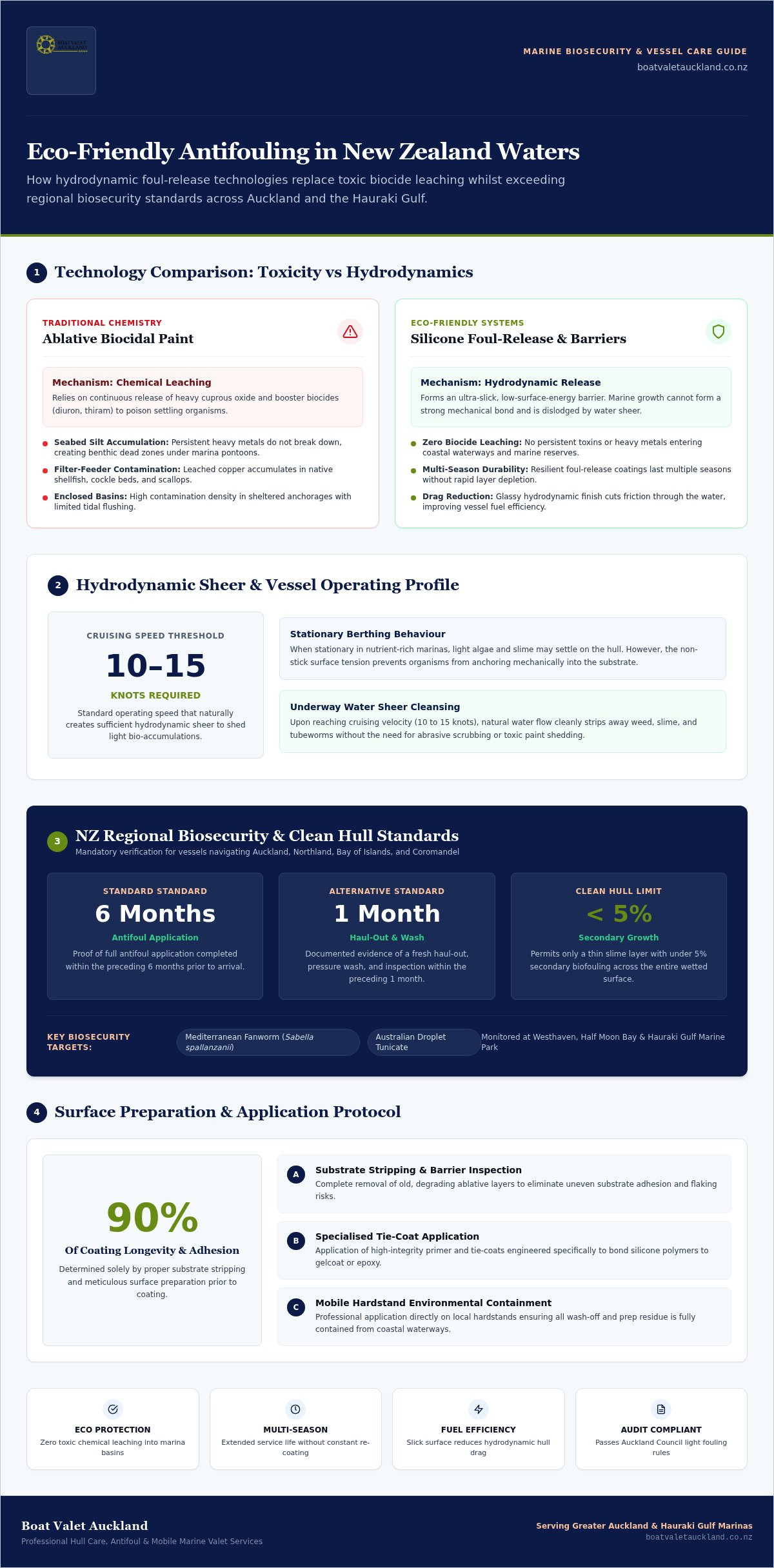
Regional councils enforce strict biosecurity rules. Under the widespread "six-or-one" marina standard, visiting craft must prove an antifoul application within the past six months or show evidence of a haul-out and wash within the preceding month. At the same time, regional council rules mandate that vessels maintain no more than light fouling, which means a thin slime layer with less than 5% secondary growth. Adopting modern eco friendly antifouling nz systems alongside routine professional hull maintenance ensures your boat glides through regional biosecurity audits without failing marina inspections or incurring costly redirection notices.
Comparing Modern Eco-Friendly Antifoul Technologies
Modern eco coatings protect hulls without turning underwater hulls into chemical dispensers. Instead of poisoning marine life, advanced systems rely on physical slickness, hydrodynamic water sheer, and ultra-hard mechanical barriers. Navigating the choices for eco friendly antifouling nz vessels requires understanding how each coating chemistry performs against your vessel's cruising speed, haul-out cycle, and berth style.
With environmental regulators phasing out persistent booster biocides like diuron and thiram, the maritime sector has pivoted. Boaters keeping up with New rules for antifouling paints have several mature technologies to consider beyond standard copper-heavy formulations.
Silicone and Foul Release Polymer Coatings
Silicone foul release coatings present an exceptionally slick, non-stick surface tension that prevents weed, slime, and tubeworms from securing a mechanical anchor. While light algae can settle on a stationary vessel, the bond remains exceptionally weak. Once your hull reaches ten to fifteen knots, standard water flow strips the accumulation away naturally.
Biocide-free hydrodynamics: Zero biocides leach into the water column, eliminating marina basin toxicity entirely.
Multi-season lifespan: A well-applied foul release layer can last multiple seasons without requiring complete renewal coats.
Fuel efficiency: The glassy finish cuts hull drag through the water, delivering noticeable fuel savings on displacement and planing craft alike.
Ceramic Hybrids and Hard Non-Biocide Barriers
Ceramic hybrid coatings and hard epoxy barriers create an impenetrable shield over underwater gelcoat. This dense matrix resists repetitive pressure washing and mechanical in-water wipe-downs without eroding toxic runoff into the harbour. They provide superb osmotic protection, making them ideal for high-use launches, trailer boats, and dry-stack vessels subjected to frequent roller contact.
Advanced Low-Copper and Organic Biocide Formulations
Low-metal and reduced-cuprous ablative systems provide a practical middle ground. They drastically reduce metal leaching rates compared to legacy antifouls while offering the continuous protection needed for low-speed yachts or craft that sit idle in high-fouling berths for months at a time. These formulations meet evolving marina criteria without altering conventional maintenance routines.
Achieving outstanding results from any advanced coating comes down to meticulous execution. If you need clarity on which system suits your vessel's displacement and mooring conditions, consider scheduling a consultation with our experienced antifouling team to inspect your hull substrate before planning your next haul-out.
Performance in Local Conditions: Auckland and the Hauraki Gulf
Auckland's marine climate creates an aggressive proving ground for underwater running surfaces. Between December and April, shallow estuary reaches and inner harbour basins reach peak water temperatures. Combined with heavy runoff and nutrient loads, this creates an environment where biofouling accelerates rapidly. Deploying an effective eco friendly antifouling nz barrier demands a clear strategy tailored directly to these northern waters.
Vessels resting in high-density marinas like Westhaven, Orakei Marina, or Half Moon Bay sit directly in nutrient-rich tidal flows. If your craft sits idle for weeks at a time, fouling pressure builds quickly regardless of your coating chemistry. The key difference lies in how effectively that buildup can be removed without stripping chemical poisons into the berth.
Tackling Warm-Water Slime and Local Marine Pests
Marine fouling follows a predictable, destructive succession across the Gulf:
Primary biofilm formation: Microscopic bacterial slime and brown algae adhere to the hull within days of immersion.
Secondary infestation: This initial slime coat provides the biological anchor required for calcifying organisms, including Mediterranean fanworm and encrusting bryozoans.
Effortless release: Non-stick polymer coatings disrupt this lifecycle. Because the organisms cannot form a mechanical bond to low-surface-energy coatings, a light wipe with a soft sponge sloughs them off cleanly without scouring the surface.
Staying ahead of this progression keeps your vessel clear for weekend crossings to sensitive destinations like Great Barrier Island, Kawau, or the Coromandel Peninsula, where regional councils inspect arrival hulls closely.
Vessel Usage Profiles: Marina Berth vs Mooring vs Dry Stack
Your vessel's mooring style dictates how an eco-friendly system performs over time. Planning your maintenance routine around your operating habits ensures consistent protection.
Displacement launches and planing powerboats used every weekend gain maximum benefit from foul release technology. The hydrodynamics of regular cruising at cruising speed naturally wash off soft weed. Conversely, yachts kept on swing moorings in sheltered, low-current bays need a scheduled monthly wipe down to prevent slime layers from thickening into hard growth. For trailer boats and vessels kept on dry-stack racks, hard non-biocidal barrier coatings deliver long-term peace of mind; they resist repeated roller contact, withstand pressure washdowns, and stay slick across multiple seasons.
Surface Preparation and Professional Application Standards
Proper surface preparation determines ninety percent of long-term coating adhesion and performance. Applying an advanced eco friendly antifouling nz system over an unwashed or poorly profiled hull guarantees rapid delamination. Because foul release polymers and hard barrier coats lack aggressive chemical solvents to bite through chalky residue, the substrate below must be structurally sound and chemically pure.
Converting Existing Hulls: Stripping vs Sealing
Switching from conventional biocidal paints to modern non-stick coatings requires a decisive approach. You cannot simply sand old copper smooth and paint over it; the incompatible chemistries will quickly blister.
Complete substrate stripping: Old, degraded ablative paint must be completely stripped back to the sound epoxy primer or bare gelcoat using controlled stripping methods.
Specialised tie-coats: Once stripped, technicians apply a multi-stage high-build epoxy primer followed by a dedicated elastomeric tie-coat. This establishes an impermeable chemical bridge between the hull and topcoat.
Film thickness control: Applying coats at precise wet-film thicknesses prevents sagging and guarantees an ultra-smooth, ripple-free finish.
Environmental Compliance on Auckland Hardstands and Slipways
Slipways and hardstands across Tamaki Makaurau operate under strict environmental mandates. Yard regulations classify hull prep zones as controlled work areas, requiring complete containment of toxic legacy dust and washdown runoff. Professional mobile teams co-ordinate directly with yard operators to capture sanding residue, ensuring all operations comply fully with regional council discharge rules.
Ongoing Hull Grooming and Maintenance Best Practices
Preserving a foul release skin requires a gentle touch. Traditional hull cleaners often attack surfaces with coarse abrasive pads or high-pressure water blasters. On foul release silicone, aggressive scrubbing tears the microscopic surface boundary and destroys its non-stick properties. Instead, schedule routine grooming using soft microfibre mitts or low-pressure sponges. Regular soft washing lifts harbour slime without gouging the coating, ensuring top speed and maximum fuel economy.
Ensure your underwater investment performs reliably for seasons to come. Contact Steve Kellie to book professional antifouling application directly on your local hardstand.
Why Partner with Boat Valet Auckland for Hull Care
Investing in an advanced underwater system only pays off when the application is carried out with absolute precision. Transitioning to modern foul release barriers demands meticulous attention to detail, strict adherence to recoat windows, and disciplined surface prep. When you choose an eco friendly antifouling nz coating, partnering with an experienced local specialist guarantees your vessel delivers the speed, fuel economy, and environmental compliance you expect.
Decades of Dedicated Auckland Marine Craftsmanship
Since 1998, Steve Kellie has provided dependable, high-calibre marine care across greater Auckland. Operating as a dedicated mobile service, Boat Valet Auckland brings decades of hard-won trade experience directly to your slipway or marina hardstand. Steve works across all primary regional marine hubs, including Westhaven Marina, Half Moon Bay, Pine Harbour, and Gulf Harbour.
Dealing directly with the business owner means complete accountability on every job. You don't get passed along to casual labourers or junior apprentices. Every hull is evaluated, washed, profiled, and coated under direct supervision. This ensures the surface substrate achieves an optimal chemical key, preventing delamination while keeping your vessel fully aligned with Auckland Council biosecurity standards.
Complete Vessel Care from Keel to Masthead
Haul-out time offers the perfect window to refresh your entire boat without wasting days on the hardstand. While your hull dries and cures after professional antifouling, our mobile unit provides comprehensive detailing across the rest of the craft:
Gelcoat & Topsides: Machine boat cut and polish followed by exterior wash and wax to lift heavy oxidation, chalking, and salt haze.
Brightwork & Decks: Professional teak restoration to revive weathered timber alongside detailed stainless steel polishing to remove tea-staining.
Interiors & Mechanics: High-clarity window polishing, meticulous engine room cleaning, and complete interior valet packages.
This seamless service saves you time and co-ordination headaches. Your craft returns to its berth with a slick, biosecurity-compliant hull beneath the waterline and an immaculate gloss above. If you want dependable eco friendly antifouling nz application backed by seasoned local craftsmanship, contact Steve Kellie to organise your next haul-out.
Protect Your Hull and Preserve New Zealand Waters
Adopting an advanced eco friendly antifouling nz system protects both your vessel's performance and our coastal marine habitats. Modern non-toxic barriers keep running surfaces clean by using hydrodynamics and low-surface-energy slickness rather than shedding persistent biocides into the sea. Pairing the right coating with disciplined surface preparation ensures full compliance with strict regional marina biosecurity checks and guarantees lasting adhesion.
Steve Kellie has delivered dependable, mobile marine expertise across Auckland hardstands since 1998. From meticulous hull profiling and specialized coating application to topside polishing and teak restoration, Boat Valet Auckland provides complete owner-operated care on-site. Book your professional hull antifouling consultation with Boat Valet Auckland today to get your boat cruising faster, cleaner, and ready for your next Hauraki Gulf voyage.
Frequently Asked Questions
Is eco friendly antifouling legally approved for use in New Zealand marinas?
Yes, eco-friendly systems comply fully with New Zealand regulations and are welcome across national marinas. The Environmental Protection Authority bans specific harmful biocides, making non-toxic foul release and low-impact formulas preferred choices. These products satisfy regional environmental standards whilst fulfilling marina slipway criteria throughout the country.
Can non-toxic foul release coatings stop barnacles in the warm Hauraki Gulf?
Foul release coatings stop barnacles mechanically rather than chemically. The ultra-slick surface prevents organisms from forming a strong structural bond. Once the vessel exceeds cruising speeds of ten to fifteen knots, water friction washes off settling spat. Craft sitting stationary in warm water simply require gentle routine wiping to dislodge loose growth.
How often does an eco friendly silicone antifouling system need reapplying?
A properly applied foul release system typically lasts several seasons before requiring recoating. Unlike traditional paints that constantly dissolve into the sea, silicone remains chemically stable on the substrate. As long as you avoid mechanical abrasion and maintain the surface correctly, an eco friendly antifouling nz application delivers impressive long-term protection.
What happens if my boat fails regional council biosecurity hull inspections?
Failing a biosecurity audit leads to strict operational restrictions. Regional officers can issue formal notices directing you to haul the boat out immediately or leave the harbour within twenty-four hours. You risk significant council infringement fines, and local marinas will decline berthing privileges until you present certified proof of an approved wash down.
Can I apply an eco friendly coating directly over my old copper paint?
No, you cannot apply silicone foul release directly over existing biocidal paint. Incompatible chemical formulas cause severe blistering and complete coating failure. The old ablative layers must be thoroughly stripped back to sound gelcoat or primer, followed by a specialised sealing tie-coat engineered specifically to bond the new silicone matrix.
How do I safely clean a silicone-coated hull without damaging the finish?
Clean silicone hulls using soft microfibre wash mitts, soft sponges, or low-pressure water rinses. Never use stiff bristle brooms, scouring pads, scrapers, or high-pressure blasters. Aggressive tools gouge the delicate silicone boundary layer, permanently destroying the non-stick surface tension required for your eco friendly antifouling nz coating to release weed and barnacles naturally.
Comments