
Coppercoat Alternative NZ: Top Antifouling Systems Compared for 2026

What if the promise of a ten-year antifoul is actually costing you more time, stress, and cash in local waters than it saves? You want your vessel protected without dreading haul-out bills or falling foul of strict regional biosecurity rules like Northland's 6-or-1 standard. Coppercoat certainly has its place, but between unforgiving application temperatures, intensive substrate preparation, and stubborn slime accumulation in warmer northern slips, it is rarely the universal fix it claims to be. If you are looking for an effective coppercoat alternative nz boat owners can genuinely depend on, you are not alone.
You will discover the highest-performing alternative hull systems available across New Zealand for 2026, from slick biocide-free silicone hydrogels to modern self-polishing copolymers engineered for local conditions. We compare genuine multi-year running requirements, real-world cruising performance, and marina biofouling compliance so you can protect your hull with complete confidence.
Table of Contents
Why Kiwi Boat Owners Seek a Coppercoat Alternative in NZ
Coppercoat is widely promoted as a ten-year antifouling silver bullet. Distributed in New Zealand by HullWell, it consists of a solvent-free epoxy resin densely packed with recycled copper powder. The theory appeals to many skippers: apply it once and skip the repetitive haul-out cycle. Yet, countless local boaties end up searching for a practical coppercoat alternative nz boatyards can roll out without extraordinary disruption. Stripping a hull back to bare gelcoat requires intensive abrasive blasting or tedious chemical scraping, driving upfront preparation labour through the roof before a single drop of epoxy touches the hull.
The Reality of Coppercoat Application and Maintenance
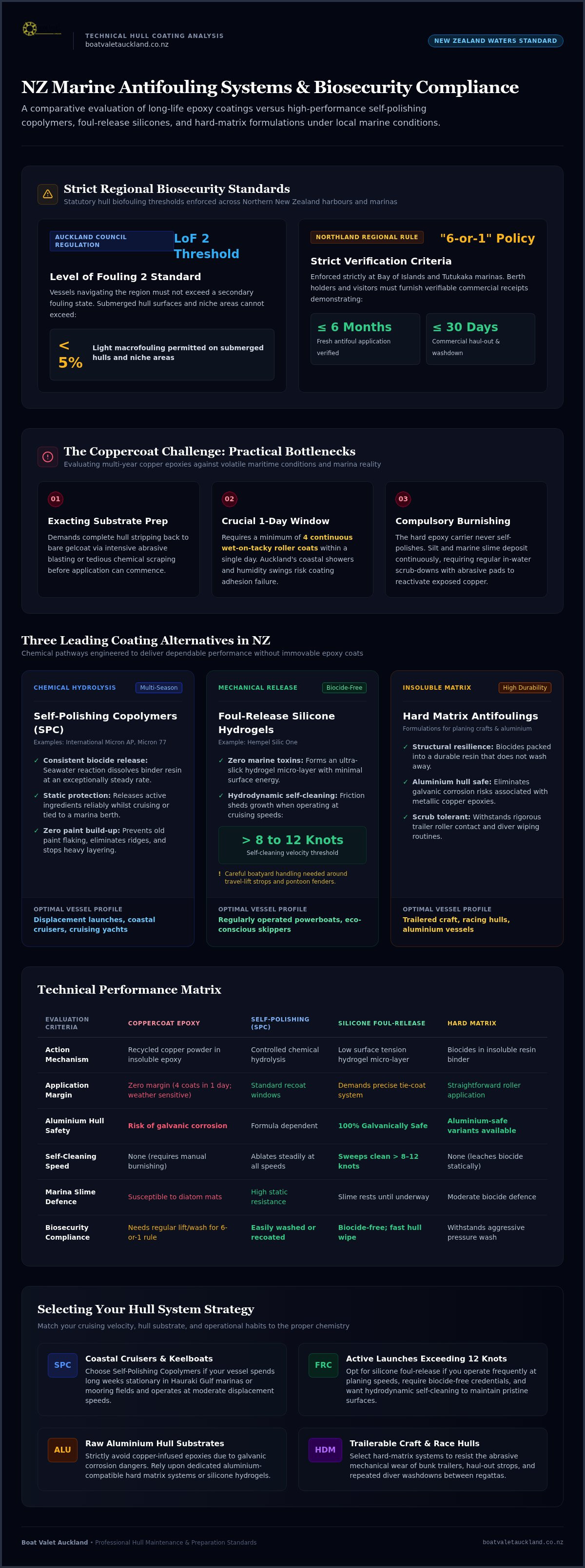
Application conditions leave zero margin for error. Coppercoat demands a minimum of four continuous wet-on-tacky roller coats applied within a single day. Auckland's volatile maritime climate, sudden coastal showers, and humidity swings often compromise this delicate curing curve. If the epoxy cures too fast or catches surface moisture between passes, adhesion fails. Ongoing maintenance does not vanish, either. Because the hard epoxy carrier does not self-polish, dead marine growth and silt blanket the hull. Owners must regularly jump overboard with abrasive pads to burnish the surface, knocking away calcification to reactivate the embedded copper.
New Zealand Marine Conditions and Biosecurity Pressures
Hauraki Gulf waters present a brutal testing ground for static coatings. In warmer, nutrient-rich mooring fields and marinas, stubborn green slime and brown diatom mats establish footholds within days. Biosecurity surveillance across the region has also never been tighter. Auckland Council regulations require vessels to remain under Level of Fouling 2, meaning submerged hulls and niche areas cannot exceed 5% light macrofouling. Head north past Tutukaka or into the Bay of Islands, and marina staff strictly enforce Northland's "6-or-1" rule. Berth holders must provide physical receipts verifying a fresh antifoul within the previous six months or a commercial lift-and-wash within the past thirty days. A multi-year epoxy does not grant automatic clearance when slime accumulates, which is why choosing a reliable coppercoat alternative nz skippers can quickly refresh or wash down makes operational sense.
Leading Coppercoat Alternatives Available in New Zealand
Skippers looking beyond copper-infused epoxy have three main chemical pathways to consider. Modern chemistry offers distinct mechanisms to keep underwater surfaces foul-free without committing to an immovable coating. When evaluating a coppercoat alternative nz boatyards regularly apply, options fall into self-polishing copolymers, foul-release silicone systems, and durable hard-matrix formulations. Selecting the correct chemistry depends on how frequently you head out, your vessel's hull substrate, and its typical cruising velocity.
Self-Polishing Copolymer (SPC) Antifouling Systems
Unlike standard physical-drying ablatives, true self-polishing copolymer (SPC) paints like International Micron AP or Micron 77 rely on a chemical reaction called hydrolysis. Seawater slowly reacts with the binder resin, causing the outermost micro-layer to dissolve at an extraordinarily steady rate. Biocides release predictably whether your boat is cruising down the coast or tied up in a calm marina berth. This controlled wear prevents heavy paint layering, eliminates nasty ridges, and stops old antifoul from flaking off over time. For displacement launches, coastal cruisers, and cruising yachts, SPC technology provides exceptional multi-season protection across New Zealand waters.
Foul-Release Silicone and Non-Biocide Coatings
Silicone foul-release technology represents the cleanest break from toxic chemistry. Products like Hempel Silic One form an ultra-slick, hydrogel micro-layer with exceptionally low surface energy. Rather than poisoning marine organisms, it denies them a mechanical foothold. Slime, weed, and juvenile barnacles might rest on the surface, but hydrodynamic water friction sweeps them clean once the boat hits speeds above 8 to 12 knots. Because these systems are completely biocide-free, they satisfy strict regional environmental guidelines. They do require careful handling around travel-lift strops and pontoon fenders, making careful yard handling essential.
Hard Matrix and Hybrid Performance Antifoulings
Hard-matrix paints retain their structural integrity throughout their entire lifespan. They pack biocides into an insoluble, durable resin that does not wash away. This hard finish makes them the practical choice for trailered boats, fast planing craft, and race boats that undergo regular diver wipe-downs. They are also crucial for aluminium hulls. Metallic copper epoxies risk rapid galvanic corrosion on alloy hulls, so copper-free hard matrix paints like Pettit Vivid (using copper thiocyanate) keep plates sound while preventing growth.
Every system requires meticulous hull preparation and compatible tie-coats to perform as advertised. If you are weighing up which system matches your vessel and usage pattern, you can book professional antifouling services with Boat Valet Auckland to get the hull prepped and coated cleanly right in your home marina.
Comparing Long-Life Antifoul Options: Performance, Prep, and Cost
Marketing brochures often promise ten years of maintenance-free boating, but practical ownership tells a different story. Choosing a reliable coppercoat alternative nz boatyards can maintain requires balancing upfront haul-out preparation against long-term maintenance cycles. Hydrodynamic drag, regional biosecurity rules, and substrate compatibility all dictate your real running costs.
Initial Preparation vs Ongoing Maintenance Demands
Substrate preparation forms the biggest cost divide. Coppercoat requires taking the entire underwater body back to bare gelcoat or raw metal via mobile media blasting. By contrast, applying an advanced SPC or aluminium-safe hard matrix typically needs only a rigorous wet-sand and spot-priming over sound existing coatings. Silicone foul-release systems sit in the middle; they require dedicated tie-coats, but they spare you aggressive mechanical stripping if your underlying epoxy barrier remains intact. Whichever route you take, routine annual lift-and-wash appointments remain unavoidable under regional biosecurity checks.
Financial Realities Across a Five- to Ten-Year Cycle
Evaluating total cost of ownership means looking beyond the price per can. Coppercoat demands massive upfront capital for blasting, dry-film thickness gauges, multi-coat application labour, and extended yard hardstand days. If early adhesion failure occurs due to ambient humidity, stripping that epoxy back off is immensely difficult. High-performance self-polishing copolymers distribute expenditure across manageable biennial haul-outs. You haul out, complete running gear checks, apply fresh coats, and splash within days. Read our guide on marine antifouling Auckland for a closer look at local yard requirements, hardstand expenses, and biosecurity protocols.
How to Choose the Right Antifouling Alternative for Your Vessel
No single coating suits every hull berthed in Auckland waters. Matching the chemistry to your hull material, average speed, and local mooring basin ensures you get genuine value from your selected coppercoat alternative nz boatyards apply. Follow this five-step decision sequence to select your next system:
Identify your substrate: Confirm whether your hull is fibreglass, timber, steel, or aluminium.
Measure your operational velocity: Determine whether your boat cruises below or above 10 to 12 knots.
Assess your slip's water exchange: Check if your berth has strong tidal flow or stagnant, sun-warmed water.
Review haul-out frequency: Align coating service life with your marine insurance survey intervals.
Verify regional biosecurity compliance: Ensure your choice makes passing marina hull inspections straightforward.
Hull Substrate and Galvanic Considerations
Aluminium craft demand absolute caution. Copper-loaded epoxies placed near alloy hulls create a galvanic cell in saltwater, causing rapid pitting and structural degradation. Even when applying specialized ceramic barrier coats, the risk to expensive saildrives, stern legs, and aluminium plates remains severe. Owners of alloy launches must stick with copper-free formulations or pure foul-release silicone systems. Timber hulls flex under seaway stress, requiring softer matrixes that won't crack along seam lines. Fibreglass gelcoats need intact epoxy barrier coats beneath any antifoul to guard against osmotic blistering during multi-year immersion.
Vessel Speed, Mooring Location, and Use Profiles
Cruising velocity dictates coating performance. Non-biocide foul-release systems require laminar water flow to scour away micro-fouling. If your launch regularly cruises above 12 knots, silicone hydrogels keep running gear and hulls immaculate. Displacement yachts moving at 5 to 7 knots cannot rely on hydrodynamic shedding alone; they require self-polishing copolymers with controlled biocide release. Mooring geography also matters. Vessels tied up in enclosed, shallow basins experience rapid diatom colonization compared to craft on deep, fast-flowing moorings. Frequent cruisers keep self-polishing resins activated naturally, while weekenders in dead-water slips need the chemical resilience of an SPC or a scrub-resistant hard matrix.
Getting your hull assessed by an experienced specialist ensures you pick the right chemistry for your cruising schedule. Talk directly with Steve Kellie and book mobile antifouling with Boat Valet Auckland to get your hull prepped and coated accurately for the upcoming season.
Professional Hull Preparation and Maintenance with Boat Valet Auckland
Coating longevity never comes down to paint chemistry alone. Even the most advanced coppercoat alternative nz boat owners choose will shed off within months if applied over contaminated substrate, salt film, or poorly keyed layers. Flawless surface prep determines whether your hull stays protected or develops bubbling, peeling, and early growth. Established in 1998 by Steve Kellie, Boat Valet Auckland provides seasoned mobile expertise directly on the hardstand, ensuring every vessel receives meticulous preparation and precision application.
The Crucial Role of Surface Preparation
Professional preparation demands methodical execution. We start with industrial high-pressure washing to eliminate bio-slime, salt deposits, and failing old paint flakes. From there, thorough mechanical sanding profiles the underlying substrate to create an unbroken physical key for your new antifouling system. While the hull is out of the water on the cradle, combining underwater work with a professional boat cut and polish Auckland treatment restores chalky, oxidised gelcoat above the boot-top, delivering an immaculate waterline-to-coachroof transformation.
Complete Mobile Marine Care Across Greater Auckland
Eliminate the hassle of juggling separate contractors during your haul-out. Steve Kellie operates a fully equipped mobile unit servicing all major Auckland marinas, including Westhaven, Gulf Harbour, Half Moon Bay, Pine Harbour, and Orams Marine. Hauling out at Hobsonville Marina? We contribute 10% towards your haul-out and hardstand fees, putting money straight back into your cruising budget.
Maximise your vessel's performance and resale appeal by pairing antifoul renewals with mobile boat grooming Auckland services, including teak restoration and stainless steel polishing. With over 25 years on Auckland hardstands, Steve provides honest, impartial advice tailored directly to your hull material and cruising habits. Call Steve Kellie at Boat Valet Auckland on 021 169 5174 today to lock in your next haul-out service.
Protect Your Hull and Cruising Freedom in 2026
Finding the right coppercoat alternative nz boaties can rely on comes down to matching paint chemistry with your hull substrate, cruising speeds, and local marina rules. Whether you choose the predictable self-cleaning action of a self-polishing copolymer or the biocide-free release of a modern silicone hydrogel, coating longevity always starts with disciplined hardstand preparation. No coating can perform if the underlying surface is compromised.
Since 1998, owner-operator Steve Kellie has provided boaties with hands-on marine expertise across all major Auckland marinas. Our mobile service delivers specialist antifouling application alongside topside cut and polish work and teak restoration, keeping your vessel immaculate from keel to coachroof. Take the guesswork out of your haul-out schedule. Book expert hull antifouling and grooming with Boat Valet Auckland today, and head out on the Hauraki Gulf with complete confidence.
Frequently Asked Questions
Is Coppercoat worth the initial investment compared to traditional antifoul in New Zealand?
For most recreational boaties, rarely. The upfront outlay for complete substrate blasting, finicky multi-coat application, and ongoing dive burnishing often outweighs the benefits. An effective coppercoat alternative nz boaties apply every two to three seasons typically proves more practical. You spread your capital across standard haul-out cycles while easily staying compliant with marina biosecurity checks across the Hauraki Gulf and Northland.
Can silicone foul-release coatings be applied over existing antifouling paint?
Not directly over traditional antifoul. Silicone hydrogels require a stable, chemically compatible foundation to bond properly. While you don't always need to blast back to bare gelcoat if the underlying epoxy barrier is sound, you must seal old, flaking antifouling completely or strip failing coats before applying a specialised conversion primer and tie-coat. Applying silicone directly over chalking paint causes immediate adhesion failure.
Why is copper-based antifouling unsafe for aluminium boats and outdrives?
Metallic copper and aluminium create a severe galvanic cell when submerged together in conductive saltwater. Because aluminium is less noble on the galvanic scale, it acts as a sacrificial anode, suffering aggressive pitting, pinholes, and catastrophic structural failure. Even coated saildrives and trim tabs require complete electrical isolation. For aluminium craft, skippers must always select copper-free formulations or pure silicone foul-release systems.
How often do boats with Coppercoat alternatives need to be hauled out in Auckland?
Most vessels using self-polishing copolymers (SPC) or high-grade foul-release coatings haul out every 18 to 24 months for recoating. Even if your coating lasts longer, insurance policies, through-hull valve servicing, and anode renewals demand an annual or biennial yard visit. Planning your haul-out around these intervals keeps your maintenance predictable and ensures your hull passes local marina biosecurity checks without hassle.
Do non-biocide foul-release systems work on slow-moving sailing yachts in NZ waters?
They work, but with caveats. Foul-release silicone relies on water movement at speeds above 8 to 12 knots to shed growth naturally. Sailing yachts cruising at 5 to 6 knots won't generate sufficient hydrodynamic friction to slough off heavier warm-water diatom slime. While organisms cannot bite deeply into the slick surface, owners of slower yachts must gently wipe down the hull periodically using soft sponges.
What are the Auckland Council clean hull rules for visiting regional anchorages?
Auckland Council enforces a Level of Fouling 2 threshold under its Regional Pest Management Plan. Submerged hulls and niche areas must not exceed light slime and a maximum of 5% macrofouling, such as barnacles or tubeworms. Cruising north into Northland waters or the Bay of Islands requires satisfying the strict 6-or-1 rule, which demands verified receipts proving a fresh antifoul within six months or a haul-and-wash within thirty days.
Can I apply a Coppercoat alternative myself, or should I hire a professional?
While DIY painting is possible, hiring a professional mobile specialist ensures correct surface profiling, proper dry-film thickness, and compliance with strict marina environmental containment rules. New Zealand boatyards require controlled work areas to catch sanding dust and paint runoff. Steve Kellie at Boat Valet Auckland brings over 25 years of hardstand experience, ensuring your chosen coppercoat alternative nz coating adheres tenaciously and performs through its full cycle.
Comments