
Professional Boat Cut and Polish Auckland: The 2026 Gelcoat Restoration Guide

A quick coat of wax won’t restore chalky gelcoat. Professional boat cut and polish Auckland owners choose removes oxidation through careful, staged correction, helping bring back colour, gloss and reflection. If your topsides look dull or the hull has lost its shine, it’s reasonable to wonder whether the damage can be reversed. A sound boat cut and polish Auckland service starts by assessing the gelcoat, not by covering the problem with a temporary finish.
Professional restoration can make a marked difference, but the process needs to suit the gelcoat’s condition. That matters in Auckland, where strong UV and salt spray affect exposed surfaces, while reflected light across the Hauraki Gulf adds to the exposure. A protective finish helps shield the restored surface, but it works best after proper preparation and polishing.
This guide explains what cut and polish involves, how it addresses oxidation, and why technique matters. You’ll also find practical ways to assess your vessel’s finish and maintain it between restoration work. Boat Valet Auckland provides mobile boat cut and polish, detailing and grooming at Auckland marinas and private properties.
Table of Contents
Understanding Gelcoat Oxidation: Why Auckland Boats Require Cutting and Polishing
Cutting vs Polishing vs Waxing: The Technical Differences Explained
The Multi-Stage Gelcoat Restoration Process: How Professionals Achieve a Mirror Finish
Assessing Your Vessel: How to Determine the Level of Correction Needed
Choosing a Professional Marine Groomer in Auckland: The Mobile Advantage
Understanding Gelcoat Oxidation: Why Auckland Boats Require Cutting and Polishing
A chalky film on a hull isn’t simply dirt. Marine gelcoat is the pigmented, resin-rich outer layer of a fibreglass structure. It provides a smooth finish, as outlined in What is Gelcoat? Over time, ultraviolet exposure and weathering degrade the surface. Washing removes salt and grime, but it can’t reverse oxidation that has already dulled the finish.
Auckland boats face strong sunlight, salt spray and reflected light across the Hauraki Gulf. Salt deposits can hold moisture and grit against the surface, so rinsing them away helps reduce residue and abrasion. For boat cut and polish in Auckland, the important step is assessing the gelcoat itself rather than applying wax over a dull surface. Look at the hull when it is clean and dry, and compare exposed sections with areas that spend more time in shade.
The Chemistry Behind Gelcoat Degradation in New Zealand Waters
UV radiation gradually damages the polymer structure in marine polyester gelcoat. As the surface weathers, it can lose smoothness and become microscopically pitted. Contaminants settle into those tiny irregularities, leaving the hull looking dull even after a wash.
Automotive finishes often use a thinner clear coat over layers of paint, whereas marine gelcoat is a thicker, pigmented finish formed as part of a fibreglass component. The surfaces weather differently, so automotive care assumptions don’t always suit a boat hull. Boat cut and polish in Auckland should be matched to the gelcoat’s condition, with oxidised material removed carefully and only as needed.
Recognising the Warning Signs of Severe Gelcoat Pitting
Check the hull in good light and look for a combination of signs. On a clean, dry area, lightly run clean fingers over the surface and check for residue:
Chalky transfer: A powdery mark on your fingers points to surface oxidation. Pitting can also give dirt, soot and salt more places to lodge.
Uneven or faded colour: Dark blue and red finishes can make fading and patchiness particularly easy to spot. Compare areas in similar light before deciding how widespread the change is.
Water sheeting rather than beading: Water spreading flat across the topsides may indicate that the surface has lost smoothness or protection. Contamination can also affect beading, so treat this as a clue, not a diagnosis.
These signs help indicate the level of correction that may be needed, but they don’t show how much gelcoat remains. Avoid aggressive home buffing based on appearance alone. A careful assessment helps protect the finish and guides the restoration process.
Cutting vs Polishing vs Waxing: The Technical Differences Explained
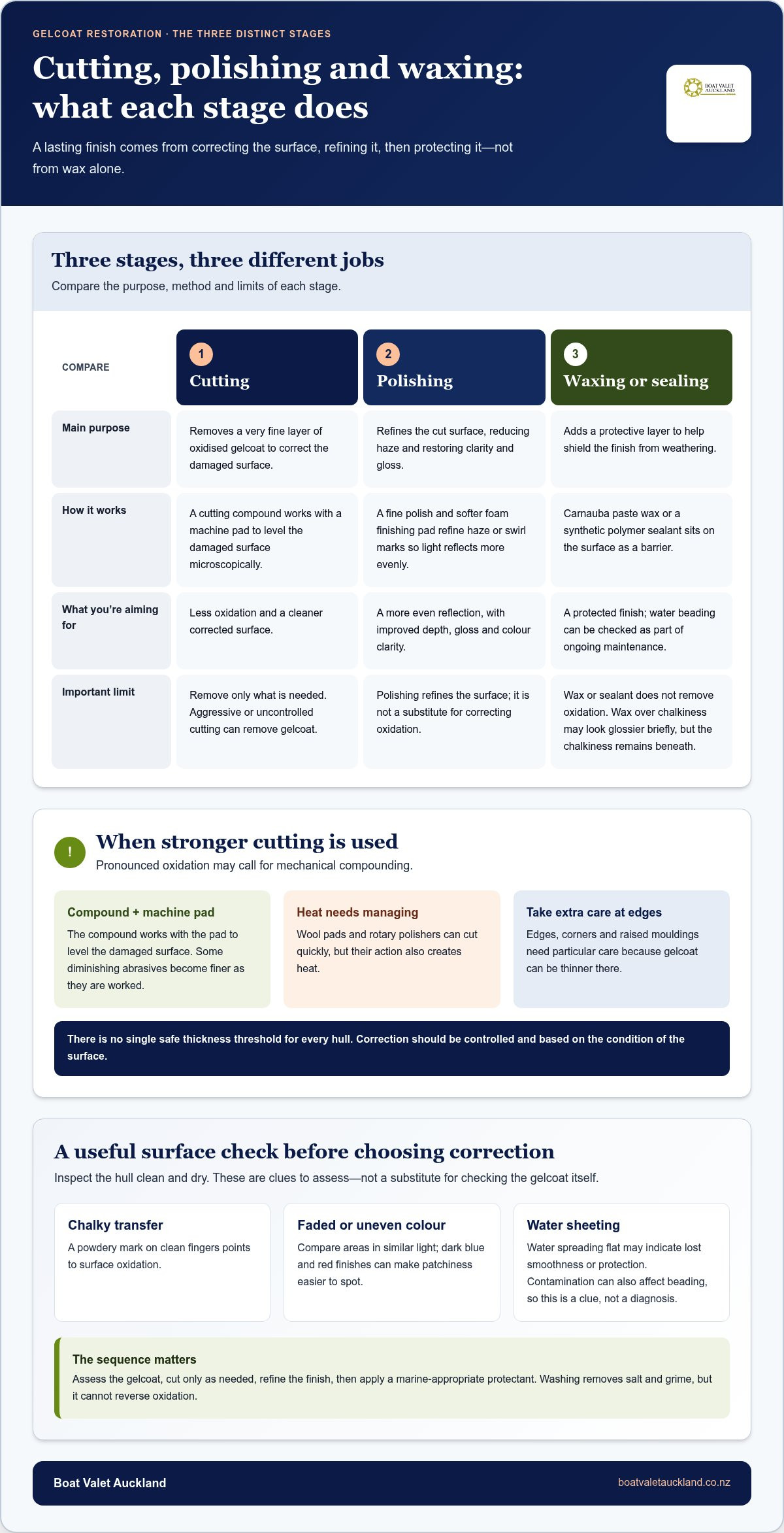
Cutting, polishing and waxing are different stages, not interchangeable ways to make a dull hull shine. Cutting removes a very fine layer of oxidised gelcoat. Polishing refines the surface left by cutting, reducing haze and restoring clarity. Wax or sealant then adds a protective layer to help shield the finish from weathering. Wax over oxidation may look glossier for a short time, but it won’t remove the chalkiness beneath it.
A proper boat cut and polish in Auckland matches the level of correction to the surface. The aim is to remove only what’s needed, refine the finish, then protect it. The international marine coating standards guide covers coating application and inspection. It isn’t a gelcoat polishing manual, but it reinforces a useful principle: preparation and application both matter to the finished result.
Mechanical Compounding: When Heavy Cutting Is Essential
For pronounced oxidation, a cutting compound works with a machine pad to level the damaged surface microscopically. Some compounds use diminishing abrasives, which break down into finer particles as they’re worked. Wool pads and rotary polishers can cut quickly, but their action also creates heat. Edges, corners and raised mouldings need particular care because gelcoat can be thinner there. There’s no single safe thickness threshold for every hull, so correction needs to be controlled and based on the surface condition.
Finishing Polishes: Restoring Deep Gloss and Clarity
After compounding, fine haze or swirl marks can scatter reflected light and make colour look flat. A softer foam finishing pad with a fine polish refines those marks, allowing light to reflect more evenly. That’s the difference between a cut surface that looks cleaner and a refined surface with depth and clarity. For practical upkeep between restoration work, see this guide to mobile boat grooming in Auckland.
Sacrificial Barriers: Marine Waxes and Sealants
Carnauba paste wax and synthetic polymer sealants both sit on the surface as protective layers, but their formulations and behaviour differ. Neither corrects oxidation. An unprotected, freshly refined finish is exposed again to UV, salt and grime, so choose a marine-appropriate protectant and maintain it according to its instructions and the vessel’s exposure. Light washing and regular checks help you notice when water no longer beads as it did after protection was applied.
For chalky gelcoat, don’t rely on wax alone. A considered sequence of cutting, polishing and protection turns surface correction into a more complete restoration. Explore professional boat cut and polish for a finish suited to your vessel.
The Multi-Stage Gelcoat Restoration Process: How Professionals Achieve a Mirror Finish
A lasting finish depends on preparation as much as machine work. Each stage addresses a different problem, from salt and stains to oxidation and polishing haze. The correction is adjusted to the vessel’s surface rather than applying the same aggressive process everywhere. Working in manageable sections also makes it easier to keep track of the result and avoid missed areas.
Surface Decontamination and Waterline Preparation
First, the hull is washed with a pH-neutral cleaner to lift salt crust, grime and loose contaminants. Targeted cleaning then addresses waterline staining, exhaust soot and rust marks. Old silicone residue and biological growth also need attention because remaining contamination can interfere with polishing or protection. Sensitive caulking, teak trim and graphics are protected before machine work begins. Topsides can be considered alongside marine antifouling in Auckland below the waterline as part of broader vessel care.
Controlled Compounding and Polishing
Once the surface is clean and dry, a suitable compound and rotary polisher work across manageable sections. The operator keeps the pad moving, watches surface warmth and eases pressure around edges, mouldings and fittings. Excess heat can damage gelcoat, so speed and technique must suit the surface and pad. Overlapping cross-hatch passes help produce even correction instead of missed strips or concentrated marks.
A second, finer polishing pass refines the compound haze and reduces buffer trails. A dual-action polisher can help finish the surface evenly. This staged approach is central to professional boat cut and polish Auckland work: the aim is to restore clarity while removing as little material as reasonably possible.
Protection and Final Inspection
After polishing, residue is removed so the finish can be assessed clearly. A compatible panel wipe, sometimes using isopropyl alcohol where suitable, can reveal leftover compound oils. Check product compatibility and test carefully first. Inspect the surface in direct light before applying a marine wax or sealant by hand according to its instructions. For context, this FROSIO overview of a marine coating system describes layered protective coatings, which serve a different role from gelcoat polishing and wax protection.
The final check shouldn’t stop at broad, flat panels. Rub rails, transom corners and cabin superstructures can hide missed residue or uneven gloss. For ongoing vessel care, explore mobile boat grooming in Auckland, or see how professional boat cut and polish can help restore your vessel’s finish.
Assessing Your Vessel: How to Determine the Level of Correction Needed
Before choosing a correction method, inspect the gelcoat in good light on a clean, dry surface. Look across the finish from different angles, then lightly run clean fingertips over an inconspicuous area. Powdery transfer suggests oxidation; a rough feel or uneven colour may indicate more advanced surface wear. This check helps guide the next step, but it can’t measure gelcoat thickness or reveal every underlying issue. Note which areas look different, such as the foredeck, cabin top or topsides, so the assessment considers the whole vessel rather than one patch.
Stage 1 vs Stage 2 vs Stage 3 Gelcoat Assessment
Stage 1, gloss loss: The surface looks dull or hazy but leaves no powder on your fingers. A light polish may be enough to restore gloss without aggressive cutting.
Stage 2, moderate oxidation: A milky veil is visible and light powder transfers to your skin. This often calls for controlled compound cutting followed by a finer polish to refine the finish.
Stage 3, advanced wear: Heavy chalking, a rough texture or visible pitting points to deeper deterioration. More extensive correction may be considered, but wet sanding or heavier cutting removes material and needs careful assessment first.
These stages are a practical guide, not a substitute for checking the surface properly. Avoid choosing an aggressive process from appearance alone. For boat cut and polish in Auckland, correction should match the condition of each area and preserve sound gelcoat wherever possible.
Hull vs Superstructure: Varying Exposure Rates on Auckland Boats
Exposure isn’t uniform across a vessel. Horizontal cabin tops and foredecks face direct sunlight for longer, while topsides can collect salt spray that dries on the surface. The direction of the sun, shade, vessel use and existing protection all affect wear, so don’t assume every panel needs the same treatment. Refreshing weathered topsides and decks can also improve the overall presentation alongside complete teak restoration in Auckland.
Pre-Sale Presentation: Protecting Your Vessel’s Appeal
Chalky, faded gelcoat can make a boat appear poorly maintained, even when the issue is largely cosmetic. A clean, reflective hull helps buyers see the vessel at its best, but it doesn’t replace a survey or establish the boat’s condition. For a more complete listing preparation, explore pre-sale boat grooming in New Zealand.
Ready to assess your boat’s finish? Arrange professional boat cut and polish tailored to its gelcoat condition.
Choosing a Professional Marine Groomer in Auckland: The Mobile Advantage
Boat cut and polish in Auckland doesn’t always require moving your vessel to another facility. A mobile groomer can work at its berth or private hardstand, avoiding an unnecessary move when the job can be completed in place. Before arranging the work, consider berth access, the areas to be polished and any site requirements. Clear access makes it easier to work methodically around the vessel.
Mobile marine grooming brings the work to locations such as Westhaven, Half Moon Bay, Hobsonville and private driveways. Each berth or hardstand has its own access and environmental requirements, so the work needs to respect site rules for washdown and runoff. A careful approach keeps the focus on restoring the finish while treating the surrounding area responsibly.
Local Knowledge and Owner-Operated Care
Boat Valet Auckland has provided mobile marine grooming across Auckland since 1998. Owner-operator Steve Kellie brings local experience directly to the job, with personal oversight through the restoration process. That matters on a vessel with varied surfaces, from gelcoat topsides to fittings and trim that need different care.
Rather than treating every boat the same, the work can be planned around the vessel’s condition and presentation goals. Owners can also coordinate topside polishing with other grooming services, such as an exterior wash and wax or teak restoration, for a more consistent appearance.
Preparing for a Gelcoat Restoration
A little preparation makes the visit more straightforward. Share the vessel’s location and access details, and clear loose gear from the areas to be polished. If the gelcoat is especially chalky or patchy, photos can help show which areas need attention. Confirm berth access arrangements with the marina and follow any site instructions for the work area.
If you’re planning ahead for a cruising season, arranging restoration before the vessel is needed gives time to assess the finish and plan the work sequence. It also avoids leaving preparation until the last moment.
Choose a specialist who understands Auckland conditions and can tailor the process to your vessel’s surfaces. Arrange your boat cut and polish with Boat Valet Auckland and discuss the gelcoat areas you’d like restored.
Get Your Boat Ready for the Next Season
Chalky gelcoat needs more than a quick coat of wax. The right restoration starts by assessing the surface, then uses careful cutting and polishing to bring back colour and gloss before applying protection. Matching the correction to the gelcoat helps avoid unnecessary material removal and supports a finish that’s easier to maintain.
For boat cut and polish in Auckland, local experience matters. Boat Valet Auckland has served marina berths and private hardstands since 1998. Owner-operator Steve Kellie oversees the work, using marine rotary compounding equipment for gelcoat restoration. It’s a considered approach to improving your vessel’s appearance and helping it look its best on the water.
Give your boat’s finish the attention it deserves. Book your mobile boat cut and polish with Steve Kellie and take the next step towards a brighter, better-protected vessel. Your next cruise can start with a hull you’re proud to show off.
Frequently Asked Questions
How much does a boat cut and polish cost in Auckland?
There isn’t one fixed price for boat cut and polish in Auckland. The scope depends on factors such as the vessel’s size, gelcoat condition and level of correction needed. A lightly hazed surface may need less work than heavily oxidised or pitted gelcoat. Whether the finish is gelcoat or paint can also affect the work involved, so a tailored assessment is the best way to establish the scope.
Can severe gelcoat oxidation always be restored without painting?
No, severe oxidation can’t always be restored to the desired finish through cutting and polishing alone. The result depends on the gelcoat’s remaining condition, including how deeply it’s pitted or weathered. A professional assessment can help determine whether careful correction is appropriate or whether the surface has deteriorated beyond what polishing can improve. Avoid repeated aggressive buffing in the hope of removing deep damage, as cutting removes material from the finish.
How often should a boat be cut and polished in Auckland waters?
There’s no single interval that suits every boat. Exposure to Auckland sun and salt, how often the vessel is used, the existing protective finish and storage conditions all affect how quickly gloss fades. Inspect the gelcoat regularly for dullness, powdery residue and changes in water beading. Light maintenance may help preserve a polished finish, while a full cut and polish is best guided by visible condition rather than a rigid calendar.
What happens if you wax a boat without cutting the oxidation first?
Waxing can make an oxidised hull look temporarily glossier, but it doesn’t remove the damaged, chalky surface. The wax may sit over the oxidation and conceal it for a short time, leaving the underlying dullness in place. Once the protective layer wears away, the chalky appearance can return. For a better result, first assess whether the gelcoat needs polishing or cutting, then apply a suitable marine wax or sealant to the corrected surface.
Is professional machine compounding safe for older fibreglass gelcoat?
It can be safe when the gelcoat is assessed and the machine process is controlled, but age alone doesn’t show how much material can be removed. Previous polishing, local thinning, damage and worn edges all matter. A professional adjusts the compound, pad, pressure and machine action to the surface, taking particular care around corners and mouldings. Heavy DIY buffing can generate heat or remove too much gelcoat, so don’t assume more cutting will produce a better finish.
Can cutting and polishing be carried out while the boat is in its marina berth?
Mobile grooming can often be carried out at a marina berth, depending on access, the job and the marina’s site requirements. Boat Valet Auckland provides mobile marine grooming at Auckland marinas and private hardstands, so the vessel may not need to be moved. Before work begins, berth access and any rules about washdown, equipment or runoff need to be respected. Clearing loose gear from the areas being polished also helps prepare the boat.
What is the difference between automotive cut and polish and marine gelcoat restoration?
Automotive paintwork and marine gelcoat are different surfaces, so their correction needs aren’t automatically interchangeable. Gelcoat is a pigmented outer finish on fibreglass and is commonly thicker than an automotive clear coat, but it can still be worn or thin in places. Marine restoration uses an approach suited to the gelcoat’s condition and the vessel’s exposed surfaces. Compounds, pads and machine technique should be selected carefully to restore gloss without excessive material removal.
Comments