
New Boat Antifouling Auckland: A First-Launch Checklist

A new boat’s first antifoul should suit its hull and intended use, not simply copy the setup on the boat beside it. For new boat antifouling Auckland owners need to decide whether the hull needs a coating before launch, which system is compatible and how to prepare the surface.
Hull material, the builder’s preparation and where and how you plan to use the boat all affect the decision. Getting these details clear early helps you plan the work around your launch date and Auckland marina or property arrangements.
This checklist covers the key decisions before launch, from checking the hull and comparing coatings to organising preparation and application. Boat Valet Auckland provides mobile antifouling at marinas and private properties across greater Auckland. Owner-operated by Steve Kellie, the business has provided antifouling since 1998.
Table of Contents
New boat antifouling in Auckland: why plan before the first launch?
Antifouling is a coating applied to an immersed hull to help limit the settlement of marine growth. In simple terms, antifouling is a protective coating for the part of a boat that remains underwater. It belongs to a specialized category of coatings, and the right approach depends on the hull and coating instructions, not just the boat’s age.
A new hull isn’t automatically ready for antifouling paint. Its material, intended use and the builder’s specifications affect both coating choice and preparation. A boat kept afloat for extended periods has a different use pattern from one routinely lifted and stored ashore. Before deciding, check the builder’s guidance and any information about factory-applied finishes. Follow both the builder’s and coating manufacturer’s instructions.
Does every new boat need antifouling before launch?
There’s no single answer for every new boat. Consider how long the hull is expected to stay immersed and whether the boat will regularly be lifted out of the water. A vessel kept afloat may need a different protection plan from one routinely removed and stored ashore. If you plan to keep your craft on a trailer or hardstand between trips, learn more about secure boat storage solutions. Use these details, together with the hull material and builder specifications, to decide whether antifouling is appropriate before the first launch.
What makes a first antifoul different?
Before work begins, identify the hull substrate and find out whether the builder has applied a factory finish or another coating. First-coat preparation depends on understanding that surface and its compatibility with the intended antifouling system. With an established system, the existing paint’s type and condition also guide preparation. Don’t assume a new hull can be treated like a previously painted one.
This is why new boat antifouling Auckland planning should begin before launch arrangements are finalised. Have the hull and finish details ready so you can organise the work and access at an Auckland marina or private property. Boat Valet Auckland provides mobile antifouling across greater Auckland, bringing the service to the vessel’s location. Clear information helps plan the work, while coating selection and preparation must follow the boat’s specifications and product instructions.
New-boat antifouling preparation: check the hull, coating and conditions
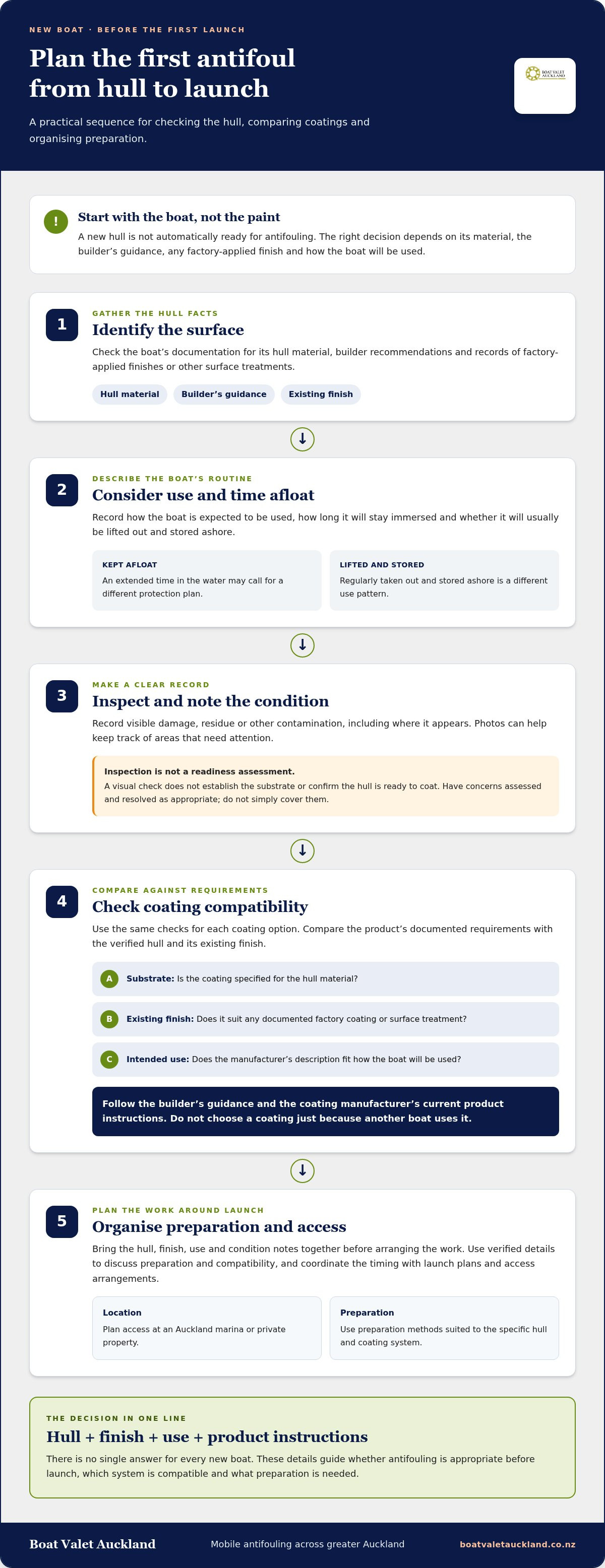
Before scheduling new boat antifouling Auckland, collect the hull and coating details in one place. This gives the professional applying the antifouling a useful starting point and helps avoid assumptions about what a new surface needs.
What information should you gather about a new hull?
Start with the boat’s documentation. Look for the hull material, the builder’s launch and coating recommendations, and any record of factory-applied finishes. Note whether the substrate is fibreglass, metal or another material. Also record how the boat will be used, how much time it is expected to spend afloat and whether it will usually be kept at an Auckland marina or taken out and stored ashore.
Hull: Record the material and relevant details from the builder.
Existing finish: Note any documented factory coating or other surface treatment.
Use and storage: Describe the expected time afloat and usual arrangements in Auckland.
Condition: Note visible damage, residue or other contamination, including where it appears.
Photos can help you keep a clear record of areas that need attention. A visual inspection can flag concerns, but it doesn’t establish the substrate or determine whether the hull is ready to coat. Don’t simply cover visible damage or contamination. Have concerns assessed and resolved as appropriate before coating work proceeds.
How do you assess coating compatibility and surface readiness?
Compatibility depends on the hull substrate, any existing finish and the instructions for the coating being considered. Don’t choose a product just because another boat uses it, or assume every new hull is bare. The boat builder’s documentation can help identify what is already on the surface, while the coating manufacturer’s instructions set out the product-specific requirements.
Base coating choice on verified hull and product requirements. An inspection can identify areas that need attention, but technical guidance is needed to determine preparation and compatibility. Avoid applying a preparation method without checking that it suits the specific hull and coating system.
Bring your notes together before arranging the work. Boat Valet Auckland provides mobile antifouling at Auckland marinas and private properties across greater Auckland. Clear information about the hull and finish helps organise professional Auckland antifouling service.
Compare antifouling options for a new boat in Auckland
Compare coatings against the boat’s requirements, rather than assuming one type suits every vessel. Labels and descriptions can vary, so check what each term means in the manufacturer’s documentation. For a first coat, start with hull compatibility and intended use. Then read the current product data sheet for application requirements and any conditions relevant to your launch plans.
Which factors should guide a first-coat comparison?
Use the same questions for each option. This makes it easier to compare coatings without treating a general category as a product recommendation.
Compatibility is essential. Don’t choose a coating based only on another owner’s experience or a familiar-sounding product label. Confirm the substrate and existing finish, then compare the manufacturer’s instructions with the boat builder’s guidance. If the documentation doesn’t establish suitability, have the coating choice assessed before work proceeds.
How do Auckland storage and launch plans affect the decision?
Where the work takes place affects scheduling, not the coating specification. Note whether the boat will be at an Auckland marina or on private property, when it is due to launch and where it will be stored afterwards. These details help organise access and timing, but don’t replace compatibility checks or product instructions.
Before work begins, account for the facility’s requirements and check relevant Auckland environmental guidance for the planned work. Access and washdown arrangements can differ between locations, so confirm the requirements for the site. Keep the coating decision grounded in the boat’s documentation and current product information.
For broader context on hull protection and antifouling considerations, read the Auckland antifouling guide. A careful comparison gives new boat antifouling Auckland owners a sound basis for discussing the first coat and coordinating the work.
First-launch checklist: prepare and schedule your Auckland antifouling
A first launch involves several moving parts. Set out the hull information, coating requirements and site arrangements before agreeing the work schedule. You can organise records and logistics; coating compatibility, preparation and application should follow the hull details and the coating manufacturer’s instructions.
What should you do before the antifouling work begins?
Collect the boat records. Bring together the builder’s documentation, hull material details and information about any factory-applied finish or coating.
Write down how the boat will be used. Note the expected launch date, how long it will usually stay afloat and where it will be stored between outings.
Record visible concerns. Photograph or note damage, residue or contamination so it can be assessed before coating work is planned. Don’t assume an antifouling coat will resolve an underlying surface issue.
Share the project details. Provide the hull and finish information, intended use and launch plans when arranging on-site antifouling. These details help inform the preparation and coating discussion.
Organise the site logistics. Speak with the Auckland marina or property contact about access, lifting arrangements and site requirements. Coordinate these with the planned work and launch.
Timing depends on the project and site, so don’t build your launch plan around an assumed fixed turnaround. Access arrangements, the work required and the coating instructions all affect the schedule.
What should you check before the boat goes in the water?
Before launch, review the completed work and read the coating aftercare guidance. Follow its product-specific instructions for curing, handling and launch timing. Don’t rely on a general rule or another boat’s schedule; use the directions for the coating applied to your hull.
Check current local environmental guidance and the requirements of the marina or property where the work is taking place. Requirements can differ by facility, so confirm the rules for your site rather than assuming they are the same across Auckland.
Gather the hull records, confirm the coating requirements, organise site access, then follow the product guidance before launch. This gives you a clear preparation sequence while keeping technical decisions tied to the relevant instructions and professional assessment. Boat Valet Auckland provides mobile antifouling at Auckland marinas and private properties across greater Auckland. Plan professional Auckland antifouling around your hull details and launch arrangements.
Book new-boat antifouling in Auckland with an experienced mobile specialist
Arranging antifouling before a first launch involves hull preparation and practical site planning. A mobile service brings the work to the boat, whether it’s at an Auckland marina or a private property across greater Auckland. This lets owners organise the work around the vessel’s location and access arrangements.
What to expect from mobile antifouling service
Boat Valet Auckland provides mobile antifouling at Auckland marinas and private properties. Owner-operator Steve Kellie plans the project around the vessel and site. Hull material, any factory-applied finish, intended use and the relevant coating instructions all help shape the work. Site access and launch arrangements matter too.
Coating and scheduling decisions should follow the details of the boat and site. Share the launch plan and access arrangements early so they can be included in the planning. Established in 1998, Boat Valet Auckland brings local experience to professional workmanship and on-site care.
How to get your first-launch project moving
Before making an enquiry, gather the boat’s documentation and note the key details. This makes the discussion about your new boat antifouling Auckland project more useful from the outset.
Substrate: Record the hull material and any information about the existing factory finish.
Compatibility: Keep the builder’s guidance and relevant coating documentation together.
Site access: Note where the boat will be prepared and any marina or property arrangements that affect access or lifting.
Launch planning: Share the intended launch timing and usual storage arrangements so they can be considered alongside product instructions.
These checks help separate the logistics you can organise from technical decisions that depend on the hull and coating requirements. Boat Valet Auckland also provides mobile boat grooming services, including cut and polish, detailing and teak restoration.
If you’re preparing a new boat for its first launch, gather your hull details and site plans, then arrange Auckland boat antifouling with Boat Valet Auckland.
Get your new boat ready for its first launch
A confident first launch starts with the right information. Check the hull material, builder’s guidance and any factory-applied finish before comparing coating options. Your boat’s intended use and time afloat matter too, so follow the coating manufacturer’s instructions rather than assuming one approach suits every vessel.
Plan practical details alongside technical ones. Share your launch timing, storage plans and access arrangements early, as marina and private-property logistics can affect how the work is organised. For new boat antifouling Auckland owners can reduce uncertainty by bringing these details together before arranging the work.
Owner-operated by Steve Kellie, the business has provided antifouling since 1998. Arrange professional antifouling for your new boat and take the next step towards a well-prepared first launch.
Frequently Asked Questions
Does a brand-new boat need antifouling before its first launch?
Not every new boat needs antifouling before launch; the decision depends on its hull, intended use and builder’s guidance. A boat expected to stay afloat for extended periods may have different coating needs from one that is routinely lifted and stored ashore. Check the builder’s documentation for the hull material and any factory-applied finish, then use the coating manufacturer’s instructions to guide the decision.
How do I choose antifouling for a new boat in Auckland?
First confirm that the coating is compatible with the hull and any existing finish. Then consider how the boat will be used, how long it is expected to remain afloat and what the coating manufacturer’s current product data sheet says. Coating descriptions and suitability vary, so don’t rely solely on another boat owner’s choice. For new boat antifouling Auckland planning, include your launch and storage arrangements when discussing the project.
Can antifouling be applied to a new fibreglass hull?
Antifouling may be suitable for a new fibreglass hull, but the hull’s finish and manufacturer guidance determine what is appropriate. Check whether the builder has applied a factory finish and follow both the boat builder’s recommendations and the coating manufacturer’s instructions. Don’t assume the surface is ready to coat or use a preparation method intended for a different hull or finish. Have compatibility assessed before work proceeds.
What preparation does a new boat need before antifouling?
Start by gathering the builder’s records, hull material details and information about any factory-applied coating. Inspect the hull and note visible damage or contamination for assessment rather than coating over unresolved concerns. Preparation depends on the substrate, existing finish and selected product instructions, so one method won’t suit every new hull. Share your notes and photos when arranging professional antifouling.
How long before launch should antifouling be completed?
There isn’t one fixed lead time or launch interval that applies to every coating. The product instructions set out relevant requirements for application, curing, handling and launch timing, while the project and site affect the work schedule. Plan around the launch date and marina or property access, and follow the coating-specific directions to determine when the boat can go in the water. Avoid relying on a general rule.
Can a mobile antifouling service work at my Auckland marina?
Yes. Work is planned around the vessel and site, so have access arrangements, any lifting requirements and launch plans ready. Coordinate site access with the marina or property contact, as facility requirements can differ. The service is owner-operated by Steve Kellie and has provided antifouling since 1998.
What should I check after antifouling and before launching?
Review the completed work and follow the aftercare guidance and product-specific instructions before launch. Check the coating’s requirements for curing, handling and launch timing rather than assuming the boat can enter the water immediately. Also account for relevant marina, property or local environmental requirements for the work site. Resolve any uncertainty about the schedule or instructions before coordinating the final launch.
Comments