
Is Propspeed Worth the Cost? A Guide for Boat Owners

What if a propeller coating could help limit marine growth without working like conventional antifouling paint? That’s the key to deciding whether is Propspeed worth the cost for your boat. Designed for propellers and underwater running gear, Propspeed creates a slick surface that makes it harder for marine organisms to attach. It isn’t a treatment for the whole hull, and results can depend on how you use your boat and how well the coating is applied.
It’s reasonable to ask whether the benefit will show up in performance or simply mean less fouling to deal with. Propspeed’s foul-release action relies partly on movement through the water to dislodge growth, so the result may differ between a regularly used vessel and one that spends long periods idle. Preparation and the full maintenance cycle matter too.
This guide explains what Propspeed is designed to do, how it differs from hull antifouling, and what to weigh up before investing. It also looks at how your boat, boating habits and local conditions around Auckland can shape the decision, so you can judge whether a specialist propeller coating fits your maintenance priorities.
Table of Contents
Is Propspeed worth the cost? Start with its design purpose
Propspeed may be worth the cost if propeller fouling is a recurring concern and its potential benefit fits your boat’s use and maintenance priorities. It’s a specialist foul-release coating for propellers and underwater running gear, not a guarantee that every surface will remain growth-free. Consider surface preparation, application and future maintenance alongside how often the vessel moves through the water.
What does Propspeed do on a propeller?
Propspeed is designed to create a smooth surface that makes it harder for marine organisms to attach. Movement through the water can help dislodge growth, but the coating doesn’t prevent fouling altogether. A boat that sits idle for extended periods may not get the same movement-related benefit as one used regularly.
In brief: Propspeed is a foul-release coating intended to reduce marine growth’s ability to adhere to compatible underwater running gear. It doesn’t promise a permanently clean propeller. Check the latest manufacturer instructions for suitable surfaces and application requirements.
How is it different from antifouling paint?
The difference is the job each coating is designed to do. Conventional anti-fouling paint is used to limit marine growth on hull surfaces, commonly through active ingredients that deter or control organisms. Propspeed instead relies on a slick foul-release surface for propellers and other compatible running gear. The two are not interchangeable systems.
For Auckland owners, treating these as separate jobs makes maintenance planning clearer. Hull antifouling protects the hull; a specialist propeller coating addresses fouling on running gear. Propspeed isn’t intended for the entire hull or as a replacement for hull antifouling. Read the Auckland hull antifouling guide for more on this separate part of boat care.
Purpose: Hull antifouling targets marine growth on the hull; Propspeed aims to make growth less able to adhere to compatible running gear.
Application area: Hull coatings are for hull surfaces. Propspeed is for propellers and compatible underwater running gear, as set out in its current instructions.
Maintenance: Both need to be part of ongoing boat care. Include Propspeed’s preparation and application requirements in the cost comparison rather than treating them as incidental.
So, is Propspeed worth the cost? Start with the fouling you actually see, how regularly you use the boat and whether the additional coating and upkeep suit your maintenance plan. That gives you a more useful answer than expecting a coating alone to deliver a clean propeller or a particular performance result.
How Propspeed’s preparation and application affect its real-world value
Application is a significant part of the value calculation. Propspeed’s manufacturer guidance describes a multi-stage process involving cleaning, sanding, priming and applying a topcoat. Each stage matters: contamination, an unsuitable surface or missed preparation can affect adhesion and performance. Application quality is part of the investment, not just a preliminary task.
Which preparation steps should owners understand?
Before committing, understand the process and how it applies to your propeller’s condition. Existing coatings, corrosion, damage or previous repairs may affect the preparation required. Compatible materials, product handling, application conditions and curing requirements should all follow the latest manufacturer instructions. Don’t assume one set of steps suits every propeller or underwater component.
The practical question isn’t simply whether the coating can be applied. It’s whether the surface can be prepared correctly and whether the full process suits your boat’s maintenance plan. Include the preparation and application effort when comparing Propspeed with other options.
What maintenance and reapplication questions matter?
Look beyond the initial application. Include inspection, removal and reapplication in your ownership-cycle comparison, and use the manufacturer’s current guidance for maintenance and curing. Avoid relying on a fixed lifespan: observed results can vary with vessel use, local conditions and surface condition. A boat used regularly may experience different conditions from one that remains idle for long stretches.
What does the manufacturer recommend for inspection and ongoing care?
How will you record the coating’s condition alongside other maintenance?
What preparation or removal work may be needed before reapplication?
Do the application and curing requirements fit your planned haul-out and launch schedule?
Propspeed’s value depends on the entire coating cycle, not application alone. If the coating needs careful preparation and future upkeep, those demands belong in the same comparison as its potential foul-release benefit. That’s a more useful basis for deciding whether Propspeed is worth the cost than considering the first application in isolation.
Propeller coating also sits alongside, rather than in place of, hull care. For owners planning wider maintenance, Auckland hull antifouling is a separate part of the boat’s upkeep.
Propspeed versus alternatives: compare the benefits, limits and upkeep
There’s no single right choice for every propeller. Compare Propspeed with another coating designed for propellers and with leaving the propeller uncoated. Use your own fouling history and maintenance priorities, and assess each coating’s claims, compatibility and care requirements on their own terms. Follow the current manufacturer instructions rather than assuming different systems work alike.
When might Propspeed suit a boat owner?
It may be worth considering if your maintenance records show recurring growth on the propeller and you use the boat often enough for movement through the water to matter to the coating’s foul-release function. If fouling has affected your confidence in the propeller’s condition or operation, record that concern. Don’t treat a coating as a guaranteed speed, fuel-use or performance improvement, as results depend on the vessel and operating conditions.
When might another approach be more practical?
If the propeller stays relatively clean, or the boat spends long periods idle, the added coating and application work may not match your priorities. Another product could suit you better if its instructions and upkeep fit your circumstances. Leaving the propeller uncoated is also a reasonable option to assess, provided you account for inspection and cleaning. Neither choice is automatically best.
Keep hull antifouling out of this comparison. It protects a different surface and isn’t a direct substitute for propeller care. To decide whether Propspeed is worth the cost, weigh its potential benefit against preparation, repeat work and the uncertainty of results for your boat.
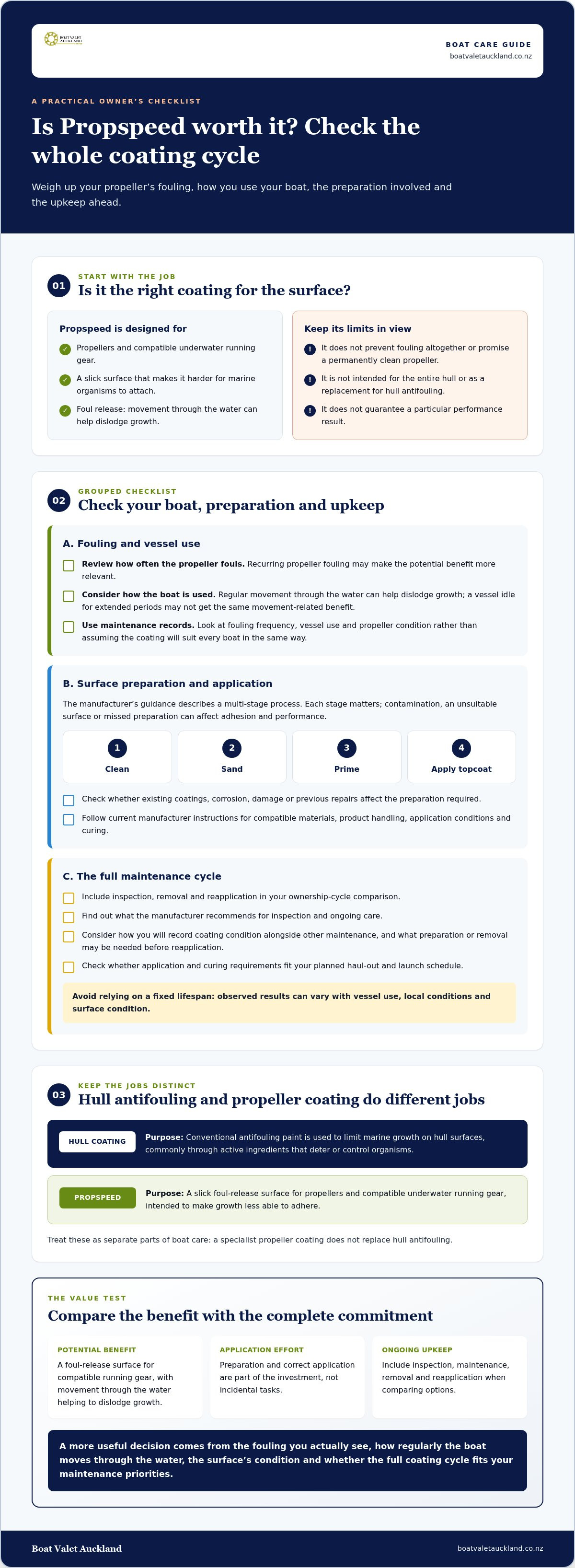
Use this checklist to decide whether Propspeed is worth it for your boat
Use your own maintenance history, not general performance promises, to assess whether the coating could suit your boat. Conditions vary around Auckland, and a vessel’s use and storage routine can shape the fouling it experiences. Work through these checks before adding a propeller coating to your maintenance plan.
What should you record before making a decision?
Fouling history: Note when the propeller was last cleaned and what you found, such as visible growth or little change since the previous inspection.
Use and storage: Record how often the boat is used, how long it typically stays in the water between trips and where it is kept. Don’t assume all Auckland moorings or boating patterns produce the same results.
Propeller condition: Describe its current state, including any visible wear or damage. A coating decision should take the existing surface into account.
Maintenance priorities: Decide whether reducing propeller fouling matters enough to accept the additional preparation, application and ongoing care.
Evidence versus expectation: Keep observations separate from assumptions. If you’re concerned about speed or fuel consumption, note what you’ve measured and under what conditions. Don’t treat a coating as a guaranteed performance improvement.
How can you judge value without relying on a price claim?
Compare the complete coating commitment with your current routine. Include surface preparation, application, inspection and any future removal or reapplication, using the manufacturer’s latest instructions for product-specific requirements. Then compare that effort with the fouling you’ve recorded and the time or attention your existing approach takes.
Ask yourself: does the propeller foul often enough for a foul-release coating to be relevant? Does your boating pattern give you a fair basis to assess it? Are you comfortable keeping up with the coating’s maintenance requirements? These questions make is Propspeed worth the cost a vessel-specific decision, rather than one based on generic savings claims.
After choosing an approach, reassess it following a representative period of your normal use. Record the conditions, propeller state and maintenance required, then compare those observations with your baseline. One inspection may not tell the whole story, particularly if your boating or storage pattern has changed.
For wider Auckland boat-care context, read this guide to mobile boat grooming in Auckland. To plan the separate hull-maintenance side of your routine, explore Auckland hull antifouling.
Plan propeller care alongside Auckland antifouling and boat maintenance
Propspeed may suit owners who regularly deal with propeller fouling and value its potential foul-release benefit, provided they’re comfortable with the preparation and ongoing care involved. It’s one part of a maintenance plan, not a fix for every underwater surface. Base the decision on your boat’s condition and use, then plan hull and propeller care as separate jobs.
How does propeller care fit into a wider maintenance plan?
Consider the propeller alongside the hull during routine maintenance, but assess each for its own condition and needs. A specialist propeller coating is intended for compatible running gear; hull antifouling protects the hull. One doesn’t replace the other. Keeping notes on propeller fouling, hull condition and cleaning helps you make better-informed choices at the next maintenance interval.
Auckland boats may be maintained at marinas or private properties and used in different ways. Storage, time afloat and how often a vessel moves can all shape its maintenance needs, so don’t assume a neighbouring boat’s experience will match yours. Professional hull antifouling can be planned as part of wider boat care, while propeller coating remains a separate consideration.
What is a sensible next step for Auckland boat owners?
Review your maintenance records and note what you’ve observed, rather than relying on assumed performance gains. If your propeller fouls repeatedly, include that evidence in your decision. If it stays relatively clean, the extra coating commitment may not suit your priorities. Reassess after a representative period of use and record the results.
Boat Valet Auckland provides mobile boat maintenance and grooming across the greater Auckland region, including professional hull antifouling at marinas and private properties. Owner-operated by Steve Kellie, the business brings local experience to planning hull care as part of your vessel’s maintenance routine, separate from a specialist propeller coating.
If you’re planning hull maintenance, plan your boat’s Auckland antifouling maintenance. The question is Propspeed worth the cost still comes down to your propeller’s fouling history, your boating habits and whether its potential benefit justifies the full upkeep for your vessel.
Make your next maintenance decision with confidence
Propspeed may suit you if your propeller fouls regularly, you value its potential foul-release benefit and you’re prepared for the application and ongoing maintenance. It isn’t a guaranteed performance upgrade, and it doesn’t replace hull antifouling. Your fouling records, boating habits and the full coating cycle are the best guides to whether Propspeed is worth the cost for your vessel.
Keep propeller care and hull protection as separate parts of your plan. Boat Valet Auckland provides professional antifouling focused on hull maintenance, bringing local experience to boat owners across greater Auckland. The owner-operated business provides mobile marine maintenance at Auckland marinas and private properties.
Plan the hull-care side of your routine with Plan your boat’s Auckland antifouling maintenance. With clear records and a maintenance plan suited to your boat, you can make a practical choice and enjoy more confidence in every season on the water.
Frequently Asked Questions
Is Propspeed worth the cost?
Propspeed may be worth considering if your propeller fouls regularly, you use your boat often and you’re prepared for the coating’s application and maintenance requirements. If fouling is rare, an uncoated propeller with routine inspection may better suit your priorities. To decide whether Propspeed is worth the cost for your Auckland boat, compare your maintenance records and observed fouling with the full coating cycle, not just its potential benefits.
What is the difference between Propspeed and antifouling paint?
Propspeed is a foul-release coating designed for compatible propellers and underwater running gear. Its slick surface aims to make it harder for marine growth to attach. Hull antifouling is designed to protect hull surfaces from fouling, using a different approach and serving a separate maintenance purpose. Propspeed doesn’t replace hull antifouling. For Auckland boat owners, consider both as distinct parts of the vessel’s care plan.
How long does Propspeed last?
There isn’t one reliable lifespan for every boat. The manufacturer generally expects the coating to last at least a year, but actual results can vary with application quality, vessel use and local conditions. Treat that as guidance, not a guarantee for your propeller. Follow the current manufacturer instructions for inspection and maintenance, and record the coating’s condition at haul-out to inform future planning.
Can Propspeed improve a boat’s speed or fuel efficiency?
It may help limit propeller fouling, which could matter to owners concerned about how growth affects their boat’s operation. However, a particular increase in speed or reduction in fuel use isn’t guaranteed. Outcomes depend on the vessel, its condition, use and other operating factors. Keep measured performance data separate from expectations, and don’t treat a coating as a substitute for investigating other causes of a change in speed or fuel consumption.
Is Propspeed suitable for every boat propeller?
No. Suitability depends on the propeller’s material and condition, as well as the manufacturer’s current compatibility and application instructions. Don’t assume the coating is appropriate for every propeller or underwater component. Before deciding, consider existing coatings, visible damage and the surface preparation required. This is especially relevant when planning maintenance at an Auckland marina or private property, where the available work conditions may also shape the process.
What happens if Propspeed is applied incorrectly?
Incorrect preparation or application can affect how well the coating adheres and performs. Contamination, unsuitable surfaces or missed stages may undermine the result, although the specific outcome depends on the circumstances. Propspeed involves a defined preparation and coating process, so follow the latest manufacturer instructions, including surface compatibility and curing requirements. Don’t assume that a poor result proves the coating itself is unsuitable for your boat.
Is Propspeed the same as propeller antifouling?
Propspeed is often discussed as a propeller coating, but technically it’s a foul-release coating rather than conventional antifouling paint. It aims to make growth less able to attach, rather than relying on biocides to deter or control organisms. The terms are sometimes used loosely, so compare products by their stated purpose and instructions. Either way, propeller care remains separate from antifouling the hull of your boat.
Comments