
How to Choose a Boat Grooming Company: An Auckland Owner’s Guide

What if the finish you see matters less than the care taken to achieve it? If you’re weighing how to choose a boat grooming company, look beyond a quick wash or a polished quote. Gelcoat, painted surfaces, teak and stainless steel need different care, and a general clean may not address the work your vessel actually needs.
Choose a company whose services and experience fit your boat’s condition, and make sure the proposed work is clearly explained before you agree to it. This guide covers practical ways to compare workmanship, service scope, communication and Auckland experience, so you can arrange care that suits your vessel and where it’s kept.
Boat Valet Auckland is owner-operated by Steve Kellie and has been established since 1998, with mobile service across the greater Auckland region. The checks below can help you distinguish grooming services, compare scopes fairly and identify the work your boat needs at a marina or private property.
Table of Contents
How to choose a boat grooming company: start with your vessel’s needs
Boats differ in size, surface materials, condition and use, so the right grooming plan depends on the vessel. A cruiser with a faded gelcoat, a launch with weathered teak and a boat needing hull protection have different priorities. Begin by deciding what you want the work to achieve. Are you preparing for an event or sale, improving the appearance of a particular surface, or addressing ongoing care and maintenance?
This distinction helps you avoid choosing by the length of a service list. A broad menu doesn’t show whether the work suits your boat. Focus instead on experience relevant to the job, a clearly explained scope and access to where the vessel is kept. That’s a useful starting point for how to choose a boat grooming company without treating a general wash as a substitute for more specific care.
Boat Valet Auckland is owner-operated by Steve Kellie and has worked across the greater Auckland region since 1998. Its mobile service covers marinas and private properties, making the vessel’s location part of the planning conversation. Discuss your priorities and the boat’s condition to shape an appropriate scope, whether the work is cut and polish, teak restoration, antifouling or another grooming task.
Identify the work your boat actually needs
Make a short list of what you can see. Note a dull or chalky finish, weathered teak, water marks on windows, tarnished stainless steel or visible hull fouling. Then separate appearance work from recurring care. Pre-sale grooming may focus on the boat’s overall presentation, while a maintenance plan may prioritise particular surfaces or the hull. This initial assessment gives the conversation a clear starting point.
Describe the concern without trying to prescribe the technical method before the surface has been assessed. The right approach depends on the material and its condition. Keep the detail of polishing, antifouling and teak treatment for dedicated guides; here, the aim is to explain the need and agree which outcome matters most. For broader background on preparation and inspection, see this overview of boating maintenance and inspection.
Match the provider to your boat and location
Consider the vessel type, the surfaces involved, its present condition and where the work will take place. Access at a marina can differ from access at a private property, so mention the location early. A mobile service can be a practical fit for Auckland owners arranging grooming where their boat is kept. Clear photos and a note of any known surface concerns can also make the initial conversation more useful.
A well-matched grooming scope is the work your boat needs, explained clearly and arranged for where it’s kept. Use that as your test. Relevant experience matters more than a long service list, and a clear scope makes it easier to understand what the work is intended to address. Start with the boat, its condition and your priorities, then discuss a plan that fits.
What experience and preparation should a boat grooming company demonstrate?
Experience is most useful when it relates to the work your boat needs. General cleaning skills don’t automatically demonstrate familiarity with marine finishes, which can respond differently to products, tools and treatment. As you consider how to choose a boat grooming company, look for a clear connection between the vessel’s surfaces, their condition and the proposed work, rather than relying on broad claims of expertise.
Preparation should be described as part of the job, not hidden inside a promise of a “quality finish”. A useful discussion identifies what will be assessed, the main stages of the work and the intended outcome. It should also allow the boat’s actual condition to shape the plan. A finish can’t be responsibly promised before the relevant surfaces and requirements have been considered.
Look for relevant marine and surface experience
Marine grooming is more than a routine wash. Gelcoat, painted surfaces, teak and metalwork each need consideration of their material and condition. For example, the approach for a dull gelcoat finish won’t necessarily suit painted surfaces or weathered teak. Look for experience relevant to the specific job, and explanations that make clear why the proposed scope suits the surface. For more detail on polishing, see this professional boat cut and polish guide.
Boat Valet Auckland has been established since 1998 and is owner-operated by Steve Kellie. Its marine grooming services include cut and polish, teak restoration and antifouling. A direct conversation with Steve can connect your goals with a suitable scope, taking the boat’s materials and condition into account.
Understand the proposed preparation and finish
Before agreeing to the work, make sure you can follow the proposed plan. It should relate to the vessel’s condition and the scope you’ve discussed, rather than describe a one-size-fits-all process. You should understand the intended stages and what the finished work is expected to address. If the boat has several surfaces or areas of concern, the explanation should distinguish them instead of treating the whole vessel as one uniform job.
Protection matters, too. Discuss how adjacent surfaces and fittings will be considered during the work, particularly where different materials meet. Clear answers help you understand the care planned for your boat and identify details to agree before work begins. They also set realistic expectations: the visible result depends on the starting condition and the work required.
Preparation is a practical sign of professional grooming because it shows the work is planned around the boat, not just the promised finish. In Auckland, Boat Valet Auckland's mobile service works at marinas and private properties across the greater region. Read about Boat Valet Auckland’s boat grooming services.
How to compare boat grooming companies, service scope and quotes
A service name alone won’t tell you what’s included. “Detailing” or “polishing” can refer to different tasks, preparation and surfaces, so compare the written scope rather than the headline. That’s central to how to choose a boat grooming company: establish what work is proposed, which areas it covers and how it fits your vessel.
Quotes can differ because boats vary in condition, access and requested work. One proposal may cover an exterior wash and wax, while another includes restorative polishing or additional surface care. Neither the longest list nor the lowest figure automatically represents the best fit. Compare the work for clarity and relevance, and note any exclusions or details that haven’t been specified.
Compare the scope, not just the service name
Check that each proposal identifies the tasks and surfaces involved. A wash and wax, cut and polish, antifouling and teak restoration address different needs. Look for a description of preparation as well as the main task, and make sure you can tell which areas are included. The marine detailing services guide provides broader context on how grooming work can differ by purpose.
Use a simple comparison to keep the details in view:
Use the same checklist for each proposal. If one says “polish” without describing the areas or preparation, while another is more specific, that difference matters. Clarify what each scope means before comparing the overall quote. A direct conversation with Steve at Boat Valet Auckland can help connect your priorities with a suitable grooming scope.
Assess communication, timing and practical arrangements
Good communication reduces uncertainty before the work starts. Discuss where the boat is kept, how it can be accessed, what preparation is planned and how the work will be coordinated. Share relevant location and access details early. For mobile grooming at an Auckland marina or private property, practical arrangements are part of the comparison, not an afterthought.
Look for a clear explanation of what’s understood and what remains to be agreed, including the intended outcome. Don’t assume every quote includes the same tasks or timing. Boat Valet Auckland is owner-operated by Steve Kellie, with mobile service across the greater Auckland region. Find out more about Boat Valet Auckland’s boat grooming services.
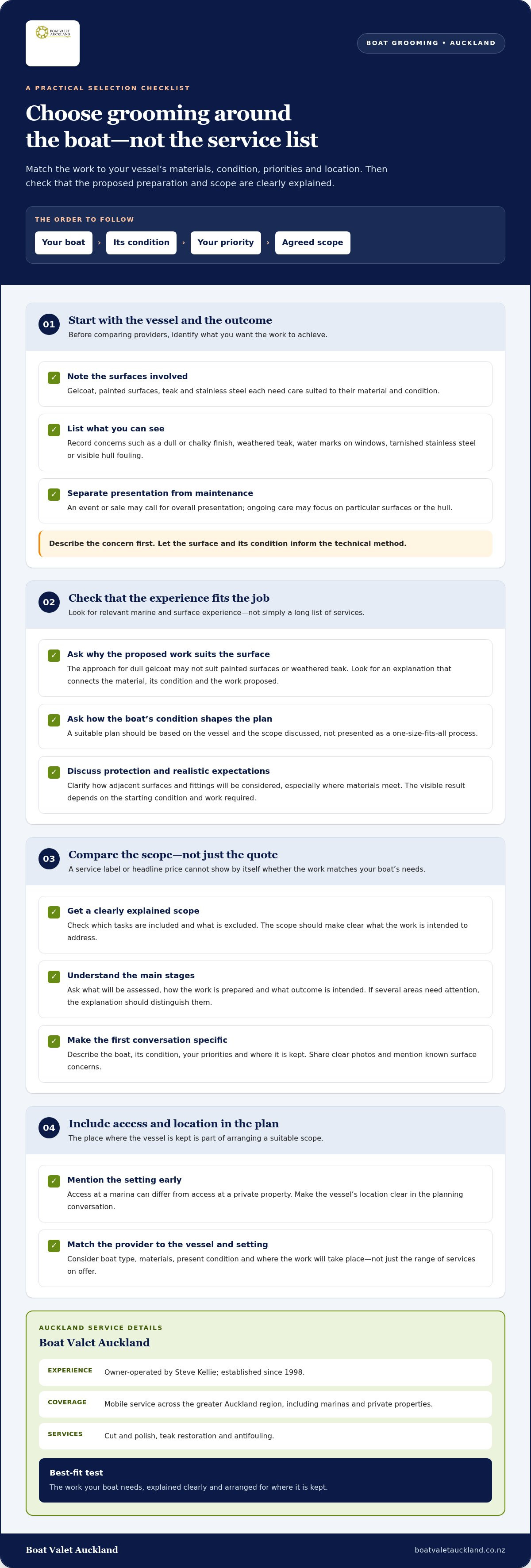
What to discuss before arranging boat grooming in Auckland
A focused first conversation makes it easier to shape the work around your boat and its location. Before getting in touch, gather a few practical details: what the vessel is, which areas need attention, what outcome you’re after and where the boat is kept. This preparation helps you explain the job clearly without needing to know the technical solution in advance.
Prepare useful details about your vessel
Start with the basics, then add details that could affect the proposed scope. This checklist can help:
Vessel: type and approximate size.
Location: marina, yard or private property, with relevant access information.
Surfaces: the areas involved, such as gelcoat, painted surfaces, teak or metalwork.
Condition: visible concerns, including dull finishes, weathered teak, water marks or hull fouling.
History and goal: recent maintenance, known concerns and the result you’d like from the work.
Clear photos can help show visible issues and give the conversation a useful starting point. Include a wider view for context and closer images of areas you’re concerned about. Photos won’t replace an assessment of the boat and its requirements, but they can help identify what needs to be discussed.
Be specific about your priority. For example, explain whether you’re preparing for a sale, improving presentation or addressing a maintenance need. This is a practical step in how to choose a boat grooming company: useful information connects your goal to a clearly described scope, rather than leaving a broad request such as “tidy the boat up” open to interpretation.
Agree the work plan and site arrangements
Once the boat and priorities are clear, discuss where the work will happen and what access involves. Auckland owners may need to consider the particular marina or private-property setting, how the vessel can be reached and any arrangements relevant to working at that location. Share your preferred timing and agree which tasks are included before the work is arranged.
It also helps to establish how changes will be handled if the boat’s condition or the requested scope needs further discussion. A clear point of contact and direct updates can prevent assumptions about what’s included or when access is expected. If antifouling is part of your enquiry, the Auckland hull protection guide offers further context for that work.
Boat Valet Auckland provides mobile grooming across the greater Auckland region, including marinas and private properties. Owner-operator Steve Kellie can discuss your vessel, priorities and location to help define a suitable scope. Learn more about Boat Valet Auckland’s boat grooming services.
Choose an Auckland boat grooming company that stays accountable
The strongest choice is the one that connects the work to your vessel, explains the preparation and agrees a clear scope with you. Relevant experience matters, but so does knowing who you’ll speak with as the work is planned. A direct point of contact helps keep your priorities and the agreed tasks together, rather than leaving you to join up separate conversations.
Use the checks from this guide to make your decision: does the proposed work suit the boat’s materials and condition? Is the preparation explained? Can you see what the scope includes? Are the location and practical arrangements understood? These details are more useful than a broad promise or an impressive service list. They give you a clear basis for agreeing what happens next, without treating a particular result as guaranteed before the work is assessed.
Why direct, local service can make planning easier
With an owner-operator, the person discussing your goals is directly involved in the business carrying out the work. That can provide continuity as you describe the boat, outline your priorities and settle the scope. It doesn’t replace a clear agreement, but it gives you a straightforward way to discuss the job and its arrangements.
Boat Valet Auckland is owner-operated by Steve Kellie and has been established since 1998. Its mobile service works across the greater Auckland region at marinas and private properties. This local, mobile approach lets owners discuss grooming where their vessel is kept, rather than treating its location as separate from the work plan.
Take the next step with Boat Valet Auckland
Whether your priority is a refreshed exterior, teak care, cut and polish, antifouling or another grooming task, explain what you’ve noticed and what you want the work to address. Share the vessel’s location and any access details, too. Steve can discuss those priorities with you and help shape a suitable scope. This is a practical way to put the question of how to choose a boat grooming company into action: start with your boat and agree the work in clear terms.
Before the conversation, gather useful photos and note recent maintenance or known surface concerns. You don’t need to arrive with a technical diagnosis. A clear description of the boat and your goals is enough to begin discussing an appropriate approach.
Discuss your boat grooming needs with Boat Valet Auckland and talk through a suitable scope with Steve.
Make your next grooming decision with confidence
The next step doesn’t need to be complicated. Record what you’ve noticed, what you want the work to achieve and any questions about the proposed scope. That gives you a useful starting point for a practical conversation and helps turn how to choose a boat grooming company into a decision based on your vessel rather than assumptions.
You don’t need to arrive with a technical diagnosis. Describe the boat in your own words, share relevant photos if you have them, and be clear about which outcome matters most. A straightforward discussion can help you decide what work to prioritise and what to agree before it begins.
Ready to discuss a grooming plan for your vessel? Talk with Steve at Boat Valet Auckland about your boat’s condition, location and priorities.
Frequently Asked Questions
What should I ask a boat grooming company before booking?
Ask what the work will cover, how the proposed approach relates to your boat’s specific surfaces, and what could change the agreed scope. For example, if you’re concerned about chalky gelcoat, ask how that condition will inform the proposed cut and polish. Also clarify what you need to do before the appointment, how access will work and who to contact if you notice another issue before work begins.
How can I compare quotes from boat grooming companies?
Compare the work each quote describes, not just the total. Check whether the quotes refer to the same areas, preparation and finish, and note any tasks that one includes but another leaves out. If one quote allows for an exterior wash and wax while another proposes restorative polishing, they aren’t like-for-like. Understanding those differences helps you judge which scope suits your priorities, rather than choosing by the lowest figure alone.
Should I choose a boat grooming company that works at my marina?
A company familiar with working at your marina may make site planning more straightforward, but location alone shouldn’t decide your choice. Consider whether the provider can work at the vessel’s location and discuss the access arrangements relevant to that site. Marina procedures and access requirements can vary, so factor in any steps you need to organise. Match practical convenience with a suitable scope and experience relevant to the work.
Can one boat grooming company handle polishing, antifouling and teak care?
Yes, a marine grooming company may handle several types of work, but each should be clearly described and matched to the boat’s needs. Boat Valet Auckland provides boat cut and polish, antifouling and teak restoration, alongside other grooming services. If your vessel needs more than one task, consider how the work areas and priorities fit together. A combined plan should still make clear what each part addresses.
How much does professional boat grooming cost in Auckland?
There isn’t one set price for professional boat grooming in Auckland. The cost depends on factors such as the vessel’s size and condition, the surfaces involved, access at its location and the work requested. A wash and wax is different in scope from restorative polishing or teak restoration. To assess a quote, compare its described tasks and preparation with the outcome you want, rather than relying on a general price estimate.
Is mobile boat grooming suitable for a boat kept at a private property?
Mobile grooming can suit a boat kept at a private property, as work can be arranged at the vessel’s location. Before making plans, consider practical details such as where the boat can be accessed, whether there’s room to work around it and how the site can be reached. Share those details early so the proposed work can be planned alongside the location. Boat Valet Auckland provides mobile service at private properties across greater Auckland.
How do I know whether my boat needs grooming or a specific restoration service?
Start with the condition of the affected area and what you want to improve. If the boat needs routine presentation care, an exterior wash and wax may be a suitable starting point. A dull finish, weathered teak or another persistent surface concern may call for more specific work, such as cut and polish or teak restoration. Describe what you can see and the result you’re after; the condition helps shape the appropriate scope.
Comments