
How Much Time Can You Save with Mobile Boat Grooming?

What if the biggest time saving isn’t the grooming itself, but not having to move your boat or spend your day doing it? The time saved with mobile boat grooming depends on the work required, your boat’s condition and the logistics of getting it serviced. A routine wash is a different commitment from cut and polish or teak restoration.
It’s hard to fit boat care around work, family and time on the water, especially when a grooming job takes longer than expected. Mobile service can reduce some of the travel and coordination involved by bringing the work to your vessel. But the hours you get back will vary, and professional service still takes time on the boat.
This guide compares your hands-on time with a mobile service, explains which grooming tasks may be handled during an on-site visit, and shows what to share when arranging boat care in Auckland. You’ll also learn how to plan around your marina or private-property location and boating routine, so you can weigh the practical time saving for your own vessel.
Table of Contents
Where boat owners lose time on grooming in Auckland
The visible work is only part of a grooming job. Before cleaning or polishing begins, an owner may need to decide what the boat needs, gather products and equipment, travel to the vessel and prepare the work area. Afterwards, there’s the tidy-up: cleaning tools, packing everything away and dealing with any follow-up.
That time adds up differently for each boat. A wash and wax, a cut and polish, and teak care all involve different preparation and hands-on work. The vessel’s size and condition matter too, so there isn’t one standard number of hours that applies to every job.
Which parts of boat grooming take up an owner’s day?
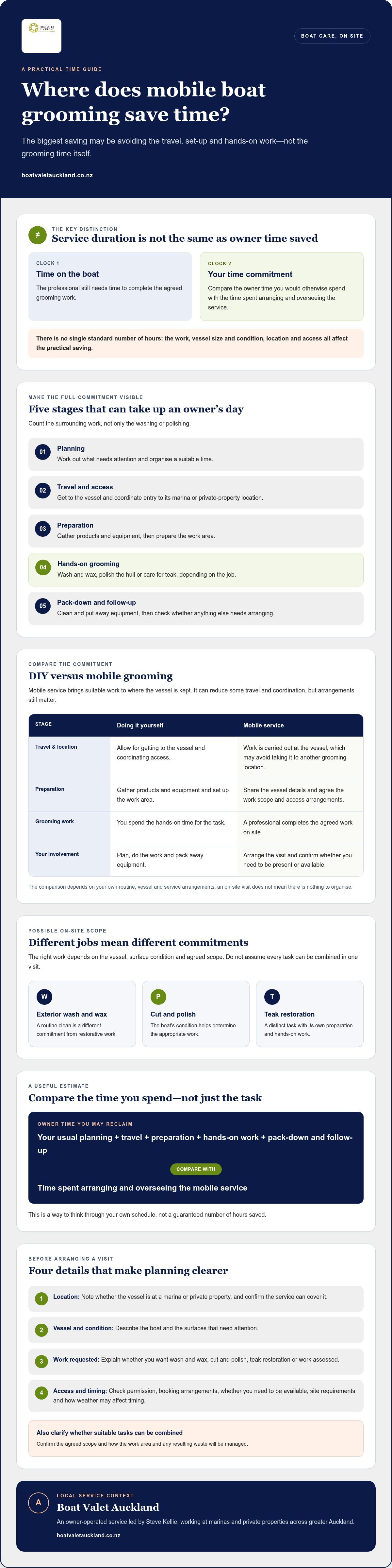
Break the job into stages to see the full commitment:
Planning: Work out what needs attention and organise a suitable time.
Travel and access: Get to the vessel and coordinate entry to its location.
Preparation: Gather products and equipment, then set up for the task.
Hands-on work: Wash and wax the exterior, polish the hull or care for teak, depending on the job.
Pack-down and follow-up: Clean and put away equipment, then check whether anything else needs arranging.
Some tasks may also involve technical considerations. For example, In-water surface cleaning describes approaches to cleaning submerged surfaces, which differs from washing accessible exterior areas. The right scope depends on the vessel and the work required.
The service’s duration is not the same as the owner’s time saved: count the hours you would otherwise spend planning, travelling, preparing, working and packing away.
Why location and access matter around Auckland
A boat at a marina and one at a private property can involve different travel and coordination for its owner. With a mobile service, the work is carried out where the vessel is located, which may remove the need for you to take it to another grooming location. The practical saving depends on your situation and the service arrangements.
Before settling on a date, confirm whether the service can cover your location, what access permission is needed and whether there’s a booking window to work around. These details can affect how much of your day you need to set aside, even if you aren’t doing the grooming yourself.
For a closer look at arranging on-site care locally, see the mobile boat grooming Auckland guide. Mapping these practical stages gives you a more realistic basis for estimating the time saved with mobile boat grooming.
How mobile boat grooming saves time by bringing the work to your vessel
Mobile boat grooming is professional care carried out where the vessel is located, such as at a marina or private property. Instead of arranging to take the boat to another grooming location, you may be able to have suitable work done on site. That can remove a journey and some coordination from your own schedule, depending on where the boat is kept and what the job requires.
There are two different clocks to consider: the time a professional spends completing the work and the time you personally spend on the job. An on-site service might take several hours, but you could still reclaim owner time if you’re no longer travelling, setting up equipment or doing the grooming yourself. Your time saved with mobile boat grooming depends on the work and arrangements, not simply the service duration.
What can an on-site grooming visit include?
Depending on the vessel and agreed scope, an on-site visit may cover exterior wash and wax, boat cut and polish or teak restoration. These are distinct tasks, and the condition of the surfaces helps determine what work is appropriate. Don’t assume every service can be completed together in one visit. Describe the boat and the results you’re after so the requested work can be assessed and the scope clarified.
What the owner still needs to organise
Mobile doesn’t mean there’s nothing to arrange. Share the vessel’s location, relevant access details and the work you’d like assessed. Confirm whether marina permission is required, what booking arrangements apply and whether you need to be present or available. Weather can also affect scheduling for some exterior work, so check how it may influence the proposed timing.
For work at a marina or private property, confirm any site-specific requirements before the visit, including how the work area and any resulting waste will be managed. Clear arrangements help avoid last-minute coordination and make it easier to understand what you’ll still need to handle.
Boat Valet Auckland is an owner-operated mobile service led by Steve Kellie, working at marinas and private properties across greater Auckland. Discuss your vessel, location and requested work with Steve, and confirm current coverage, access arrangements and which tasks may be combined. For a broader overview of grooming options, explore the marine detailing services in New Zealand guide.
Mobile grooming versus DIY: compare the time commitment, not just the task
A fair comparison counts your time, not just the hours spent applying polish or washing surfaces. A mobile professional’s working time is their labour, not time you’ve personally saved. Your potential saving comes from the owner tasks you avoid, balanced against the time you still spend describing the job, arranging access and checking the result.
Which time costs belong in a fair comparison?
Use your own routine as the baseline. Include travel only if you would otherwise make a separate trip or move the boat. Count equipment preparation and pack-down if you do the work yourself, then record your hands-on time and any follow-up. Don’t count a professional’s labour as your personal time saved.
Separate a one-off job, such as a cut and polish, from recurring basic cleaning. A quick routine wash may suit DIY, particularly if the boat is easy to access and you already have the equipment. More detailed work can involve extra preparation and careful application. Your own time saved with mobile boat grooming will depend on what you’d otherwise do yourself.
When does professional mobile grooming make more sense?
Think about the task’s complexity, the finish you want, your confidence and the tools available to you. Cut and polish or teak restoration may call for more preparation and sustained effort than routine cleaning. If you have the time and enjoy the work, DIY may suit you. If not, compare the owner tasks you’d avoid with the organising and oversight a service still requires.
For task-specific context, read the professional boat cut and polish Auckland guide. It can help you consider the work involved before deciding which approach fits your boat and schedule.
How to estimate the time saved before booking boat grooming
There’s no reliable hours figure that fits every boat or grooming job. Instead, compare the owner time you’d spend doing the work yourself with the time you’ll still spend arranging and overseeing a mobile service. Include only tasks that apply to your real situation. If you wouldn’t need to travel, for example, don’t count travel as time saved.
A simple four-step time-saving estimate
Define the job. Write down the specific task, such as exterior wash and wax, cut and polish or teak restoration. Note the preparation, equipment gathering, hands-on work and clean-up you’d normally do.
Estimate your DIY time. Use your own experience and the boat’s current condition. Include a trip to the vessel only if it’s part of your usual routine.
Estimate your service-arranging time. Allow for discussing the work, confirming access and schedule, and any oversight you expect to provide. Count travel or coordination only if the service would genuinely remove it.
Compare the totals. Subtract your time arranging and overseeing the service from your estimated owner time doing the job yourself. Treat the result as a personal estimate, not a guaranteed saving or a measure of the professional’s working hours.
To estimate your personal time saved with mobile boat grooming, subtract the time you’ll spend arranging and overseeing the service from the owner time you’d otherwise spend on the job.
For a simple worksheet, jot down your own estimates beside these categories: travel, preparation, hands-on work, clean-up, coordination and follow-up. Keep routine cleaning separate from a one-off restoration task. The figures are yours to assess; vessel size, condition and access can change the work involved.
What to confirm before arranging an Auckland visit
Share the vessel’s location, its condition, the work you’d like assessed and any access requirements. Then confirm the proposed scope and schedule, whether marina permission is needed, and how weather could affect timing. Ask which requested tasks can be completed together rather than assuming they’ll all fit one visit. Confirm current service coverage and access arrangements for your specific location.
With those details, you can make a more useful comparison against your own boating routine. To discuss your vessel, location and schedule, contact Boat Valet Auckland.
Reclaim your boating time with Boat Valet Auckland
Boat Valet Auckland is an owner-operated mobile marine grooming and antifoul maintenance business led by Steve Kellie. Established in 1998, it works at marinas and private properties across greater Auckland. Having the work carried out where your boat is kept may reduce some travel and coordination for you, though the time you reclaim depends on the job, access and your own arrangements.
Match the service to the work your boat needs
Start with your priorities rather than choosing work by name alone. Antifouling, interior valet, window polishing and pre-sale grooming address different needs. The right scope depends on the vessel’s condition and what you want to achieve, so explain what you’ve noticed and ask which work is appropriate. Confirm whether the requested tasks can be combined during one visit rather than assuming they can.
If you’re preparing to sell, the pre-sale boat grooming guide offers further context on grooming priorities for a vessel going to market. A clear scope helps you understand what’s being considered and plan around the boat’s use.
Make the next step straightforward
When discussing a visit, share the boat’s location, its condition, the tasks you’d like assessed and any scheduling constraints. Mention access requirements for the marina or private property, too. Before agreeing on a visit, confirm the proposed work and timing, how weather may affect the schedule, and any access arrangements that need to be in place. Coverage and access can vary by location, so check that your specific Auckland site can be accommodated.
Mobile grooming can take some of the work off your personal to-do list, but it can’t promise a fixed number of hours back. The useful next step is a practical conversation about your vessel and priorities. Discuss your boat grooming needs with Boat Valet Auckland and share the details needed to assess the work and location.
Make time for more days afloat
The real time saved with mobile boat grooming depends on your boat, its condition and the work required. Compare the owner time you’d spend travelling, preparing, grooming and packing away with the time needed to arrange and oversee a service. On-site care can reduce some travel and coordination, but your own estimate is the best guide.
For help weighing up the work, Boat Valet Auckland is an owner-operated service led by Steve Kellie and established in 1998. It works at marinas and private properties across greater Auckland, with services including cut and polish, antifouling and teak restoration. Confirm the scope, location access and scheduling details for your boat.
Discuss your boat grooming needs with Boat Valet Auckland, and take a practical step towards spending less of your own time on upkeep and more enjoying your boat.
Frequently Asked Questions
How much time can mobile boat grooming save?
There’s no reliable single figure for every boat. Your time saved with mobile boat grooming depends on the work required, vessel condition, location, travel, preparation and clean-up. Estimate the owner hours you’d otherwise spend on those tasks, then subtract the time you’ll need to arrange access and communicate with the groomer. Treat the result as your own planning estimate, not a guaranteed saving or a measure of service duration.
Does mobile boat grooming save time compared with doing it yourself?
It can save owner time if a professional completes suitable work at your vessel and you’d otherwise travel, prepare equipment, groom the boat and tidy up. But a small routine task may be quicker to do yourself, especially if your equipment is ready and the boat is easy to reach. Compare the complete job, including preparation and coordination, rather than just the hands-on cleaning time.
What boat grooming tasks can a mobile service do on site?
Depending on the boat, location and agreed scope, Boat Valet Auckland offers exterior wash and wax, boat cut and polish, teak restoration, interior valet and antifouling. The right work depends on the vessel’s condition and the areas needing attention. Not every task suits every boat or visit. Describe what you’d like assessed, then confirm the proposed scope, access and timing before making plans.
Do I need to move my boat for mobile grooming in Auckland?
Not necessarily. Mobile grooming is provided at the vessel, including at marinas and private properties across greater Auckland, so moving it to a separate grooming location may not be needed. The arrangement depends on where the boat is kept and whether the site is accessible. Before organising a visit, confirm current coverage, marina permissions or property access requirements, and suitable scheduling with the service provider.
How can I calculate the time saved by hiring a boat groomer?
List the owner time you’d usually spend travelling, preparing equipment, doing the grooming, cleaning up and coordinating the work. Include only tasks you’d personally handle. Then subtract the time you expect to spend arranging access and discussing requirements with the service provider. This gives you a useful personal estimate for that job. It isn’t a standard saving, a promised outcome or an estimate of the groomer’s working hours.
Is mobile boat grooming worth it if I have time to clean my boat myself?
It depends on the work required and how you’d rather spend your free time. DIY can suit simple, regular upkeep if you have the equipment and confidence to do it. For more involved work, such as cut and polish or teak restoration, consider the preparation and finish you want. Weigh that effort against the convenience of on-site professional care and the time you’d prefer to spend boating.
What should I tell a boat groomer before arranging an Auckland visit?
Share where the boat is kept, its general condition, the work you’re considering and any access or timing restrictions. Point out the areas needing attention, such as teak, the interior or the hull. Ask what the proposed scope includes, whether marina permission is needed and how weather may affect scheduling. Clear details help the provider assess the job and confirm a suitable arrangement for your location.
Comments