
Gelcoat Restoration in NZ: A Guide for Boat Owners

Could a chalky, faded hull need full restoration, or is the problem only on the surface? It can be difficult to tell, and aggressive DIY compounding may worsen the finish if the gelcoat hasn’t been assessed first. Understanding the gelcoat restoration process nz boat owners can expect starts with identifying the condition of the surface.
If your boat’s colour has dulled, a quick wash may not be enough. The right approach depends on whether the gelcoat has surface oxidation, deeper wear or damage that needs a different response. Matching the correction to the condition helps avoid unnecessary abrasion.
This guide explains how gelcoat is assessed, prepared, corrected and protected, so you’ll know what happens at each stage. You’ll also learn when boat cut and polish can help restore gloss and how ongoing care supports the finish in New Zealand’s sun and marine conditions. Boat Valet Auckland is owner-operated by Steve Kellie and provides mobile boat care at marinas and private properties across greater Auckland.
Table of Contents
Gelcoat restoration in NZ: identify oxidation, fading and damage first
Gelcoat restoration involves assessing, correcting and protecting the gelcoat surface. It goes beyond washing: cleaning removes dirt and salt, but won’t necessarily bring back lost gloss or address damage. Gelcoat forms the finished outer surface of many fibreglass boats. Read more about what gelcoat is and its role on fibre-reinforced composites.
Oxidation is weathering of the gelcoat’s outer surface that can leave it dull, faded or chalky. It’s a useful clue, not a complete diagnosis. Similar symptoms can have different causes, so polishing before assessing the surface risks treating the wrong problem. A sound gelcoat restoration process nz begins with inspection, not a buffer.
How to recognise oxidised or faded gelcoat
Look for a dull or powdery appearance, lost gloss or colour that seems washed out. Compare exposed areas with sheltered sections. Differences in colour and shine can show where weathering is more noticeable. Staining may sit on the surface, but it can also draw attention to a deeper defect.
These signs are reasons to investigate, not proof of oxidation. A photograph or quick visual check may not reveal every flaw, particularly where the surface is marked, uneven or has been repaired before. Inspect the boat in good light and note where its appearance changes.
When a surface mark may be more than oxidation
Light staining and superficial scuffs can affect appearance without indicating a crack. A crack, chip or area with visible fibres is different: it may involve damage to the gelcoat or the laminate beneath it. Abrasive polishing can improve a surface finish, but it won’t repair damage.
Take care around marks with clear edges, openings or exposed fibres. Don’t try to make them disappear by increasing pressure or using a more aggressive polishing approach. If you can’t judge the depth, or you can see signs of an earlier repair, have the surface assessed before correction begins.
The practical distinction is simple: faded gloss may call for surface correction, while cracks, chips or exposed laminate need closer assessment. Identifying which you’re dealing with helps prevent unnecessary abrasion and sets a sensible direction for the work. Match the next step to what inspection reveals, not appearance alone.
The gelcoat restoration process: prepare, correct and protect
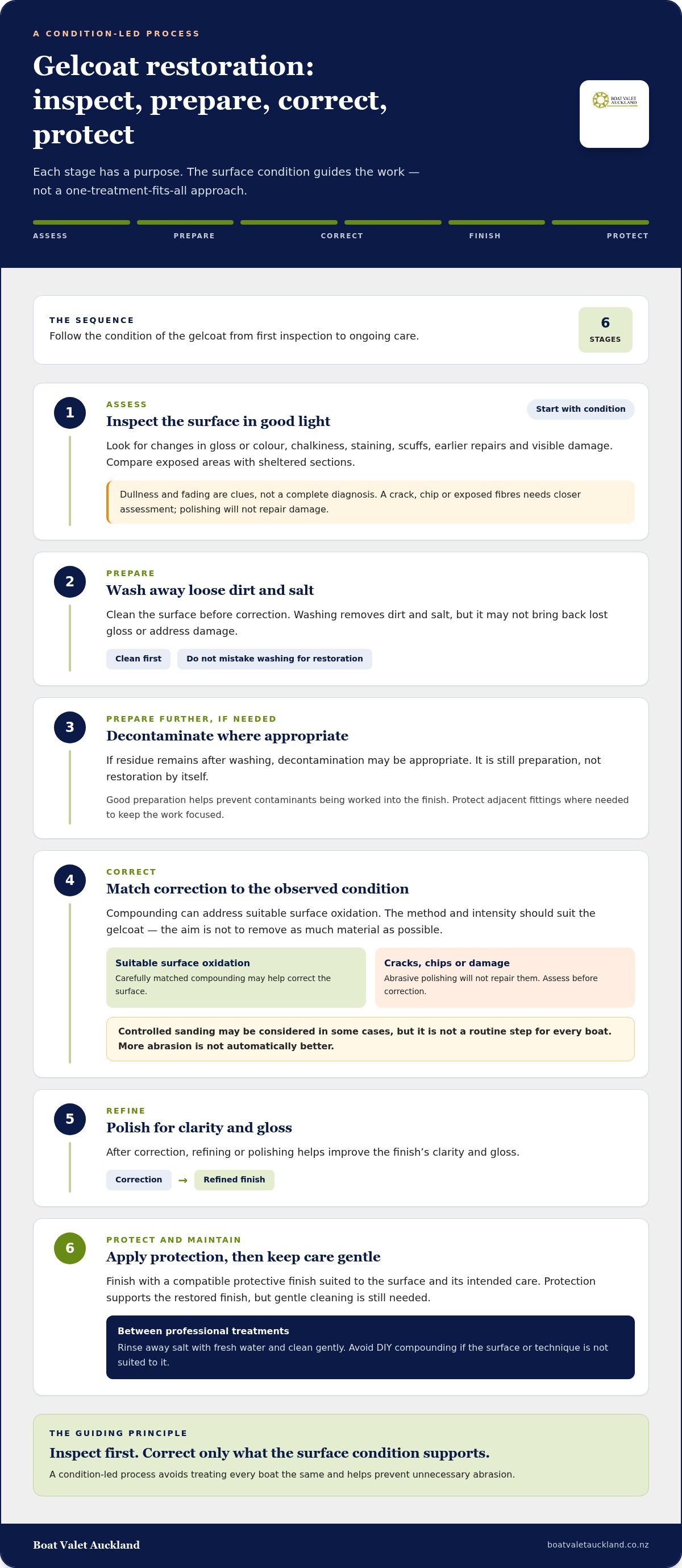
A reliable gelcoat restoration process nz follows the condition of the surface rather than applying the same treatment to every boat. The usual sequence is to inspect, wash, decontaminate where appropriate, correct, refine and protect. Each step prepares the surface for the next, and the inspection guides the level of correction.
Gelcoat is a formulated outer finish, and its chemical composition helps explain why its condition and response to correction can vary. The aim isn’t to remove as much material as possible. It’s to address suitable surface defects carefully, then finish and protect the corrected area.
Preparation: inspection, washing and surface cleaning
Inspect the gelcoat in good light. Note changes in gloss, staining, scuffs, repairs and damage, then choose an approach suited to the surface. Wash away loose dirt and salt first. If residue remains, decontamination may be appropriate, but it’s still preparation, not restoration by itself.
Good preparation helps prevent contaminants being worked into the finish during correction. Protect adjacent fittings where needed, so the work stays focused on the surface being treated.
Correction, refinement and gelcoat protection
Once the surface is clean and ready, correction can begin. Compounding can address suitable surface oxidation, but it won’t repair cracks, chips or other damage. Match the method and intensity to the observed condition. Controlled sanding may be considered in some cases, but it isn’t a routine step for every boat. More abrasion isn’t automatically better.
After correction, refining or polishing helps improve the finish’s clarity and gloss. The final stage is protection: apply a compatible protective finish suited to the surface and its intended care. Protection supports the restored finish, but doesn’t remove the need for gentle cleaning.
When a boat needs more than a wash, professional cut and polish provides a measured approach to surface correction. Boat Valet Auckland provides professional boat cut and polish at marinas and private properties across greater Auckland. A condition-led process gives each stage a clear purpose, from clean preparation through to protection.
DIY or professional gelcoat restoration in Auckland: compare the options
The right choice depends on what the finish needs and how confident you are working on it. Routine washing and gentle, compatible surface care are useful maintenance. They may be enough when the gelcoat is generally sound and only slightly dull. If chalkiness is widespread, the gloss is uneven or washing leaves the finish faded, take a closer look before deciding whether correction is needed.
DIY care avoids arranging a service, but more involved correction takes hands-on effort and a steady technique. A power buffer used too aggressively can affect the finish, particularly if you’re unsure how the surface will respond. Professional cut and polish applies correction according to the observed condition, which can help achieve a more consistent finish across larger or unevenly weathered areas. Neither approach is right for every boat.
When careful DIY gelcoat care may be enough
Start with a thorough wash and assess the surface once it’s clean. If the gloss is only mildly reduced and there are no cracks, chips, exposed fibres or uncertain repairs, routine care may be all that’s needed for now. That’s maintenance, not full restoration. Avoid moving to abrasive correction simply because the finish isn’t perfect.
Stop if the surface changes unexpectedly or cleaning reveals marks that look deeper than the surface. A new patch of dullness, a visible defect or uncertainty about previous work is a reason to pause rather than keep polishing. Continuing without knowing what you’re treating makes it harder to judge the next step.
When professional cut and polish is the sensible next step
Widespread chalkiness, patchy gloss or previous polishing and repairs can make the right approach less clear. An experienced operator can assess the finish and tailor the work to its condition, rather than treating every area with the same level of correction. This is useful when you want a more even result without relying on guesswork or unnecessary abrasion.
Professional cut and polish is a practical option when routine washing no longer improves the appearance. Boat Valet Auckland provides mobile boat cut and polish at marinas and private properties across greater Auckland. For a broader overview of the service, read the professional boat cut and polish guide.
Use the surface condition and your confidence as decision points: light dullness may need only careful upkeep, while broad or uncertain changes are better assessed before correction. That’s the core of a sensible gelcoat restoration process nz: choose the least aggressive approach suited to the finish, and stop if the surface suggests there’s more going on.
Protect restored gelcoat from Auckland’s marine conditions
A restored finish still faces sun, salt spray and the wear of regular boating. These conditions can gradually affect the gelcoat’s appearance, especially on more exposed surfaces. Aftercare won’t make the finish maintenance-free, but gentle, consistent cleaning and early attention to changes can help maintain its appearance.
A practical aftercare routine for boats around Auckland
After use, rinse exposed surfaces with fresh water when practical to remove salt and grime. Clean with a marine-suitable method and a soft cloth or sponge. Avoid harsh household cleaners and abrasive pads, which can mark the finish or affect its appearance. There’s no single schedule that suits every boat, so let how often and where you use it guide your routine.
Check high-exposure areas periodically, including surfaces that receive more direct sun or spray. Look for changes in gloss or colour, and note whether a difference is spreading or confined to one spot. Regular visual checks won’t diagnose every issue, but they can help you notice changes early. For wider vessel-care advice, see this marine detailing services guide.
Keep the finish protected between restoration visits
Protection supports the finish, but doesn’t replace normal cleaning and inspection. Treat persistent staining differently from salt residue that rinses away. If you notice a crack, chip or mark that doesn’t respond to gentle cleaning, avoid trying to polish it out. Assessment can help distinguish a surface issue from damage that needs a different response.
Consistent, gentle care helps preserve a restored appearance, while regular checks make new changes easier to spot. Keep your routine simple and suited to the boat’s use. This supports the finish between professional visits without aggressive cleaning or unnecessary polishing.
If your gelcoat needs more than routine care, arrange mobile boat cut and polish in Auckland with Boat Valet Auckland at a marina or private property across greater Auckland.
Arrange mobile gelcoat restoration in Auckland with Boat Valet
Once you have a clearer idea of what the finish needs, discuss the boat’s condition and the appropriate work. Boat Valet Auckland provides mobile boat cut and polish at marinas and private properties across greater Auckland. Owner-operator Steve Kellie leads the business, which was established in 1998.
Every vessel and gelcoat surface is different. The work should respond to what can be observed rather than assuming every boat needs the same level of correction or promising an identical result. Assessment helps guide the approach, from surface preparation through suitable correction and protection. Point out any cracks, chips, exposed fibres or previous repairs so they can be considered before polishing begins.
What to share when arranging a gelcoat assessment
Start by describing what you’ve noticed. Explain where fading, chalkiness, staining or marks are most visible, and whether the appearance changes between exposed and sheltered areas. Mention any areas that have been polished or repaired before, if you know their history.
Clear photographs can help show the affected areas, and sharing the vessel’s location gives useful context for discussing mobile service. Photos are a starting point, not a substitute for assessing the surface itself. This information helps frame a practical discussion about the work, without relying on appearance in a photograph alone.
Get professional boat cut and polish in Auckland
The restoration process begins by understanding the finish, then preparing the surface and matching correction to its condition. Refinement and protection follow as appropriate. A considered gelcoat restoration process nz means choosing work that suits the vessel, not applying the same treatment everywhere.
With mobile service at Auckland marinas and private properties across greater Auckland, professional care can be carried out at the vessel’s location. If your boat’s gelcoat needs more than routine washing, describe what you’ve noticed and discuss the next step with Steve. Discuss boat cut and polish and arrange care suited to your vessel.
Give your boat’s gelcoat the right care
A chalky or faded finish doesn’t automatically mean your boat needs intensive correction. First work out whether you’re seeing surface oxidation or deeper damage, then match the work to the gelcoat’s condition. A sound gelcoat restoration process nz moves from assessment and preparation through suitable correction and protection. Gentle, regular cleaning helps maintain the finish afterwards.
If washing no longer improves the appearance, professional boat cut and polish is a practical next step. Boat Valet Auckland provides mobile marine care at marinas and private properties across greater Auckland. Owner-operator Steve Kellie has cared for boats through the business since it was established in 1998.
Share what you’ve noticed and discuss an approach suited to your boat’s finish. Discuss your boat’s gelcoat restoration with Boat Valet Auckland.
Frequently Asked Questions
What is the gelcoat restoration process for a boat?
A sound gelcoat restoration process nz starts with assessing the surface and cleaning it before choosing how to correct and protect it. The work may include washing, suitable decontamination, compounding where oxidation is present, and refining or polishing to improve gloss. The approach depends on the gelcoat’s condition. Cracks, chips or exposed fibres need assessment rather than more polishing, and sanding isn’t automatically part of every restoration.
Can faded or chalky boat gelcoat be restored?
Faded or chalky gelcoat may be improved if the issue is surface oxidation and the finish is suitable for correction. Assess the surface first, because chalkiness and lost gloss are clues, not proof of the underlying condition. Washing may remove grime but won’t necessarily restore shine. If fading is widespread or the surface has damage or previous repairs, professional boat cut and polish provides a condition-led approach.
How do I know if my boat needs gelcoat restoration or repair?
Dullness, faded colour and a powdery-looking surface can point to oxidation, while a crack, chip or exposed fibres may indicate damage beyond the surface finish. These signs aren’t a definitive diagnosis, especially if there are old repairs or staining that won’t wash away. Avoid trying to polish defects out. If you’re unsure about their depth or the surface changes unexpectedly, pause and arrange an assessment.
Is it safe to compound gelcoat yourself?
Compounding may suit an owner with the right experience and a surface that needs correction, but it isn’t risk-free. Too much pressure or repeated abrasive work may worsen the finish, especially if you haven’t identified what’s causing the dullness. Start by cleaning and assessing the gelcoat carefully. If the surface has cracks, chips, previous repairs or you’re unsure how it will respond, don’t compound it yourself.
How long does boat gelcoat restoration take?
There isn’t one reliable timeframe for every boat. The duration depends on the size of the areas being treated, the gelcoat’s condition and the preparation and correction required. A boat with localised dullness may need a different scope of work from one with widespread oxidation or uneven previous polishing. An assessment helps clarify what the work involves, but a general time estimate may not reflect the vessel’s actual condition.
What should I do if gelcoat has cracks or exposed fibres?
Stop polishing the affected area and arrange an assessment. Cracks, chips and exposed fibres may indicate damage that compounding won’t address, so don’t try to hide them by increasing abrasion. Take clear photographs and note where the damage appears. A professional can assess the visible condition and help establish the appropriate next step. Boat cut and polish is for suitable surface correction, not a substitute for addressing damage.
How do I protect restored gelcoat in Auckland’s marine environment?
Rinse salt and grime from exposed surfaces with fresh water when practical, then clean gently using marine-suitable methods. Avoid harsh household cleaners and abrasive pads. Auckland boats face sun, salt spray and regular use, so inspect exposed areas periodically for changes in gloss, colour or new marks. Protection supports the finish, but doesn’t make it maintenance-free. Have cracks, chips or persistent staining assessed rather than polishing them repeatedly.
Comments