
Environmental Antifouling Solutions NZ: The 2026 Boat Owner’s Guide

Is your boat’s current hull protection quietly poisoning the very Auckland waters you love to cruise? It is a confronting question, but one that every local owner must face. You need a clean, fast hull that breezes through strict marina biosecurity inspections, yet finding effective environmental antifouling solutions NZ that actually work in our warm northern climate has historically been a challenge. Most boaties feel stuck between a rock and a barnacle when it comes to choosing between performance and conservation.
The good news is that by 2026, you don't have to compromise your values to keep your vessel in top condition. This guide reveals how to protect your high-value asset whilst significantly reducing your impact on the marine life of the Hauraki Gulf. You will discover how the latest non-toxic coating technologies allow you to maintain peak performance without the heavy metal guilt. We will preview the shift in local EPA regulations and explain why a proactive professional grooming routine is the essential partner to any modern hull strategy. You can achieve a slick, biosecurity-ready finish that costs less in the long run and keeps our local ecosystems thriving.
Table of Contents
The Shift to Environmental Antifouling Solutions in NZ
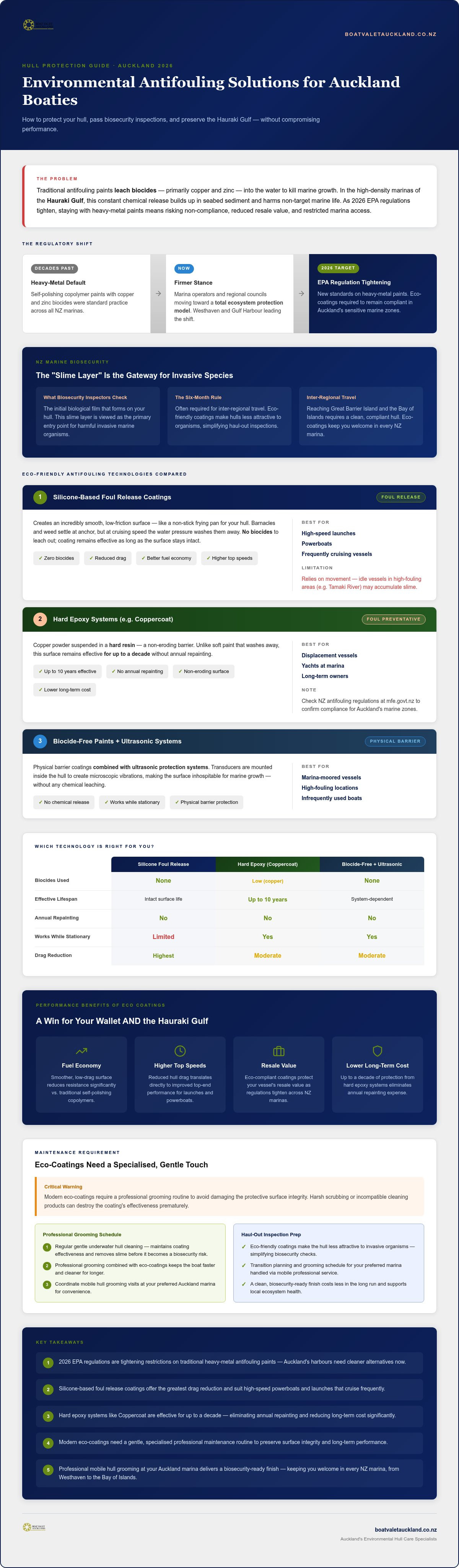
The tide is turning for Auckland boat owners. For decades, heavy-metal paints were the default choice for hull protection, but environmental reality is catching up with tradition. Traditional antifouling works by leaching biocides, primarily copper and zinc, into the surrounding water to kill marine growth. In the high-density marinas of the Hauraki Gulf, this constant chemical release builds up in the seabed sediment and harms non-target marine life. Choosing environmental antifouling solutions nz is no longer just a niche preference; it's a necessary step toward preserving our local cruising grounds for the next generation of Kiwi boaties.
Marina operators and regional councils are now taking a firmer stance. We're seeing a move away from simply managing growth toward a total protection model for our ecosystems. If you want to keep enjoying the pristine waters of the Great Barrier or the Bay of Islands, your hull maintenance strategy needs to evolve. Transitioning to eco-friendly coatings isn't just about avoiding "green guilt", it's a practical business decision that protects your vessel’s resale value and ensures you remain welcome in every New Zealand marina.
New Zealand Marine Biosecurity Standards
Regional coastal plans are becoming increasingly strict as we approach 2026. The focus has shifted toward the "slime layer", which is the initial biological film that forms on your hull. Biosecurity officials view this layer as the gateway for invasive species. In the context of NZ hull maintenance, biosecurity is the practice of preventing the spread of harmful marine organisms by ensuring vessel hulls are free from "hitchhiking" invasive species. Using modern, eco-friendly coatings makes your hull less attractive to these organisms, which simplifies your haul-out inspections and ensures you pass the "six-month rule" often required for inter-regional travel.
Why Auckland Boaties are Leading the Change
Auckland’s premier facilities, such as Westhaven and Gulf Harbour, are at the forefront of this environmental shift. These marinas are under local pressure to reduce heavy metal contamination in their basins. Beyond the regulatory requirements, many owners are discovering that "going green" actually improves vessel performance. A smoother, non-toxic coating reduces drag significantly compared to traditional self-polishing copolymers. This leads to better fuel economy and higher top speeds. When you combine these performance gains with a professional grooming schedule, your boat stays faster and cleaner for longer. It's a win for the Hauraki Gulf and a win for your wallet.
Types of Eco-Friendly Antifouling Technologies
Selecting the right hull protection is no longer a matter of picking the cheapest tin of blue paint. Modern environmental antifouling solutions nz offer diverse ways to keep your vessel clean without dumping toxins into the Hauraki Gulf. These technologies generally fall into two categories: those that make it impossible for growth to stick, and those that provide a permanent, non-eroding barrier. Each has its own strengths depending on your vessel type and how often you get out on the water.
Silicone-based coatings lead the way in "foul release" technology. These products create an incredibly smooth, low-friction surface. Think of it like a non-stick frying pan for your hull. Barnacles and weed might settle whilst you're at anchor, but as soon as you hit cruising speed, the water pressure simply washes them away. This is a game-changer for high-speed launches and powerboats that frequently cruise the islands. Because there are no biocides to leach out, the coating remains effective as long as the surface stays intact.
Hard-wearing epoxy systems, such as Coppercoat, take a different approach. Instead of a soft paint that erodes over time, these systems use copper powder suspended in a hard resin. Because the surface doesn't dissolve, it remains effective for up to a decade without the need for annual repainting. You should consult the New Zealand antifouling regulations to ensure your chosen system meets current biosecurity and environmental standards for Auckland's sensitive marine zones.
Foul Release vs. Foul Preventative
The mechanics of silicone coatings rely on movement. If your boat sits idle in a high-fouling area like the Tamaki River, a "foul release" system may still accumulate a slime layer. Displacement vessels and yachts that spend more time at the marina might prefer biocide-free paints that rely on physical barriers. These coatings are often combined with ultrasonic protection systems. These devices use transducers mounted inside the hull to create microscopic vibrations, making the surface uninhabitable for marine larvae before they can even attach.
Long-Life Epoxy Systems
Switching to a 10-year epoxy system is a major strategic move. It drastically reduces the frequency of shipyard visits and the associated haul-out costs. These are not "set and forget" solutions, however. Unlike traditional ablative paints that wear away to reveal fresh toxins, hard epoxy surfaces require regular, gentle cleaning to remain effective. If you aren't sure which system suits your Auckland mooring, you can book a consultation for antifouling maintenance to protect your investment and ensure your hull stays slick.
Performance Comparison: Traditional vs. Environmental Coatings
Traditional antifouling is a race against time. The biocide leaches out until the paint is spent, usually within 12 to 18 months. In contrast, modern environmental antifouling solutions nz rely on surface integrity rather than chemical depletion. This shift changes the performance profile of your boat. In high-fouling Auckland hotspots like the Tamaki River, traditional paints can struggle once the top layer becomes clogged. Environmental coatings, particularly silicone foul-release systems, maintain a consistently slick surface that prevents barnacles from gaining a permanent foothold.
Fuel efficiency is where the performance gap becomes most obvious. Traditional ablative paints have a microscopic "sandpaper" texture that creates drag. Eco-friendly coatings are significantly smoother. By reducing this skin friction, you can see noticeable gains in knots and a reduction in fuel consumption. Whilst the upfront application cost of these systems is often higher due to the specialised labour required, the 5 to 10-year lifespan of products like Coppercoat or high-end silicone means you skip years of annual haul-out fees. The long-term savings on shipyard visits easily outweigh the initial investment.
Durability in NZ Conditions
Our local conditions are notoriously tough on marine materials. New Zealand’s high UV levels can degrade inferior coatings quickly. Silicone systems are particularly resilient to UV, but they demand perfection during the preparation phase. Unlike traditional paint, you can't just roll these over an old surface. They require a dedicated primer system and a clean, controlled environment for application. Performance also varies by use. A boat that cruises the Hauraki Gulf every weekend will see better "self-cleaning" results than a vessel sitting idle in stagnant marina waters.
The ROI of Going Green
Investing in a premium environmental system pays dividends when it's time to sell. A hull that hasn't been layered with years of flaky, heavy-metal paint is a major selling point. You'll also find that your annual maintenance schedule becomes about grooming rather than grinding. By keeping the surface polished and free of slime, you extend the coating's life indefinitely. This proactive approach is a core part of Pre-Sale Boat Grooming NZ, ensuring your vessel presents as a high-performance asset to prospective buyers. You should always check the latest New Zealand antifouling regulations to ensure your long-term strategy remains compliant with local biosecurity standards.
Maintenance and Cleaning for Eco-Friendly Hulls
Transitioning to modern hull protection is only half the battle. The way you maintain these surfaces is fundamentally different from the "scrub it hard" mentality of the past. Traditional copper-based paints are designed to be abrasive-tolerant or to erode away, but eco-coatings require a much gentler touch. Using a hard-bristled brush or a scraper on a silicone foul-release surface is a fast way to turn a high-performance coating into a shredded mess. These surfaces rely on their microscopic smoothness to stay clean; once you scratch that surface, you've created a perfect home for barnacles to anchor.
Regular grooming is the secret to making environmental antifouling solutions nz last their full 5 to 10-year lifespan. If you let hard calcareous growth like barnacles or tube worms fully cement themselves to a silicone or hard epoxy surface, removing them without damaging the coating becomes nearly impossible. Professional mobile groomers are essential partners in this process. Since 1998, we've seen how a "little and often" approach saves boat owners thousands in premature repainting costs. A specialist understands exactly how much pressure to apply to remove the biofilm without compromising the integrity of the expensive topcoat.
The Importance of Regular Hull Detailing
Waiting for your next annual haul-out is a mistake with modern systems. By the time you get the boat out of the water at a yard, the growth has often bonded too tightly for a gentle clean. Establishing a monthly grooming schedule during the Auckland boating season, which typically runs from October through to April, keeps the hull slick and fast. This proactive care is a core component of Marine Detailing Services NZ, where the focus is on preservation rather than aggressive restoration. It's about maintaining that "just applied" performance every time you leave the marina.
Safe Cleaning Practices for the Hauraki Gulf
Stick to soft sponges or microfibre cloths for silicone-based hulls. Even a standard plastic-bristled brush can create micro-scratches that give marine larvae a place to grip. You're looking for the "slime layer"-a thin film of bacteria and algae that increases drag and acts as a foundation for larger organisms like barnacles. Catching this layer early means a simple wipe-down is all that's required to restore your hull speed. If you're moored in a high-growth area like the Tamaki River, you'll need to be even more vigilant with your cleaning frequency.
Contact Steve today to organise a professional antifouling maintenance plan that keeps your hull biosecurity-ready and performing at its peak.
Organising Your Environmental Antifouling Schedule
Transitioning to environmental antifouling solutions nz requires more than just a change in product. It's a strategic shift in how you manage your vessel's lifecycle. If you're moving from traditional copper-based paint to a silicone or hard epoxy system, the preparation phase is critical. You can't simply roll a new eco-friendly coating over years of old, flaky ablative paint. The hull must be stripped back to a sound substrate to ensure the new technology bonds correctly. This is why professional application is non-negotiable. A failed bond doesn't just waste money; it leaves your high-value asset vulnerable to invasive species and performance loss.
The real secret to success lies in what happens after the boat is back in the water. Once your new coating is applied, the maintenance schedule shifts from aggressive annual scrubbing to regular, gentle grooming. This is where the mobile advantage becomes your greatest asset. Instead of losing weeks every year to the shipyard, you coordinate with a specialist who maintains the hull at your own berth. This partnership approach ensures your boat remains biosecurity-ready and fast throughout the entire season without the constant need for haul-outs.
Planning Your Next Haul-Out in Auckland
Timing is everything in the Hauraki Gulf. Most Auckland boaties aim for a spring haul-out in September or October. This ensures the hull is slick and protected just as the water temperatures rise and marine growth accelerates. You should coordinate with local shipyards well in advance, as slots fill up quickly before the summer cruising season. For a detailed breakdown of local facilities and requirements, refer to our guide on Marine Antifouling Auckland. Getting the application right the first time sets the foundation for years of low-maintenance cruising.
The Boat Valet Auckland Advantage
I've been working in Auckland marinas since 1998, and I've seen the industry evolve from heavy-duty toxins to the advanced coatings we use today. My role is to be your practical partner in this transition. We provide mobile grooming services at Westhaven, the Viaduct, and Orakei, bringing the expertise directly to your vessel. I focus on a "precision first" approach, ensuring that your delicate silicone or epoxy surfaces are cleaned with the correct tools and techniques. We keep your hull in showroom condition whilst respecting the marine ecosystems we all enjoy. It's about finding the balance between a high-performance finish and environmental responsibility. Contact Steve Kellie today to discuss a tailored maintenance plan that protects your investment for the long haul.
Protecting Your Vessel and Our Marine Heritage
Adopting environmental antifouling solutions nz is a strategic move for any boat owner looking toward 2026. You now understand that modern coatings offer more than just compliance; they provide a high-performance finish that reduces drag and saves on fuel. The shift from traditional paints to eco-friendly systems requires a new approach to maintenance, focusing on gentle, regular grooming rather than aggressive seasonal scrubbing. By making this transition, you ensure your vessel breezes through biosecurity checks whilst protecting the Hauraki Gulf for the next generation of Kiwi boaties.
Since 1998, I've worked as a mobile marine specialist across all major Auckland marinas, providing the regional knowledge needed to keep high-value assets in peak condition. My team offers comprehensive grooming and antifouling care tailored to the specific needs of your vessel's coating. Contact Steve Kellie at Boat Valet Auckland for expert hull maintenance and take the hassle out of your transition to a cleaner, faster hull. It is time to enjoy the water with the confidence that your boat is performing at its best and leaving no trace behind.
Frequently Asked Questions
Are environmental antifouling solutions as effective as traditional copper paint?
Modern environmental antifouling solutions nz are highly effective but work on different principles. Traditional paints kill growth through chemical leaching; silicone systems make the hull too slippery for barnacles to attach. Hard epoxy systems provide a permanent, non-leaching barrier that resists attachment. Both technologies match traditional performance in Auckland conditions, provided you follow a professional grooming schedule. This shift ensures your vessel remains fast and fuel-efficient without releasing heavy metals into the harbour.
Do eco-friendly hull coatings cost more to apply?
The initial application cost for eco-friendly coatings is typically higher than standard paint. This is because these systems require much more intensive surface preparation and specialised labour to ensure a perfect bond. You should view this as a long-term investment rather than an annual expense. Since these coatings can last between five and ten years, you skip several expensive haul-outs and repainting cycles. The reduction in drag also leads to fuel savings.
Can I apply silicone antifouling over my existing paint?
You cannot apply silicone coatings directly over old antifouling paint. These systems require a perfectly clean, stable substrate to bond correctly. Most installations involve stripping the hull back to the gelcoat and applying a specific primer system. If you try to shortcut this process, the coating will likely peel or fail within its first season. Professional application is essential to ensure the bond is strong enough to withstand high cruising speeds and Auckland's tidal flows.
How often do biocide-free hulls need to be cleaned?
Biocide-free hulls perform best when cleaned once a month during the peak Auckland growing season from October to April. This prevents the initial slime layer from developing into hard calcareous growth. Since there are no toxins to kill the organisms, you rely on physical removal. A gentle wipe with a soft sponge is usually enough to keep the surface slick. This proactive routine is much easier than trying to remove established barnacles from a damaged coating.
Will using an environmental coating help me pass Auckland marina biosecurity checks?
Choosing a modern environmental coating significantly improves your chances of passing strict biosecurity inspections. These systems are designed to resist the invasive species that regional councils want to keep out of the Hauraki Gulf. Because the surfaces are so smooth, any light growth is easily identified and removed. Many Auckland marinas now view a well-maintained eco-hull as a sign of a responsible owner, making your arrival and departure processes much smoother and faster.
What happens if I damage a silicone foul-release coating?
Minor scratches in a silicone coating can usually be repaired during a short haul-out using specialised touch-up kits. If the damage is extensive, the low-friction properties of the hull will be compromised, leading to increased drag and growth. You must avoid using hard scrapers or abrasive brushes, as these create micro-scratches that marine larvae use as anchors. Contact a specialist immediately if you notice the coating lifting or peeling to prevent further degradation of the surface.
Are there specific environmental antifouling brands recommended for NZ waters?
Several systems are proven to work well in New Zealand conditions, including hard epoxy resins and silicone foul-release products. These technologies are formulated to comply with the 2026 EPA biocide regulations whilst handling our high UV levels. The best choice depends on whether you have a high-speed launch or a slower displacement yacht. I recommend choosing a system with a local track record in Auckland marinas to ensure the product can handle our specific marine biology.
How does the water temperature in Auckland affect eco-friendly coatings?
Auckland’s warm summer water temperatures act as a catalyst for marine growth, making proactive hull care essential. Eco-friendly coatings are designed to be stable in these conditions, but they still require movement or grooming to stay clean. In stagnant marina environments during a heatwave, the biofilm can form more rapidly. A professional grooming plan ensures that these temperature spikes don't lead to a permanent build-up of weed or barnacles on your expensive hull coating.
Comments