
Alternatives to Propspeed in NZ: Choosing Propeller Protection

The obvious alternative to Propspeed may not be another coating. If you’re researching alternatives to propspeed nz, the right option depends on your propeller’s material, how often your vessel moves and the maintenance approach that suits your boating conditions.
Foul-release coatings, hard-film systems, conventional antifouling and physical propeller guards work in different ways. A product that suits one boat may not suit another. Surface preparation matters too, because the bond between a coating system and the metal affects how it performs.
This guide compares the main propeller-protection approaches and explains what to weigh up before choosing one. You’ll learn how use patterns can affect foul-release coatings, why material compatibility matters and what to consider when planning professional antifouling maintenance. For Auckland boat owners, it’s a practical way to make propeller protection part of the vessel’s wider care plan, not just a product decision.
Table of Contents
Why look for alternatives to Propspeed in New Zealand?
Propspeed is a brand name for a propeller-protection coating, not a general term for every product used below the waterline. It is a silicone-based foul-release system. Rather than working like conventional biocidal antifouling paint, it creates a surface intended to make marine growth less likely to adhere. Owners searching for alternatives to propspeed nz may be looking for another coating, a different application method or a maintenance plan that better fits their boat.
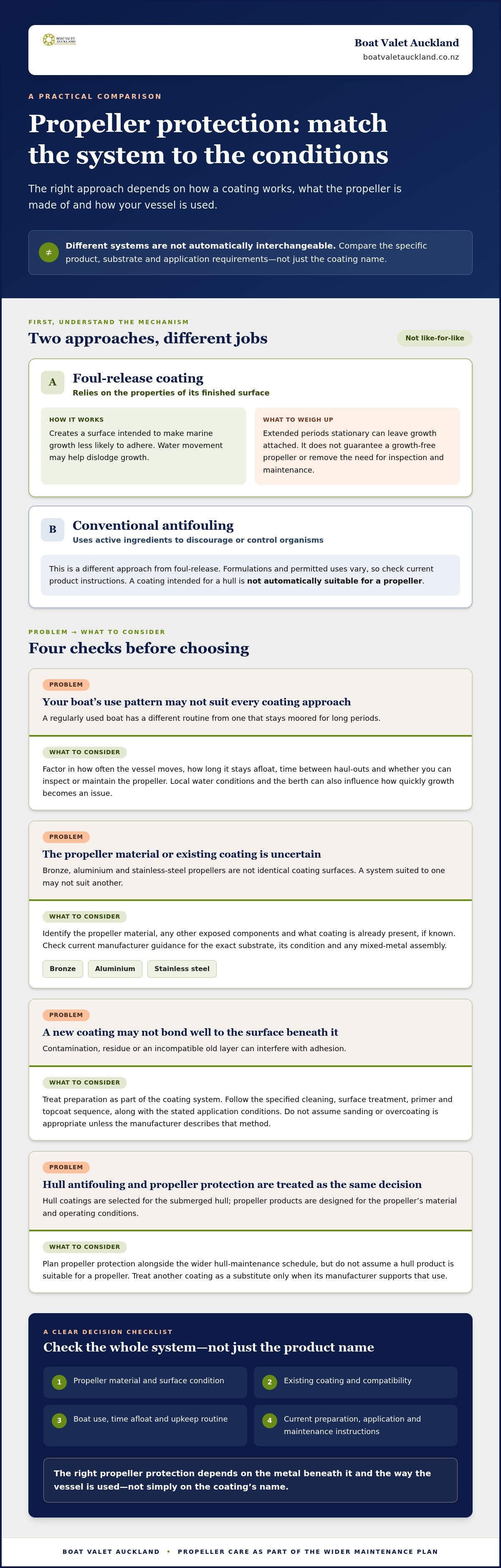
These options aren’t automatically equivalent. A coating’s suitability can depend on the propeller’s material, the surface condition, any existing coating and the maker’s preparation and application instructions. Compare evidence for the specific system and substrate, not just broad claims about preventing growth.
Propeller protection also has a different job from hull antifouling. Hull coatings are selected for the submerged hull, whilst propeller products are designed for the propeller’s material and operating conditions. The two can sit within one maintenance plan, but don’t assume a hull product is suitable for a propeller. For background on how marine organisms attach to submerged surfaces, see Understanding Biofouling.
What owners may mean by a Propspeed alternative
Start by clarifying the problem you want to solve. You might want a different foul-release coating, be considering conventional antifouling or want to change how the system is applied and fitted into your maintenance schedule. These are separate decisions. A paint intended for a hull is not necessarily an alternative coating for a propeller. Treat a different propeller coating as a substitute only when its manufacturer supports that use.
Consider the full system, including surface preparation, primer where specified, application conditions and ongoing care. A coating that appears suitable on paper may not match the existing surface or the way your boat is used. Follow current manufacturer guidance for the propeller material and any coating already on it.
Why Auckland boating conditions matter
Maintenance planning in Auckland should reflect your time afloat and operating pattern. A boat used regularly has a different routine from one that stays moored for long periods. The time between haul-outs and your ability to inspect or maintain the propeller also shape the decision. Local water conditions and the vessel’s berth can influence how quickly growth becomes an issue, so there isn’t one coating choice for every Auckland marina.
Plan propeller protection alongside the wider hull-maintenance schedule. Coordinating the two can help you organise preparation and upkeep around how you use the vessel, rather than choosing products in isolation. The Auckland antifouling guide provides further context on planning hull protection locally.
Quotable takeaway: The right propeller protection depends on the metal beneath it and the way the vessel is used, not simply on the coating’s name.
How propeller-protection coatings work and what they depend on
Propeller coatings don’t all tackle marine growth in the same way. Broadly, conventional antifouling coatings use active ingredients to discourage or control organisms on a treated surface. Foul-release systems aim to create a smooth, low-adhesion surface, so water movement can help dislodge growth. They may reduce attachment, but they don’t guarantee a growth-free propeller or remove the need for inspection and maintenance.
These are different approaches, not interchangeable labels. The Choosing the Right Antifouling Solution discussion in Marine Log also highlights why antifouling decisions depend on the coating system and its intended use. For any product, use current manufacturer instructions to establish which surfaces it is designed for, how it should be applied and what operating conditions it requires.
Foul-release coatings versus conventional antifouling
A foul-release coating relies on the properties of its finished surface rather than deliberately releasing biocides to control growth. Its performance can be affected by how the boat is used: movement through the water may help shed organisms, whilst extended periods stationary can leave growth attached. Conventional antifouling takes a different approach, using a coating designed to limit marine growth through its active ingredients. Formulations and permitted uses vary, so check current instructions rather than assuming hull paint is suitable for a propeller.
Why propeller material and preparation matter
Bronze, aluminium and stainless-steel propellers aren’t identical coating surfaces. Each product system has its own substrate requirements, and a primer or preparation method intended for one material may not suit another. Check the manufacturer’s guidance for the exact propeller material and condition, including instructions for mixed-metal assemblies or previously applied coatings.
Preparation is a process, not a quick wipe before application. The surface may need to be cleaned and treated in a specified way, with any existing coating assessed according to the product instructions. Contamination, residue or an incompatible old layer can interfere with adhesion. Application conditions and the specified sequence matter too, particularly where a system combines a primer with a topcoat. Don’t assume sanding or overcoating is appropriate unless the manufacturer describes that method.
Identify the propeller material and any other exposed components.
Record what coating is already present, if known.
Follow current product instructions for cleaning, preparation, application and maintenance.
Quotable takeaway: Careful substrate preparation is the foundation for coating adhesion, which helps determine whether the system can deliver its intended performance.
For Auckland owners, propeller protection can be considered alongside the vessel’s wider antifouling maintenance plan, with the chosen process guided by the surface, product instructions and boat use.
Propspeed alternatives compared: coating approaches and trade-offs
There’s no reliable way to rank propeller coatings without comparable evidence for the same substrate, preparation, application conditions and vessel use. Instead, compare what each system is designed to do, which surfaces its manufacturer specifies and what upkeep it calls for. The table is a starting point for assessing alternatives to propspeed nz, not a claim that one category will suit every boat.
Conventional antifouling products for propellers
Some owners consider conventional antifouling because it’s already part of their hull-maintenance routine. Assess it as a separate category, not a universal replacement for a foul-release coating. Product documentation should clearly identify propeller use and the relevant substrate. If it describes hull use only, don’t infer that it can be applied to a propeller. In New Zealand, product instructions and suitability matter alongside any applicable requirements for handling and disposal.
Other specialist propeller-protection systems
Specialist systems can vary in film type and application process. Compare the complete instructions, from surface preparation to ongoing care, rather than a headline claim or a single reported result. Manufacturer-published test information can help explain the conditions behind a performance claim. Owner accounts may offer useful context, but they’re anecdotal unless testing conditions and results are independently documented and comparable.
Before deciding, note the propeller material, present coating and typical operating pattern. Then compare only systems with instructions that address those details. This keeps the decision grounded in evidence and makes maintenance expectations clearer.
How to choose an alternative for your boat in Auckland
Choose by fit, not by a headline claim. Start with four details: the propeller material, how the vessel is used, what coating is already on the surface and how you plan to manage maintenance. This narrows the options before you compare products and helps you avoid a system that isn’t intended for your component.
Identify the substrate. Check whether the propeller is bronze, aluminium, stainless steel or another material. Include any other components the coating may touch.
Describe the use pattern. Note how often the boat operates, how long it typically stays afloat and whether it spends extended periods alongside.
Record the existing surface. Find out what coating is present, if known, and note visible wear or damage.
Set maintenance priorities. Consider how often you can inspect the propeller and when maintenance fits your haul-out schedule.
These steps make searches for alternatives to propspeed nz more focused. They also give you a clear basis for comparing product instructions with the boat’s actual operating conditions.
Match the option to your vessel’s use
Regularly operated vessels and boats that sit alongside for long stretches have different maintenance needs. Movement through the water may help some foul-release systems shed growth, but that doesn’t mean every frequently used boat will get the same result. A sailing vessel’s movement may differ from a launch used for short trips, whilst seasonal cruising creates its own periods of activity and inactivity. Vessel type alone isn’t a reliable predictor.
In Auckland, consider your usual berth, time afloat and operating routine together. Local conditions can inform when you inspect and maintain the propeller, but they don’t make one coating the right choice for every marina or vessel. Build the plan around observed fouling and the product’s stated operating requirements, then review it as your use changes.
Check compatibility before choosing
Read current manufacturer documentation for the precise component and substrate. Confirm that the product instructions cover the propeller material, preparation method and application conditions. A coating intended for a bare surface may have different requirements from one applied over an existing system. If the history is unclear, don’t assume an old coating can simply be covered or removed using a particular method.
Condition matters too. Corrosion, damaged areas, residue or uneven layers can affect the preparation needed before application. Follow the specified sequence and maintenance guidance. Performance depends on preparation, application and how the vessel is used, not just the product name.
Propeller protection can be planned alongside broader hull care. For that wider context, the marine antifouling maintenance guide explains how to think about hull protection in Auckland. To include professional antifouling in your vessel’s maintenance plan, arrange antifouling maintenance with Boat Valet Auckland.
Professional antifouling support for Auckland boat owners
Propeller protection is one part of keeping a vessel ready for the water. Professional antifouling maintenance helps owners organise hull care around the boat’s condition, time afloat and maintenance schedule, while keeping propeller considerations in view. Hull antifouling and propeller protection have different purposes, so treating them as one product choice can lead to the wrong assumptions.
Boat Valet Auckland provides mobile antifouling at marinas and private properties across the greater Auckland region. Owner-operated by Steve Kellie, the business has been established since 1998 and provides vessel maintenance at the boat’s location. Hull antifouling can form part of a wider care plan without assuming one propeller coating suits every vessel.
What a practical maintenance conversation should cover
Start with the vessel’s maintenance history and how it’s used. The propeller’s material and visible condition, any existing coating and the timing of hull maintenance all help shape the discussion. If you have product details, previous work records or notes on when the boat was last hauled out, keep them handy. These details help make the maintenance plan specific to your vessel rather than based on a broad product claim.
On-site service makes it possible to organise antifouling around where the vessel is berthed or kept. Boat Valet Auckland’s mobile service is carried out at Auckland marinas and private properties, bringing maintenance to the vessel’s location. The aim is a practical plan that accounts for the boat and its care requirements, not a promise of a particular coating result.
Plan propeller protection alongside hull care
Hull antifouling addresses the submerged hull; propeller protection must be considered in relation to the propeller component, its material and the product’s instructions. The two can be coordinated in a wider maintenance schedule, but don’t assume a hull coating is suitable for the propeller. Use current manufacturer guidance for any propeller system, especially where the surface has a previous coating or mixed materials.
Keep a simple record of products used, application dates and preparation details. This gives you a clearer starting point at the next maintenance interval and helps avoid guesswork about what is already on the surface. Note changes in how often the vessel operates too, as a shift from regular cruising to long periods alongside may affect inspection and maintenance planning.
For broader upkeep beyond antifouling, Boat Valet Auckland’s mobile boat grooming in Auckland can be part of an overall vessel-care routine. If you’re weighing up alternatives to propspeed nz, connect the decision to your boat’s maintenance history and wider antifouling plan. Discuss antifouling care for your boat with Boat Valet Auckland.
Make your next maintenance decision with confidence
Before selecting among alternatives to propspeed nz, turn your research into a clear maintenance brief. Note the propeller material, existing coating and how the boat is normally used. Keep product instructions and previous maintenance records together, so the next decision is grounded in the vessel’s actual condition rather than a broad performance promise.
Then consider propeller protection as part of the wider antifouling plan. A coordinated approach can make it easier to organise upkeep around your boating routine and keep useful records for future maintenance. If the propeller’s coating history is unclear, include that in the discussion before planning any work.
Boat Valet Auckland provides antifouling maintenance at Auckland marinas and private properties. Discuss antifouling care for your boat with Steve Kellie and take a practical next step towards a maintenance plan that fits.
Frequently Asked Questions
What are the alternatives to Propspeed in New Zealand?
Options include other silicone foul-release coatings, specialist hard-film systems and conventional antifouling products whose documentation specifically allows propeller use. A physical propeller guard is another kind of protection, but it protects against contact rather than marine growth, so it isn’t a coating substitute. To compare alternatives to propspeed nz, narrow the choice by your propeller material, how the boat is used and the maintenance approach you can follow.
Is conventional antifouling paint suitable for a propeller?
Use it only if the product documentation expressly identifies the propeller component and its material as suitable. A label or instruction for hull use alone doesn’t establish propeller compatibility. Look for guidance covering the specific surface, preparation method and application. If the propeller already has a different coating, don’t assume the new paint can go over it. Product instructions should explain the correct approach to existing coatings.
Can I apply a Propspeed alternative myself?
Some propeller-protection systems are intended for DIY application, but suitability depends on the particular product and your ability to follow its complete instructions. Check whether the manufacturer specifies DIY use, then review preparation steps, application conditions, protective measures and any required curing time. A missed step can affect the finished coating. If the process calls for tools or conditions you can’t provide, professional application may be more practical.
How do I choose a propeller coating for my boat?
Begin with the propeller’s material and coating history, then consider how the boat is operated and maintained. A boat used for regular trips has a different use pattern from one that remains berthed for long periods. Compare products using their technical documents, not just advertised claims. Note the inspection and upkeep the system calls for, and keep those instructions with your vessel’s maintenance records.
Do Propspeed alternatives work on bronze and stainless-steel propellers?
Some systems may be specified for bronze, stainless steel or both, but compatibility varies by product. Check the technical documentation for the exact material and any primer or preparation requirements. Don’t infer suitability from a product’s general description. Also account for nearby components, such as a hub or fasteners, which may use different materials. If your propeller assembly combines metals, follow the manufacturer’s instructions for each relevant surface.
How often should propeller protection be reapplied?
There isn’t one reapplication interval that suits every coating and vessel. Follow the product’s current maintenance instructions, then assess the propeller’s condition during routine servicing or haul-out. How often the boat operates, how long it stays afloat and the state of the coating can all affect the maintenance plan. Record the application date and product used, so future inspections can be compared with a reliable history.
Does Auckland’s marine environment affect which propeller protection I should choose?
Local conditions are one factor in planning, but they don’t point to a single coating for every Auckland boat. Consider the vessel’s usual berth, time afloat, operating routine and the fouling you observe during inspections. A boat that sits unused for a long stretch may need a different maintenance plan from one used regularly. Track what you find between haul-outs, then use that record to guide future product and upkeep decisions.
Comments