Professional Mobile Boat Cut and Polish Auckland: The 2026 Guide
- Steve Kellie

- 11 minutes ago
- 13 min read
Is your boat’s gelcoat actually protecting your investment, or is it slowly being bleached white by the Hauraki Gulf’s unforgiving UV levels? Most Auckland boaties take pride in their vessel, yet it's disheartening to watch a vibrant hull turn chalky and aged under the relentless Kiwi sun. You likely recognise that saltwater and high UV are constant battles, but finding the time to organise a haul-out often feels like a secondary job. That is exactly why a professional mobile boat cut and polish Auckland service is the most effective way to restore your vessel’s showroom shine without the hassle of transporting it to a distant yard.
I understand the frustration of seeing a high-value asset lose its lustre. This 2026 guide will show you how to achieve a mirror-like finish that doesn't just look good for a week, but provides genuine, long-term protection against the elements. We'll cover everything from the multi-stage abrasive cut required for deep oxidation to the convenience of having expert detailing performed right at your local marina or driveway. You'll learn how personal accountability and Steve Kellie’s 25 years of local experience can transform your boat's appearance while safeguarding its future value.
Table of Contents
What is a Boat Cut and Polish? Gelcoat Restoration Explained
Many boat owners mistake a simple wash and wax for a full restoration. A true boat cut and polish is a technical, multi-stage process designed to revive the physical structure of your vessel's surface. "Cutting" refers to the precise removal of a microscopic layer of oxidised material. This process strips away the "chalky" matte finish that plagues older boats, revealing the fresh, uncompromised layer beneath. It is the only way to transition from a dull, lifeless hull to a smooth, reflective surface that looks brand new. This intensive process is essential for achieving professional boat cut and polish Auckland results that stand the test of time.
While a one-stage polish might offer a temporary shine, it often masks defects rather than fixing them. For lasting results, a mobile boat cut and polish Auckland service uses a multi-stage approach. This ensures the surface is properly levelled before any gloss is added. Without the cutting stage, you're simply waxing over damage. This leads to a faded finish within weeks as the wax evaporates and the underlying oxidation reappears.
The Science of Gelcoat Oxidation
Marine Gelcoat is a porous material. Over time, these microscopic pores trap salt, dirt, and environmental pollutants. In Auckland, our exceptionally high UV index accelerates the chemical breakdown of the polymers within the gelcoat. This degradation creates a rough surface that scatters light instead of reflecting it. Oxidation is the primary cause of boat dullness in NZ. When your hull feels like a chalkboard, the surface has become physically compromised by the sun and sea. Unless this damaged layer is removed, no amount of cleaning will bring back the shine.
Cutting vs. Polishing: Knowing the Difference
Understanding the stages of restoration is vital for any owner. My mobile boat cut and polish Auckland service follows a strict hierarchy of preparation and refinement to ensure a showroom finish:
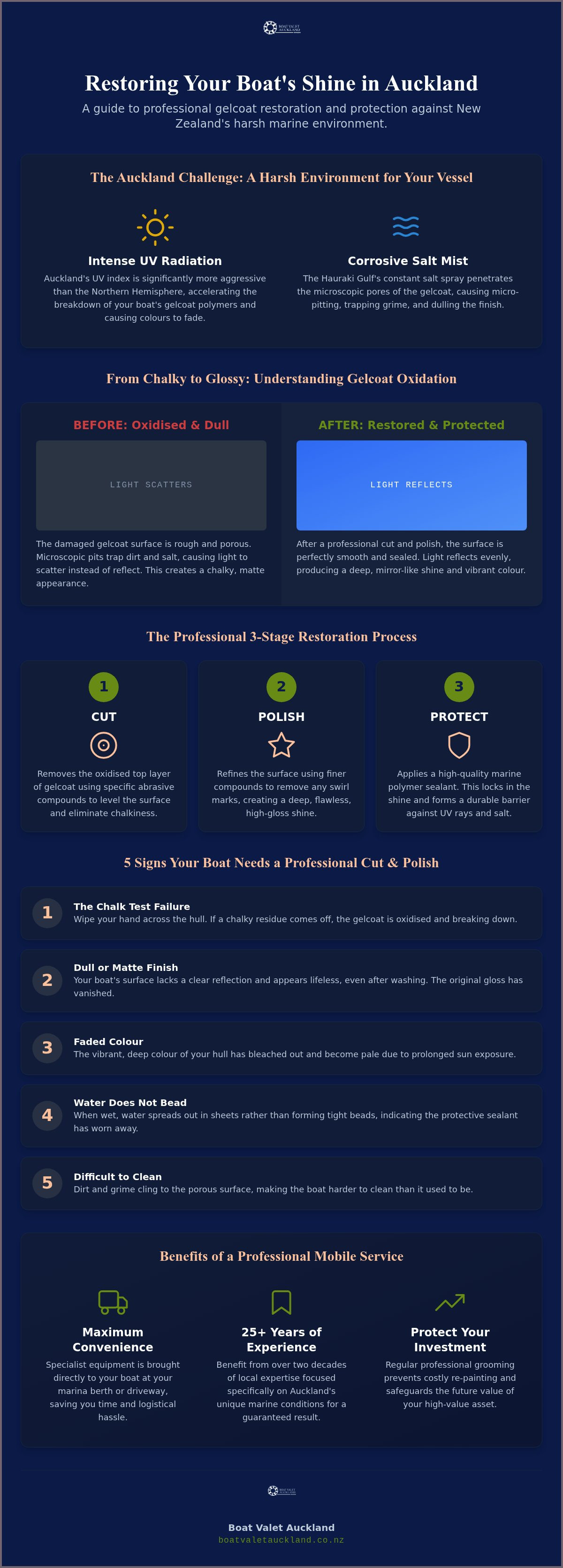
The "cut" stage: I use specific abrasive compounds and high-speed rotary buffers to level the surface. This removes the oxidation and shallow scratches that make the boat look aged.
The "polish" stage: This step refines the finish. It uses finer compounds to remove any "swirls" or "holograms" left by the cutting stage, resulting in a deep, wet-look shine.
The "wax/sealant" stage: Once the shine is restored, I apply a protective barrier. This locks in the results and prevents the pores from reopening to salt and UV rays.
This methodical approach ensures a finish that lasts through the season. It's the difference between a quick tidy-up and a genuine restoration of your vessel's value. By treating the gelcoat at a microscopic level, we provide a foundation for long-term protection.
Why Auckland Vessels Require Specialist Marine Polishing
Auckland presents one of the harshest marine environments on the planet. Our city's unique geographic position means vessels are subjected to a UV index that is significantly more aggressive than in the Northern Hemisphere. This intense radiation does more than just fade your boat's colour; it physically dismantles the polymers in your gelcoat. By 2026, weather patterns have become even more erratic, requiring a more robust approach to protection than in previous decades. A standard wax simply won't cut it. You need a mobile boat cut and polish Auckland specialist who understands how to build a resilient barrier against these specific local conditions.
Regular maintenance is a financial strategy as much as an aesthetic one. Once a gelcoat reaches the point of failure, it becomes porous and allows moisture to penetrate the laminate. This can lead to structural issues that are far more expensive to fix than a routine polish. Keeping up with a professional grooming schedule prevents the need for a full re-paint, which can cost tens of thousands of dollars. It is a proactive way to manage your investment while keeping the vessel looking its absolute best.
The Impact of the Hauraki Gulf Environment
The Hauraki Gulf is beautiful, but it is brutal on boat finishes. Marinas like Westhaven and Viaduct Harbour are constantly shrouded in a fine salt mist. This salt spray accumulates in the microscopic pores of the gelcoat, leading to micro-pitting. Over time, these pits act like tiny anchors for dirt and grime, making the boat harder to clean. Humidity is another silent killer for boat finishes in Auckland. Poor-quality waxes applied in damp conditions can trap moisture against the hull, leading to clouding or premature degradation of the finish. I only use marine-grade products specifically formulated for Southern Hemisphere conditions. These products bond at a molecular level, providing a hard-wearing shield that resists the abrasive nature of salt-air environments.
Asset Value and Resale Protection
A boat's exterior is the first thing a surveyor or potential buyer sees. In the NZ market, a well-maintained finish is a direct indicator of how the rest of the vessel has been treated. Investing in pre-sale boat grooming NZ is the most effective way to maximise your asking price and ensure a quick sale. Beyond the looks, a professional mobile boat cut and polish Auckland service prevents the chalking that leads to permanent damage. When gelcoat fails, it no longer sheds water effectively. This can lead to moisture ingress into the fibreglass, potentially causing osmosis or delamination. Protecting your asset now saves you from catastrophic repair bills later. If you want to ensure your vessel remains in peak condition, you can book a professional assessment with Steve Kellie today.
Mobile Boat Polishing: Convenience at Your Marina or Driveway
Moving your vessel to a boatyard is often the biggest hurdle to regular maintenance. It is time-consuming, expensive, and logistically challenging. My mobile boat cut and polish Auckland service removes this friction entirely. Whether your boat sits on a stacker, a marina berth, or your own driveway, the workshop comes to you. This level of convenience means you don't have to worry about transport logistics or the stress of towing through Auckland traffic. I bring the expertise and the equipment directly to your vessel's location.
The range of mobile service is fully adaptable. I handle everything from compact trailer boats in suburban driveways to large launches moored at Hobsonville Marina. For major projects that require a haul-out, I provide a 10% contribution towards haul-out fees at Hobsonville Marina. This unique incentive helps offset the costs of larger restoration jobs, making professional maintenance more accessible for owners of significant assets. I manage all water and power requirements on-site, ensuring the setup is safe, compliant, and efficient.
Servicing Auckland’s Premier Marinas
I regularly operate in Westhaven, Orakei, and Gulf Harbour. These premier locations have strict health, safety, and environmental regulations that must be followed. I handle all the necessary compliance and coordinate directly with marina management for seamless access. When you work with Steve Kellie, you get a professional who respects the marina environment. I ensure all power leads are tested and tagged, water usage is strictly controlled, and no harmful runoff enters the Hauraki Gulf. This professional approach protects your reputation with the marina as much as it protects your boat.
Trailer Boat Grooming at Home
Driveway detailing is the ultimate convenience for trailer boat owners. You can prepare your vessel for the summer season without ever leaving the house. This service goes beyond just the gelcoat. I also polish the trailer frame and all stainless steel fittings to ensure a uniform finish. A shiny hull often makes dull rails or a weathered trailer look worse. By treating the entire package at your property, you ensure your boat is truly showroom-ready for the next trip to the ramp. It is a hardworking, proactive way to maintain your vessel's value with zero downtime.
5 Signs Your Boat Needs a Professional Cut and Polish
Identifying when your vessel requires professional intervention is the only way to prevent permanent damage. Many owners assume a dull finish is just a natural part of a boat's aging process. It is actually a cry for maintenance. If you spot these signs, it is time to book a mobile boat cut and polish Auckland service to stop the degradation before it becomes a structural issue. Waiting too long often turns a simple restoration into a far more complex and costly project.
Watch for these five key indicators of gelcoat distress:
The Chalk Test: Run your hand across the hull. If your palm comes away with a white, powdery residue, your gelcoat is actively oxidising.
Loss of Reflection: A healthy boat should shine when it is dry. If your vessel only looks good when it is wet, the surface has become matte and porous.
Stubborn Waterlines: Scum lines or salt stains that won't shift with a standard wash mean contaminants have bonded to the compromised gelcoat.
Faded Colour: Darker hulls, particularly blue or black ones, will show cloudy or milky patches known as "ghosting."
Yellowing Fibreglass: When white gelcoat begins to yellow, it is a sign that the original UV inhibitors have completely dissipated.
The Chalky Gelcoat Warning
That white powder isn't just dried salt. It is actually dead gelcoat particles that have been bleached and physically broken down by the sun. Restoring a chalky finish with a mobile boat cut and polish Auckland specialist ensures this dead material is removed without compromising the structural integrity of the hull. If you leave this chalk on the surface for too long, the restoration becomes significantly harder. Eventually, the gelcoat may become too thin to safely cut. You should check your hull for this residue after every three months of sun exposure to stay ahead of the damage.
Faded Graphics and Stainless Steel
UV damage doesn't stop at the hull's surface. You will often notice vinyl decals and boat names becoming brittle or losing their vibrancy alongside a dull finish. There is also a direct relationship between a neglected hull and tea-staining on your stainless steel. As the gelcoat becomes porous, it traps salt more effectively, which then migrates to your rails and cleats. For a complete solution that covers every inch of your vessel, consider my full range of marine detailing services NZ. Don't let your investment fade away; contact Steve Kellie today for a professional assessment of your boat's finish.
Expert Marine Restoration with Boat Valet Auckland
Choosing a service for your vessel is about trust. Since 1998, Boat Valet Auckland has been led by Steve Kellie with a simple philosophy: personal accountability. When you book a mobile boat cut and polish Auckland, you aren't dealing with a faceless crew. You're working with an owner-operator who has spent over 25 years perfecting the art of marine grooming in local waters. I understand that every boat has a unique history. Whether it's a classic launch or a modern racer, the approach must be tailored to the specific condition of the gelcoat or paintwork. This is why my mobile boat cut and polish Auckland service remains the trusted choice for local boaties who value precision over speed.
My comprehensive service includes everything required to keep a vessel in peak condition. Beyond the cut and polish, I specialise in teak restoration, stainless steel polishing, and interior valets. I only use high-performance marine compounds that are proven to withstand the specific UV and saltwater challenges of the Hauraki Gulf. This commitment to quality ensures that the shine we achieve isn't just a surface-level fix, but a deep restoration that protects your asset for the long term. I invite you to book a free consultation to discuss your specific vessel goals and see how we can restore your boat's showroom shine.
A Personal Approach to Marine Grooming
Dealing directly with the owner ensures a level of quality control that larger companies often struggle to match. I personally oversee the work to ensure it meets my "look at every detail" mantra. This means I don't just buff the easy sections. I get into the corners, around the fittings, and across the transom where oxidation is often most stubborn. I believe that a partnership-based approach is the best way to find solutions for your boat. We don't just dictate a service. We listen to what you want to achieve, whether that's a pre-sale groom or a complete gelcoat overhaul.
We customise every project based on the boat’s age and current condition. A 20-year-old hull requires a different abrasive grade than a three-year-old vessel that just needs a seasonal refresh. This precision prevents unnecessary wear on your gelcoat while delivering the best possible aesthetic result. It's a hardworking, proactive attitude that values precision and long-term relationships over quick turnarounds.
Integrating Antifoul and Maintenance
A professional cut and polish is most effective when integrated into a broader maintenance plan. Most owners find it efficient to coordinate their topside restoration with their boat antifouling Auckland schedule. Having a single provider manage both the hull protection and the aesthetic finish simplifies the logistics. It ensures that the entire vessel, from the waterline to the flybridge, receives consistent care. This integrated approach is the most cost-effective way to preserve your vessel's value and performance. If you're ready to see your boat transformed, contact Steve Kellie today for a no-obligation quote. We'll organise a time to visit your vessel and provide a clear, practical plan for its restoration.
Protect Your Vessel for the Seasons Ahead
Auckland's marine environment is unforgiving, but your boat doesn't have to suffer the consequences. By identifying the early signs of gelcoat distress and acting before oxidation takes hold, you safeguard your investment. A professional mobile boat cut and polish Auckland service delivers the deep restoration required to combat our high UV levels and salt-air corrosion. This on-site approach removes the logistical headache of transport. It allows you to focus on enjoying the water instead of managing maintenance schedules.
Steve Kellie provides a personal, owner-operator service. It's backed by over 25 years of local industry experience. Whether your vessel has a modern painted finish or a classic gelcoat hull, the focus remains on precision and long-term protection. Don't wait for the next "chalky" layer to appear. It's time to restore that mirror-like shine and lock in a barrier that stands up to the Hauraki Gulf's toughest conditions.
Contact Steve Kellie at Boat Valet Auckland for a Free Quote today. We service all major Auckland marinas and private properties with a commitment to excellence. Let's get your boat ready for its next adventure.
Frequently Asked Questions
How long does a mobile boat cut and polish usually take?
The duration depends on the size of your vessel and the severity of the oxidation. A standard 7-metre trailer boat typically requires a full day for a thorough restoration. Larger launches or yachts moored at Auckland marinas can take three to five days to complete. As an owner-operator, I focus on precision rather than speed to ensure every inch of the hull is properly levelled and sealed. I provide specific timeframes during consultations.
Can a cut and polish remove deep scratches in the gelcoat?
A professional cut and polish is highly effective at removing surface scuffs, light scratches, and oxidation. However, it cannot repair deep gouges that have penetrated through the gelcoat into the fibreglass laminate. These require a specific gelcoat repair service to restore the structural integrity and colour match. During the assessment, I will identify which marks can be polished out and which require more intensive repair work to ensure your boat's finish is uniform.
Is it better to polish my boat in summer or winter in Auckland?
Most Auckland owners prefer a mobile boat cut and polish auckland service just before the summer season to ensure maximum UV protection. However, winter is actually an excellent time for restoration. The cooler temperatures allow marine compounds to work more effectively without drying too quickly. Having the work done in the off-season means your vessel is protected from winter moisture and is completely showroom-ready the moment the spring boating weather arrives.
Will a professional polish help my boat go faster?
Yes, a professionally polished hull can improve your vessel's performance. Oxidation creates a microscopically rough and porous surface that increases hydrodynamic drag as you move through the water. By smoothing the gelcoat to a mirror-like finish, we reduce this friction. This often results in a slight increase in top-end speed and better fuel efficiency. A slick, hydrophobic surface allows the hull to glide more easily, making your time on the water more economical.
How often should I have my boat professionally polished in NZ?
Given the extreme UV levels in New Zealand, I recommend a full professional cut and polish every twelve months. To maintain the shine and protection, you should apply a high-quality marine wax every three to six months. This regular maintenance cycle prevents the gelcoat from becoming porous and chalky. Proactive care is far more cost-effective than waiting for the finish to fail, which then requires a much more aggressive and expensive restoration.
Do you provide your own water and power for mobile grooming?
For most mobile boat cut and polish auckland jobs, I require access to a standard water tap and a reliable power outlet. When working at Auckland marinas like Westhaven or Gulf Harbour, I utilise the service pedestals provided at your berth. For driveway grooming, a standard garden tap and outdoor socket are perfect. I bring all my own industrial-grade hoses and heavy-duty, tested power leads to ensure the setup is safe and efficient.
What is the difference between a wax and a ceramic coating for boats?
Marine wax provides a traditional, deep gloss and is excellent for seasonal protection. It typically lasts three to six months before needing a top-up. Ceramic coatings create a semi-permanent chemical bond with the gelcoat, offering superior hardness and UV resistance that can last significantly longer. While ceramic is a larger initial investment, it provides a more durable shield against Auckland's harsh salt-air environment. I can help you choose the best option during our assessment.
Can you restore a faded blue or dark-coloured hull?
Dark-coloured hulls, such as navy blue or black, are particularly susceptible to Auckland's sun and often show "cloudiness" or milky patches very quickly. I specialise in restoring these surfaces using a multi-stage refinement process. This removes the white oxidation that masks the true colour of your boat. By following the cut with high-end marine sealants, we restore the deep, rich pigment of the hull and provide a barrier that prevents fading from returning.
Comments