
Best Antifouling for Auckland Harbour: 2026 Expert Guide
- Steve Kellie

- 11 minutes ago
- 12 min read
Auckland’s Waitematā Harbour is officially a fouling hotspot, and the generic maintenance advice that worked five years ago will leave your hull covered in barnacles by Christmas. With warmer water temperatures and nutrient-rich currents, the question of how often to antifoul boat Auckland owners must ask has become more critical than ever. You’ve likely noticed that growth in high-flow areas like Westhaven is getting more aggressive, whilst the 2026 EPA regulations have changed the rules on which biocides we can actually use. It’s frustrating to invest in a haul-out only to see your boat’s performance drop within months.
We understand that you want a clean hull for at least 12 to 18 months without the headache of constant scrubbing or unexpected costs. This expert guide provides the most effective antifouling solutions tailored specifically for the Hauraki Gulf’s unique conditions. You’ll discover which paints comply with the latest environmental standards, how to optimise your fuel efficiency, and the exact maintenance frequency required to protect your vessel. I’ve been working in Auckland shipyards since 1998, and I’m here to help you navigate these changes with practical, local advice that keeps your boat fast and your costs down.
Table of Contents
Why Auckland Harbour Requires Specific Antifouling Strategies
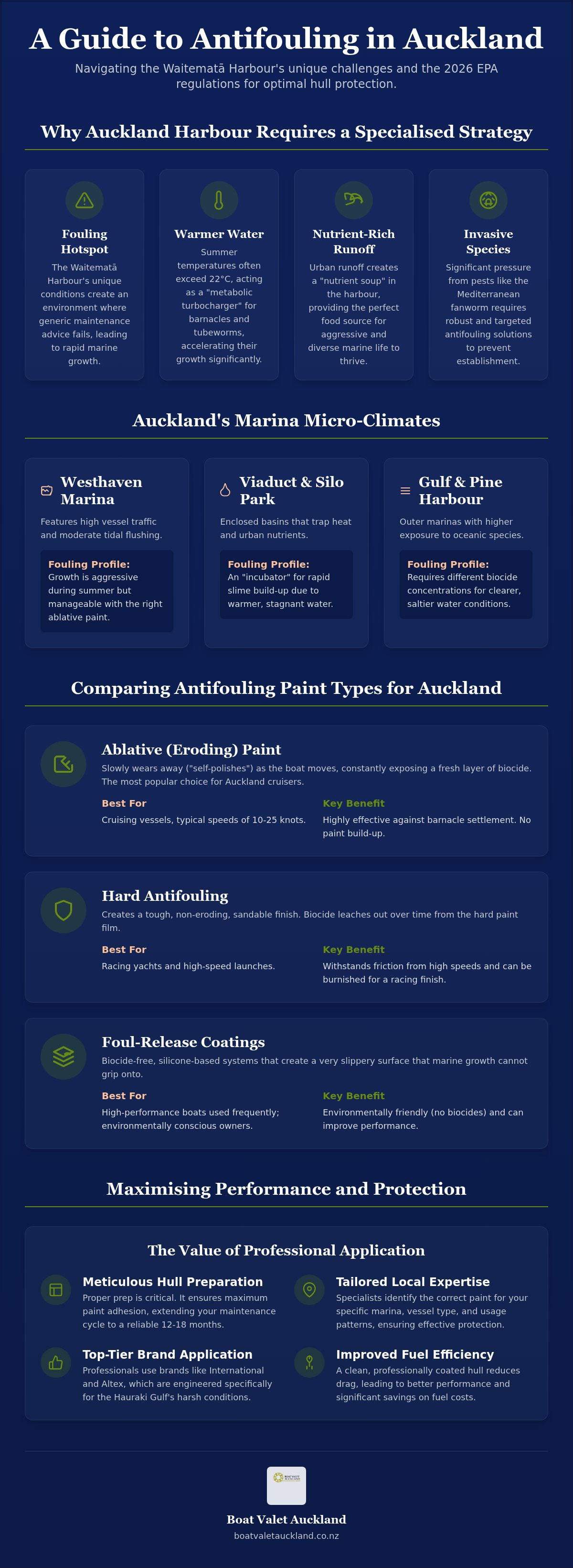
Auckland's Waitematā Harbour is a unique biological environment that demands more than just a standard paint job. The combination of warm summer peaks and nutrient-rich urban runoff creates a "nutrient soup" where marine life thrives. Generic products often fail here. If you're trying to determine how often to antifoul boat Auckland owners should expect, the answer is heavily dictated by these local variables. A hull that stays clean in the Marlborough Sounds will often be covered in barnacles within weeks in the Hauraki Gulf if the wrong strategy is applied.
To understand the challenge, it helps to know what is antifouling paint and how it interacts with our specific currents. In high-flow areas like Westhaven, the constant movement of water can cause eroding paints to wear away too quickly. Conversely, in stagnant basins, the lack of water movement prevents the paint from "self-cleaning," allowing slime to take hold. We also face significant pressure from invasive species like the Mediterranean fanworm. This pest requires robust marine antifouling Auckland requirements for 2026 to prevent it from establishing a foothold on your running gear.
The Impact of Water Temperature and Salinity
Auckland’s summer water temperatures often climb above 22 degrees, which acts as a metabolic turbocharger for marine growth. Barnacles and tubeworms grow significantly faster in these conditions compared to cooler southern waters. Salinity levels also fluctuate between the upper harbour and the outer Hauraki Gulf. Increased freshwater runoff in the upper harbour affects the leaching rate of your paint. This is why a "one-size-fits-all" product often fails to provide protection for the full 12 to 18 months that local boaties expect.
Auckland Marina Micro-Climates
Every marina in the region has its own fouling profile. I've seen hulls coming out of different piers in the same marina with completely different growth patterns. Your specific berth dictates how often to antifoul boat Auckland vessels under your care.
Westhaven Marina: Features high vessel traffic and moderate tidal flushing. Growth is aggressive during summer but manageable with the right ablative paint.
Viaduct and Silo Park: These enclosed basins trap heat and urban nutrients. The water is often several degrees warmer than the main channel, creating an incubator for rapid slime build-up.
Gulf Harbour and Pine Harbour: These outer marinas face higher exposure to oceanic species. Vessels here often require different biocide concentrations to handle the clearer, saltier water.
Understanding these micro-climates is the first step in choosing a protection system that actually works for your lifestyle. It keeps your hull fast and your fuel bills manageable.
Comparing the Best Antifouling Paint Types for 2026
Choosing the right coating determines how often to antifoul boat Auckland vessels need care. The market has shifted significantly due to the 2026 EPA biocide regulations, and what worked for your hull three years ago might not be the best choice today. We generally categorise modern coatings into four main groups, each behaving differently in the Hauraki Gulf’s nutrient-rich waters.
Ablative, or eroding paints, are the most popular choice for Auckland cruisers. These coatings are designed to wear away slowly as you move through the water. This "self-polishing" action constantly exposes a fresh layer of biocide, which is highly effective at preventing barnacle settlement. Hard antifouling, by contrast, creates a tough, sandable finish that doesn't erode. Racing yachts in the Royal New Zealand Yacht Squadron and high-speed launches favour this because it withstands the friction of high speeds without stripping off. Foul-release coatings represent the high-performance, biocide-free end of the spectrum. These silicone-based systems make the hull so slippery that growth simply can't grip. Finally, copper-epoxy systems like Coppercoat offer a multi-year solution, though they require meticulous application to survive Auckland's aggressive fouling environment.
Eroding vs Hard Antifoul: Which is Right for You?
Match your paint to your typical cruising speed. If your vessel usually travels between 10 and 25 knots, an ablative paint is typically your best bet. It prevents the heavy paint build-up that can cause "shelling" over several seasons. Hard paints are better suited for boats exceeding 30 knots or those that are regularly scrubbed by divers. Unlike eroding types, hard paints require wet-sanding between seasons to remove the exhausted outer layer. If you're tired of the DIY mess, I can organise a professional antifouling service that handles the preparation and application whilst you stay at the office.
Eco-Friendly and Biocide-Free Alternatives
New Zealand's 2026 environmental standards have tightened the rules on copper and zinc leaching. Staying compliant with New Zealand's biofouling requirements is now a legal necessity for all boaties. Silicone foul-release coatings are an excellent eco-friendly alternative, but they aren't "set and forget." In Auckland’s high-slime waters, these coatings often require more frequent professional grooming. Without the chemical punch of traditional biocides, they rely entirely on their physical slipperiness. If your boat sits idle in a warm basin like the Viaduct for too long, even the slickest silicone can struggle without a regular cleaning schedule.
Top Antifouling Brands Recommended for Auckland Waters
Selecting a premium brand is the most effective way to manage how often to antifoul boat Auckland schedules. I've spent over 25 years observing how different formulations hold up against local growth in marinas from Gulf Harbour to West Harbour. The brands we recommend comply with the International Convention on the Control of Harmful Anti-fouling Systems. This ensures your vessel meets global environmental standards whilst maintaining a clean hull in our sensitive marine ecosystems. Not all paints are equal; some are designed for the open ocean, while others are perfected for the specific "nutrient soup" of the Waitematā.
International Paint and Altex dominate the local market for good reason. They've invested decades into testing their biocides in New Zealand conditions. However, commercial-grade options like Jotun are now gaining traction amongst larger Auckland yachts that require maximum durability between haul-outs. We also consider Propspeed an essential addition to any maintenance plan. It remains the industry standard for protecting propellers and running gear, ensuring your vessel doesn't lose speed to calcified growth on the shaft or blades.
International Micron Series: The Auckland Staple
International Paint's Micron series is a reliable heavyweight in Auckland marinas. Micron 66 is particularly effective for vessels that remain in the water year-round. It uses a sophisticated self-polishing copolymer technology that performs exceptionally well in high-slime areas like Westhaven and the Viaduct basins. When it's time for your next haul-out, Micron is famously easy to re-coat, which reduces the labour time required for preparation. International Paint remains the global benchmark for biocide technology, consistently delivering the most reliable protection against Auckland's aggressive slime and barnacle settlement.
Altex No. 5: The Local Contender
Altex No. 5 is the local favourite for many Kiwi boaties. It’s engineered specifically for the barnacle species and marine life found in the Hauraki Gulf and the Waitematā. For many owners, it offers a high level of protection without the premium price tag of some European imports. It’s highly compatible with most existing coatings, making it a versatile choice for my mobile maintenance sessions at Auckland shipyards. If your boat is a regular cruiser that spends weekends in the Gulf, Altex No. 5 provides a robust barrier that stands up to our local conditions. Using a product designed for our specific water chemistry often yields better results than a generic global formulation.
Choosing between these brands depends on your boat's usage and where it’s berthed. A boat sitting in the still, warm waters of the Viaduct has different needs than one regularly crossing the Tiritiri Channel. I can help you weigh these options to ensure your hull stays clean and efficient until your next scheduled maintenance.
Maximising Performance: Preparation and Maintenance Tips
Applying the best paint is only half the battle. If you want to extend how often to antifoul boat Auckland cycles, you need to focus on what happens before the roller touches the hull. Preparation determines 90% of your final result. Without a clinical approach to cleaning and sanding, even the most expensive biocide will peel or fail prematurely. I’ve seen countless DIY jobs where the owner skipped the hard work, only to find barnacles taking hold within three months.
Managing a haul-out is often the most stressful part of vessel ownership. I coordinate directly with Auckland shipyards to provide a seamless mobile service. Whilst your boat is on the hardstand, I handle the project management so you don't have to. This includes a thorough inspection for hull blistering or osmosis, which must be treated before any new coating is applied. We also look at the topsides. A professional Boat Cut and Polish prevents chalky runoff from contaminating your fresh antifoul, a common issue that many boaties overlook.
The Importance of Hull Preparation
We start by removing the "dead" layer of exhausted paint. This ensures a proper chemical bond for the new coat. Skipping this step leads to "shelling," where layers of old paint flake off and create an uneven surface that increases drag. Precision masking is also non-negotiable. It creates a crisp, clean waterline that defines the aesthetic of a well-maintained vessel. A tidy finish isn't just about looks; it shows that every centimetre of the hull has been properly sealed against the Waitematā's aggressive fouling.
Propspeed and Running Gear Care
Never ignore the metal components of your vessel. Standard antifouling paint doesn't stick to propellers or shafts and will usually fly off the moment you engage the engine. Propspeed is the industry standard for a reason. It’s a foul-release coating that makes metal surfaces too slippery for marine growth to attach. During the mobile application process, we also ensure your anodes are replaced. This is your primary defence against galvanic corrosion in Auckland’s marinas, where stray current can quickly eat away at your running gear if left unprotected.
Finally, consider mid-season grooming. A light professional clean every six months can extend your antifoul life significantly. It removes the initial biofilm or "slime" before it becomes a home for larger organisms. This proactive approach keeps your vessel fast and fuel-efficient until your next scheduled haul-out.
Why Professional Mobile Antifouling Beats DIY in Auckland
Attempting a DIY antifoul often seems like a cost-saving measure, but it frequently leads to expensive rework. The physical labour is gruelling, and the health risks associated with sanding biocides are significant. When you're calculating how often to antifoul boat Auckland vessels, remember that a professional application typically lasts months longer than a weekend DIY job. I've been managing these projects since 1998. I know exactly how to prep a hull so the paint stays on and the barnacles stay off.
The real value lies in the convenience. I coordinate with the shipyard and handle the entire mobile maintenance programme whilst you're at work. There's no need for you to spend your weekends in a dusty shipyard. We also offer a holistic finish. By combining your hull protection with a professional boat cut and polish, we ensure that chalky oxidation from your topsides doesn't wash down and neutralise your fresh antifoul. This integrated approach is something most DIYers simply don't have the equipment or time to achieve.
Professional application also prevents the nightmare of "paint flake." Over several seasons of poor DIY layering, paint becomes brittle and starts to shell off. Fixing this requires a full hull strip back to the gelcoat, which is a massive, multi-thousand-dollar expense. We apply the right thickness and the right chemistry the first time to avoid these long-term headaches.
The Boat Valet Auckland Difference
I operate as an owner-operator, which means I'm on-site and directly accountable for every hull I touch. You aren't dealing with a faceless corporation or a revolving door of junior staff. My deep integration with Auckland's major marinas and shipyard facilities ensures a hassle-free experience for you. We take a complete view of your vessel’s health, from the waterline down to the running gear, ensuring every component is protected for the season ahead.
Protecting Your Investment
A clean, smooth hull isn't just about speed; it's about protecting your asset's value. If you're looking at the market, a well-maintained hull and polished topsides significantly increase your chances of a quick sale. Our pre-sale grooming guide highlights how first impressions at the marina can make or break a deal. Beyond resale, the fuel savings from a clean hull are immediate. A fouled bottom can increase fuel consumption by 20% or more, making professional maintenance the most cost-effective decision you'll make this year.
Ready for a cleaner hull? Contact Steve at Boat Valet Auckland for a quote today and let's get your vessel back to peak performance.
Secure Your Hull’s Performance for the Season Ahead
Auckland's waters aren't getting any easier on your hull. Between the aggressive barnacle growth in Westhaven and the new 2026 EPA regulations, your maintenance strategy needs to be precise. We've seen that the question of how often to antifoul boat Auckland owners face depends entirely on matching the right biocide technology to your specific marina's tidal flow. Generic advice simply doesn't cut it in the nutrient-rich environment of the Hauraki Gulf.
Don't leave your vessel's performance to chance with a rushed DIY job. Professional application ensures you avoid the long-term costs of paint failure and expensive hull stripping in the future. I’ve been serving Auckland boaties since 1998, providing a mobile service at Westhaven, the Viaduct, and Hobsonville. As specialists in both hull protection and aesthetic detailing, we manage the entire project whilst you stay at the office. Take the stress out of your next haul-out and ensure your boat remains fast and fuel-efficient.
Get an Expert Antifouling Quote from Steve Kellie and enjoy the peace of mind that comes with a professionally maintained vessel. Your hull is in safe hands.
Frequently Asked Questions
How often should I antifoul my boat in Auckland Harbour?
In Auckland's nutrient-rich waters, most vessels require fresh protection every 12 to 24 months. The exact frequency of how often to antifoul boat auckland depends on your specific marina and vessel usage. Boats berthed in high-flow areas like Westhaven or those that remain stationary through the warm summer months often need attention closer to the 12-month mark to prevent aggressive barnacle settlement and maintain hull efficiency.
Can I apply new antifouling over the old paint?
You can apply new antifouling over old paint if the existing layer is stable and compatible. We first perform a high-pressure water blast to remove the exhausted "dead" layer and any biofilm. If the old paint is flaking or "shelling," we must sand it back to a sound surface. Applying fresh biocide over a failing substrate is a waste of resources; it will eventually peel and leave your hull exposed.
What is the best antifouling for a boat that sits in Westhaven Marina?
Westhaven is a high-fouling environment with significant tidal movement, so premium ablative paints are generally the most effective choice. Products like International Micron 66 or Altex No. 5 are engineered to handle these specific Auckland conditions. These self-polishing coatings ensure a fresh layer of biocide is always active. For vessels berthed here, we recommend a robust two-coat application with an extra "belt" around the waterline where light encourages growth.
Is Propspeed worth the extra cost for my propeller?
Propspeed is absolutely worth the investment because standard antifouling cannot withstand the centrifugal forces of a spinning propeller. It is a specialised foul-release coating that creates a super-slick surface, preventing barnacles from bonding to the metal gear. This maintains your engine's efficiency and prevents the vibration caused by unbalanced, fouled blades. Without it, you will likely lose several knots of speed and burn significantly more fuel during the season.
How long does a professional antifouling service take?
A standard professional service typically requires two to four days on the hardstand. This timeframe allows for thorough preparation, drying, masking, and the application of multiple coats with the correct drying intervals. If we are also performing a professional boat cut and polish or replacing anodes, we coordinate these tasks to fit within your scheduled haul-out. Our mobile service organises these timelines with the shipyard to ensure your vessel spends minimal time ashore.
Are there any "copper-free" antifouling options that actually work in NZ?
Silicone-based foul-release coatings are the most effective copper-free alternatives currently available in New Zealand. These products don't use biocides to kill marine life; instead, they make the hull too slippery for organisms to attach. They perform exceptionally well on high-speed vessels that are used regularly. However, they do require a different maintenance approach, often needing more frequent professional grooming to remove the light slime that can accumulate whilst berthed in Auckland basins.
What happens if I don’t antifoul my boat for two years?
Skipping your maintenance for two years in Auckland usually results in heavy barnacle and tubeworm infestation. This growth creates massive drag, which can increase your fuel consumption by over 20% and put unnecessary strain on your engines. In some cases, invasive species like Mediterranean fanworm can settle, leading to biosecurity issues. The cost of the extra fuel and the eventual heavy scrape-back far outweighs the price of regular, professional antifouling maintenance.
Do I need to replace my anodes every time I antifoul?
You should replace your sacrificial anodes every time the boat is hauled out for antifouling. Anodes are designed to corrode so your expensive running gear doesn't. If an anode is more than 50% depleted, it will not last another full season in the water. Auckland's marinas often have stray electrical currents that accelerate this corrosion. Replacing them during your biennial maintenance is the only way to ensure your shafts and propellers remain protected.
Comments