
New Boat Commissioning in Auckland for Commercial Vessels

A commercial vessel can be complete at launch and still need careful commissioning before it is ready for work. In Auckland, commissioning brings the finished build, its systems and intended role together through practical checks and handover. New boat commissioning detail in Auckland matters most when a workboat must serve more than one purpose.
It’s natural to focus on the build itself, but the transition from construction to service is where operational requirements meet the vessel as delivered. This guide explains how new boat commissioning detail in Auckland supports commercial vessel construction and multi-purpose workboat projects, what the process covers, and how presentation and ongoing care contribute to preparing a boat for service. You’ll get a clearer picture of the steps that help align a new vessel with the work it was built to do.
Table of Contents
Which Auckland boatyards and marine service providers offer commissioning?
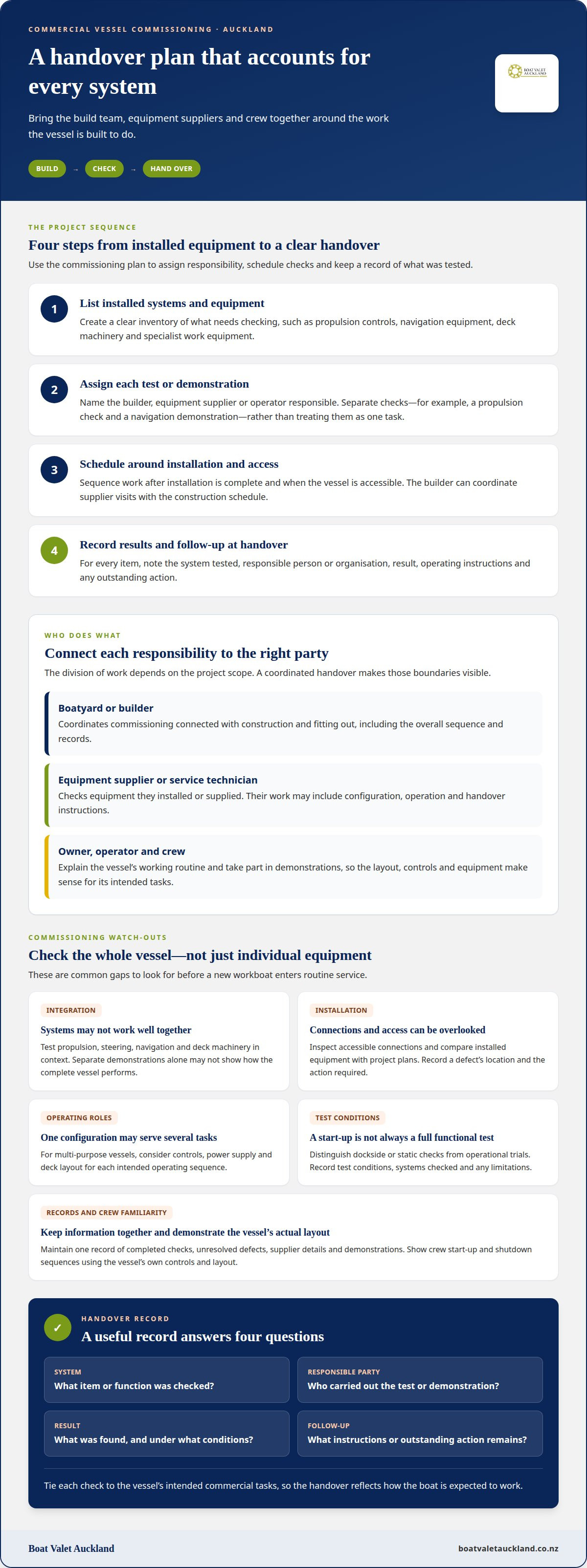
For a commercial vessel in Auckland, commissioning is usually a coordinated handover, not a single task. The boatyard or builder manages work connected with the completed build, while specialist suppliers handle equipment they installed or supplied. The division of responsibility depends on the project scope. Propulsion controls, navigation equipment and deck machinery may involve different teams, so the commissioning plan should name who is responsible for each.
Start with the build contract and handover scope. These documents show whether commissioning is included, which tests are planned, and who records the results. For example, the builder may coordinate an initial systems run while an equipment supplier checks its own control unit. Written responsibilities help prevent gaps, such as the yard assuming an item is complete when its supplier expects to test it separately.
Auckland boatyards are central to commissioning that requires access during construction or fitting out. The build team can sequence the work: complete installation, inspect connections, power up systems, then record outstanding items. For a multi-purpose vessel, the sequence should reflect its operational roles. A dive-support boat, for instance, needs its installed work equipment considered alongside propulsion, steering and onboard controls.
Marine equipment suppliers and their service technicians check the systems they install or supply. Their work may cover installation, configuration, operation and handover instructions for that equipment. The builder coordinates these visits with the vessel’s construction schedule. A clear commissioning record identifies the system tested, the person or organisation responsible, the result and any follow-up action.
The vessel’s owner, operator and crew may also contribute. Their input matters because a commercial boat must suit its intended work, not merely operate at the wharf. An operator can explain how deck access, storage and controls fit the working routine. The builder and relevant suppliers can then address practical questions during demonstrations and handover. This is especially useful when a vessel has several roles or changes equipment between tasks.
Use the commissioning plan to map responsibilities instead of relying on a general promise that the boat is ready. A useful project sequence is:
List the vessel’s installed systems and equipment.
Assign each test or demonstration to the builder, supplier or operator.
Schedule checks around installation completion and access to the vessel.
Record results, operating instructions and follow-up work at handover.
For example, a propulsion check and a navigation equipment demonstration are separate activities, even if both happen before handover. Recording each one separately makes the status of each system easier to understand. Apply the same approach to deck machinery and specialist work equipment. Tie each record to the installed item, the responsible party and the relevant handover notes.
For new boat commissioning detail in Auckland, the most useful provider is the party responsible for the specific work, supported by a builder coordinating the overall sequence. A boatyard may lead the process, with specialist suppliers and the operator taking defined roles. Before construction is signed off, make sure the handover plan links those roles to the vessel’s intended commercial tasks.
Auckland boatyards and builders handle commissioning connected with construction and fitting out. Marine equipment suppliers and their service technicians check and commission the systems they install or supply.
What are common commissioning problems and risks for new boats?
Commissioning problems often arise where separate installations need to work together. On a commercial workboat, propulsion, steering, navigation equipment and deck machinery may each work correctly alone but interact poorly. A control display, for example, might not show the expected information. A structured test sequence can expose these issues before the vessel enters routine service.
Incomplete installation checks are another source of trouble. A connection may be loose, a cable poorly routed or a fitting difficult to access once surrounding equipment is installed. These issues can be awkward to diagnose later. During commissioning, inspect accessible connections and compare installed equipment with the project plans. Record defects clearly, including their location and the action required.
Systems integration deserves particular attention on multi-purpose vessels. A workboat configured for transport and dive support, for instance, may have different equipment requirements for each role. Controls, power supply and deck layout need to suit the intended operating sequence. Test each relevant function in context, rather than treating separate equipment demonstrations as proof that the complete vessel works as intended. Just as commercial operators coordinating shore-side logistics turn to vehicle conversion specialists like Nafaa Cars to adapt transport for specific operational demands, multi-purpose workboat teams must verify that all bespoke equipment integrates seamlessly into their working routine.
Testing in unsuitable conditions can also give a misleading result. A dockside demonstration may show that an item powers up, but not how it performs during the vessel’s intended operation. Where practical, distinguish static checks from operational trials in the commissioning plan. Record the conditions, systems tested and any limitations, so the handover does not confuse a basic start-up with a full functional test.
Gaps in documentation create problems after handover. If operating instructions, system settings and outstanding tasks are scattered across emails, the operator may struggle to find the right information. Keep one record of completed checks, unresolved defects, supplier details and demonstrations. For example, note which control was tested and where its operating guidance can be found. This gives the crew a useful reference when questions arise.
Training matters just as much. A new vessel may have familiar equipment arranged in an unfamiliar way. If crew members have not practised start-up and shutdown sequences, they may miss a step or misread an alarm. Arrange demonstrations around the vessel’s actual layout. Cover normal operation, routine shutdown and what to do if a system behaves unexpectedly.
Finish and surface issues can be overlooked when attention is focused on machinery. Construction dust, residue or scuffs may affect painted areas, windows or interior surfaces. A final visual inspection helps distinguish cosmetic defects from functional problems and gives the build team a clear close-out list. Keep surface preparation and protection separate from machinery commissioning, but coordinate both before handover.
A practical risk review can group problems by the action they require:
Installation: inspect connections, cable runs and access to service points.
Integration: test related equipment together in its intended working sequence.
Operation: demonstrate controls and record crew questions during handover.
Close-out: document defects, responsible parties and completed follow-up work.
For a new vessel, this record makes it easier to distinguish an unresolved commissioning issue from a later maintenance need. It also helps the operator explain a fault precisely, using the system name and observed behaviour instead of a general description. For appearance-related follow-up, arrange care for the vessel’s finish as a separate part of preparing the boat for service.
Public displays can offer context, but they do not replace commissioning aboard the intended vessel. More than 200 boats are on display on land and water at the Auckland Boat Show. The Auckland Boat Show has 30 boats available to sea trial. The 2024 Auckland Boat Show displayed 400 boats and features more than 1.3km of boats on the water.
Boat Valet Auckland
Boat Valet Auckland is a practical next step when commissioning is complete and the vessel needs presentation or surface care before entering service. Mechanical and systems commissioning are separate; grooming focuses on the boat’s finish, exterior and interior.
Choose work to suit the vessel’s condition and intended use. Antifouling supports hull maintenance, while Boat Cut and Polish refreshes exterior surfaces. Teak Restoration focuses on teak areas, and Interior Valet prepares cabin spaces for crew or passengers. Schedule these services as part of handover preparation or when the boat needs attention after initial operation.
For a commercial vessel, a clean, well-presented finish supports a professional first impression without replacing operational checks. Contact Boat Valet Auckland to discuss the care your vessel needs.
Prepare the vessel for its next stage
As technical handover progresses, plan presentation and surface care separately as part of preparing the vessel for work. New boat commissioning detail in Auckland should keep operational checks distinct from finishing tasks while allowing time for both in the project schedule.
Boat Valet Auckland provides Boat Cut and Polish for exterior surfaces, Antifouling for hull care, and Teak Restoration for teak areas. These services address the vessel’s appearance and upkeep without replacing commissioning checks or equipment testing. Choose the work that suits the boat’s condition and stage of preparation.
Give your vessel a considered finish as it moves towards service. Contact Boat Valet Auckland to discuss its care, and take the next step with confidence.
Frequently Asked Questions
What does new boat commissioning include in Auckland?
New boat commissioning in Auckland brings together the checks, demonstrations and handover tasks agreed for the vessel. The scope may cover installed equipment operation, control familiarisation, outstanding build items and records for the operator. A commercial boat may need different checks from a recreational vessel because its working equipment and roles differ. Treat exterior grooming and antifouling as separate care tasks, not substitutes for technical commissioning.
What steps are involved in commissioning a new boat before launch?
Before launch, commissioning usually progresses through installation completion, inspection, system testing and handover preparation. The build team can identify unfinished work and confirm equipment is ready for testing. Relevant suppliers then demonstrate their installed systems, and the operator can learn the controls and normal procedures. Record defects and follow-up actions before handover. The project plan determines which checks happen ashore and which require the vessel to be afloat.
How long does new boat commissioning take in Auckland?
Commissioning time depends on the vessel’s equipment, the scope of its tests and whether checks uncover work that needs correction. A straightforward handover with accessible systems differs from one involving a multi-purpose workboat, several suppliers and specialist equipment. Scheduling also depends on when installations are ready and when the vessel can be tested. The project programme should show the expected sequence and how outstanding work affects handover.
What sea trials and systems checks are included in boat commissioning?
Sea trials and systems checks depend on the vessel’s equipment and the agreed commissioning scope. They can assess how propulsion, steering, navigation displays and installed work equipment operate, including how related controls function together. A test record should identify the item, the check performed and any issue needing attention. For example, recording an alarm response separately from a general start-up demonstration gives the operator more useful information.
What information should buyers confirm with the boat dealer before commissioning?
Before commissioning, buyers should establish what the agreed scope covers, who coordinates each supplier and which records will be handed over. Clarify how defects are recorded and followed up, what demonstrations the operator receives, and which equipment manuals or operating instructions are provided. For a commercial vessel, describe its intended tasks and ask how the planned checks relate to them. This makes responsibilities and handover expectations clear.
Comments