
How to Fix Dull Faded Gelcoat and Bring Back Its Shine

A dull finish isn’t always just a polishing problem: if chalk transfers to your hand when you wipe the surface, the gelcoat is oxidised. To fix dull, faded gelcoat, wash away dirt and residue, then use compound and polish suited to the level of oxidation, followed by protection. The key is matching the treatment to the surface rather than reaching for the strongest product first.
It’s frustrating to see a boat’s colour look flat and chalky, especially after cleaning. The right approach depends on the gelcoat’s condition: light fading and surface stains call for a gentler method than heavy oxidation.
This guide explains what causes a faded look, how to choose a restorer, and when to use cleaner-wax, compound or polish. You’ll also learn how to prepare the surface and protect the finish, helping you decide whether to tackle the work yourself or arrange professional restoration in Auckland.
Table of Contents
Applying polish after the restorer dries
To limit renewed fading in New Zealand’s UV and marine conditions, keep the gelcoat clean and maintain a compatible protective finish. For a boat stored outdoors, wax at least twice a year, as it may last only a few months.
Let the restorer dry fully. Follow its label before applying polish or another coating. For example, Marine Polytrol is a restorer; use it according to its directions, then make sure the surface is ready for the next product. Don’t assume every restorer needs the same drying time.
Apply polish in manageable amounts. Work with about 2 tablespoons of compound, polish or wax at a time, rather than loading the pad. For wax, about a tablespoon on the pad is a useful starting amount. Spread it evenly and follow the product directions.
Keep the tool controlled. Use a polishing speed between 1,000 and 1,200 rpm, and work steadily without holding the pad in one place. A rotary buffer can continue spinning for several seconds after switch-off, so keep it clear of the surface until it stops. Wear gloves and eye protection when handling compounds.
Choose one protection system. Acrylic sealer can be applied in four initial coats, with at least 30 minutes of drying time between coats. Reapply it at least once a year. If using ceramic sealant instead, follow its preparation and curing instructions, and don’t layer it with another coating unless the product directions allow it.
Finish with clean materials and regular care. Use a clean polishing cloth, such as a 6-inch by 6-inch square, to avoid dragging residue across the gelcoat. If waxing a boat kept outdoors, repeat the application at least twice a year; wash off salt and grime between treatments so the finish stays clean.
Choosing a gelcoat restorer
Set your DIY budget by the work involved. In New Zealand, the cost depends on the products and tools you need, the area to treat and the oxidation’s severity. Reusing a suitable buffer can reduce what you need to buy; heavy oxidation may call for compound, pads and additional finishing products. If you’re deciding how to fix dull faded gelcoat, start by assessing the surface before buying supplies.
Gather the basic materials first. You’ll need a gelcoat restorer or rubbing compound, a buffer, suitable wool or foam pads, clean microfibre cloths, gloves and eye protection. Add wet-and-dry abrasive paper if smooth gelcoat needs sanding. Choose products made for boat surfaces and follow their labels.
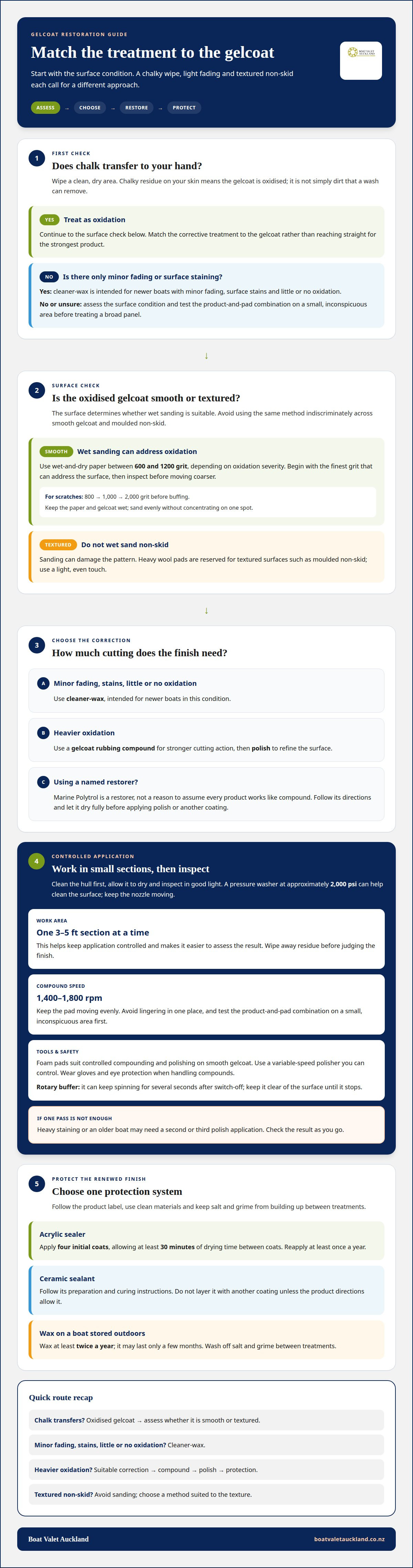
Match the product to the finish. Cleaner-wax is intended for newer boats with minor fading, surface stains and little or no oxidation. For heavier oxidation, use a gelcoat rubbing compound, then polish to refine the surface. Marine Polytrol is another named restorer; follow its directions rather than assuming it works like compound. The best way to fix dull faded gelcoat depends on choosing a treatment suited to the actual condition.
Choose the pad for the surface. Foam pads suit controlled compounding and polishing on smooth gelcoat. Wool pads cut more aggressively, so reserve them for appropriate surfaces and use a light, even touch. Wet sanding is recommended for smooth oxidised gelcoat, while heavy wool pads are reserved for textured surfaces such as moulded non-skid.
Select a buffer you can control. A variable-speed polisher lets you adjust the tool to the product and surface. Keep the pad flat, work steadily and avoid lingering in one spot. Test the product-and-pad combination on a small, inconspicuous area before treating a broad panel.
If your boat also needs attention to its timber, explore teak restoration as a separate part of its upkeep.
Compound and polish for oxidised gelcoat
Use a staged process to restore oxidised gelcoat without removing more material than necessary: clean, assess, sand only where needed, then compound and polish.
Clean and wet sand the gelcoat
Wash the hull to remove dirt and chalky residue before treatment. A pressure washer at approximately 2000 psi can help clean the surface, but keep the nozzle moving. Let the gelcoat dry, then inspect it in good light. Wet sanding can address oxidation on smooth gelcoat; avoid sanding textured non-skid because it can damage the pattern.
Choose sandpaper grit
For oxidised gelcoat, select wet-and-dry paper between 600 and 1200 grit, depending on oxidation severity. Begin with the finest grit that can address the surface, then inspect your progress before moving coarser. For scratches, use 800-, 1,000- and 2,000-grit paper in sequence before buffing. Keep the paper and gelcoat wet, and sand evenly without concentrating on one spot.
Choose rubbing compound or polish
Choose rubbing compound for stronger cutting action, then use polish to refine the finish. Cleaner-wax suits newer boats with minor fading, surface stains and little or no oxidation. Follow the product directions and use formulations intended for gelcoat. Knowing how to fix dull, faded gelcoat means matching the product’s cutting strength to the surface, not simply choosing the most abrasive option.
Remove oxidation from small hull sections
Work on one 3-5 ft section at a time, so you can control application and assess the result. Use a polisher between 1,400 and 1,800 rpm for rubbing compound, keeping the pad moving evenly. Wipe away residue before judging the finish. For heavy staining or an older boat, a second or third polish application may be needed. A controlled test patch helps show how to fix dull faded gelcoat across the remaining hull.
Causes of faded and chalky gelcoat
Check for oxidation before choosing a treatment. Wipe a clean, dry area with your hand. If chalky residue transfers to your skin, the gelcoat surface is oxidised. This powder forms as the outer layer breaks down, rather than simply collecting dirt. A wash can remove grime, but it won’t reverse oxidation.
Look at the boat’s sun exposure. Ultraviolet radiation gradually degrades the surface, reducing its gloss and making colour appear flat. One boat owner reported that a finish dulled after the boat sat in the sun for about three years. That example shows how prolonged exposure can matter; it isn’t a fixed timetable for every boat.
Consider the marine environment and care routine. Sun, salt, weather and repeated wetting can all contribute to a tired-looking finish. Dirt and salt deposits can also obscure the surface, so wash the gelcoat before judging its condition. If the chalky transfer remains after cleaning, oxidation is a stronger explanation than surface grime alone.
Distinguish fading from damage. A uniformly dull panel may point to oxidation, while isolated marks can come from scratches, stains or uneven product application. Inspect the whole area in good light and compare affected sections with a less-exposed part of the boat. This helps you avoid treating a stain as widespread oxidation.
Match the cause to the next step. Light fading and surface stains call for a less aggressive approach than heavy oxidation. Chalk on your hand signals that the finish needs corrective care, not just another coat of wax. Don’t use oil or petroleum jelly to disguise dullness: it can hide the damage temporarily and add preparation work if the gelcoat is painted later.
Boat Valet Auckland: Boat Cut and Polish
Boat Valet Auckland provides Boat Cut and Polish for owners dealing with dull, oxidised gelcoat or a finish that needs careful attention. It’s a practical option when the affected area is extensive, the surface is difficult to treat evenly, or you’d rather leave the corrective polishing to an experienced marine grooming team. The mobile service works at marinas and private properties across Auckland.
A cut and polish addresses the boat’s exterior finish, with treatment tailored to the gelcoat’s condition. If other areas need attention, Boat Valet Auckland also offers Antifouling, Teak Restoration and Interior Valet as separate services.
For help deciding whether Boat Cut and Polish suits your boat, contact Boat Valet Auckland or visit boatvaletauckland.co.nz.
Choose the right next step for your boat
Make a practical decision based on the gelcoat’s condition and the work you’re comfortable doing. A small, manageable area may suit a careful DIY approach; extensive oxidation or an uneven finish can make professional polishing the simpler route. Knowing how to fix dull, faded gelcoat starts with assessing the surface honestly, then choosing treatment that won’t add unnecessary abrasion.
Think beyond the immediate shine, too. A consistent care routine helps you spot renewed chalkiness early and address it before the finish becomes harder to restore. If the hull needs more than a light refresh, Boat Valet Auckland offers Boat Cut and Polish to restore the exterior finish.
Take the next step at a pace that suits your boat and your plans. Contact Boat Valet Auckland about Boat Cut and Polish, and move towards a cleaner, brighter finish with confidence.
Frequently Asked Questions
How do you restore dull, faded gelcoat on a boat?
Restore dull, faded gelcoat by correcting the surface first and checking the result before applying protection. Clean a small test area, let it dry, then compare it with surrounding panels in consistent light. If the colour improves but scratches or pits remain, polishing hasn’t repaired physical damage. Treat each panel consistently and remove product residue before applying a protective coating.
How can you tell whether faded gelcoat needs polishing or repainting?
Polishing can improve a surface that looks dull but remains intact; repainting or repair may be needed where the coating is damaged. Inspect for cracks, chips, deep gouges or exposed underlying material, not just colour loss. Try a small test area first. If its gloss returns but defects remain visible, polishing alone won’t replace missing material, so assess the damage before choosing a finish.
Which gelcoat compounds, polishes and waxes work best, and how do they compare?
Choose products by their purpose: compound cuts through surface oxidation, polish refines the finish, and wax or sealant provides protection. Cleaner-wax combines cleaning with a protective layer, so it suits light surface work rather than substantial correction. Check the label for gelcoat compatibility, then test the complete product combination on a discreet patch before treating the whole boat.
What safety precautions are needed when sanding and polishing gelcoat?
Wear gloves and eye protection when handling abrasive products, and clear the work area before starting a buffer. Keep control of the tool, its pad away from loose clothing and cables, and wait for it to stop before setting it down. Disconnect the machine before changing pads. Work steadily and avoid prolonged pressure on one part of the hull.
How much does DIY gelcoat restoration cost in New Zealand?
DIY costs in New Zealand depend on the products and tools needed, the area being treated and the severity of oxidation. Reusing a suitable buffer can reduce what you need to buy, while heavy oxidation may require compound, pads and additional finishing products.
Comments