
Eco-Friendly Boat Cleaning in Auckland: How to Choose Products That Work

The bottle with the greenest label isn’t automatically the best cleaner for your boat or the gentlest choice for the water around it. For eco-friendly boat cleaning auckland, the practical test is whether a product has credible environmental evidence, suits the surface and task, and can be used without careless runoff.
Labels often use broad terms such as “green” or “biodegradable”, which can make it hard to compare products. A cleaner suited to gelcoat may not be right for teak, glass or stainless steel, and using too much can leave unnecessary residue. This guide explains how to assess product claims, match cleaners to boat surfaces and reduce runoff. With Auckland boating conditions in mind, you can choose products for their suitability and evidence, not just their labels.
Table of Contents
What does eco-friendly boat cleaning mean for Auckland boat owners?
A green-coloured label doesn’t tell you the whole story. For eco-friendly boat cleaning auckland, consider the ingredients, the job, the surface, the amount used and where the residue goes. A broad environmental claim alone doesn’t show how a product will perform or what happens after washing.
Responsible boat cleaning means choosing a product suited to the task, using it as directed and taking practical steps to limit residue entering the surrounding water. It can reduce avoidable impacts, but it doesn’t mean cleaning has zero environmental effect.
Separate routine washing from specialist maintenance. A wash removes everyday grime and salt from accessible surfaces; cut and polish, teak restoration and antifouling are different jobs with their own materials and methods. Treating a stained or deteriorated surface as a routine-wash problem can lead to unnecessary scrubbing or repeated product use. Identify the work first, then choose an appropriate approach.
What makes a boat-cleaning product a more considered choice?
Assess ingredients, directions, packaging and suitability for the task separately. Look for specific evidence behind a claim, such as ingredient details or a clearly identified certification, rather than relying on words like “green” or “natural”. Check product documentation and make sure the evidence relates to the product you’re considering.
How you use a product matters too. Applying more than directed may increase residue without improving the result. Don’t assume a cleaner is harmless to marine life simply because its label sounds reassuring.
Ingredients: Look for clear information, not just a broad environmental description.
Directions: Follow the stated dilution, application and rinsing instructions.
Packaging: Consider how the product is stored and how to manage its container after use.
Task fit: Check that the cleaner is intended for the surface and type of soiling involved.
Why does Auckland’s marine setting matter?
Boats are cleaned close to the water in Auckland marinas and around the Waitematā Harbour. Wash water can carry loosened grime and cleaning residues across a hardstand or deck towards a drain, marina basin or receiving water. The route isn’t always obvious, so consider where water will flow before you start. The Hauraki Gulf is also part of Auckland’s boating environment, making careful product use and runoff awareness practical considerations for vessel owners.
Marine pollution has multiple sources and pathways. Understanding Marine Pollution provides wider context for why materials entering waterways deserve attention. It doesn’t establish whether a specific cleaner is safe or suitable; product documentation is the source for those details.
Discharge and cleaning requirements can vary by location and facility. A product claim doesn’t determine what may be discharged. Follow current Auckland Council guidance and the relevant marina’s rules before cleaning, especially if wash water could reach a drain or the sea.
How to assess eco-friendly boat-cleaning product claims
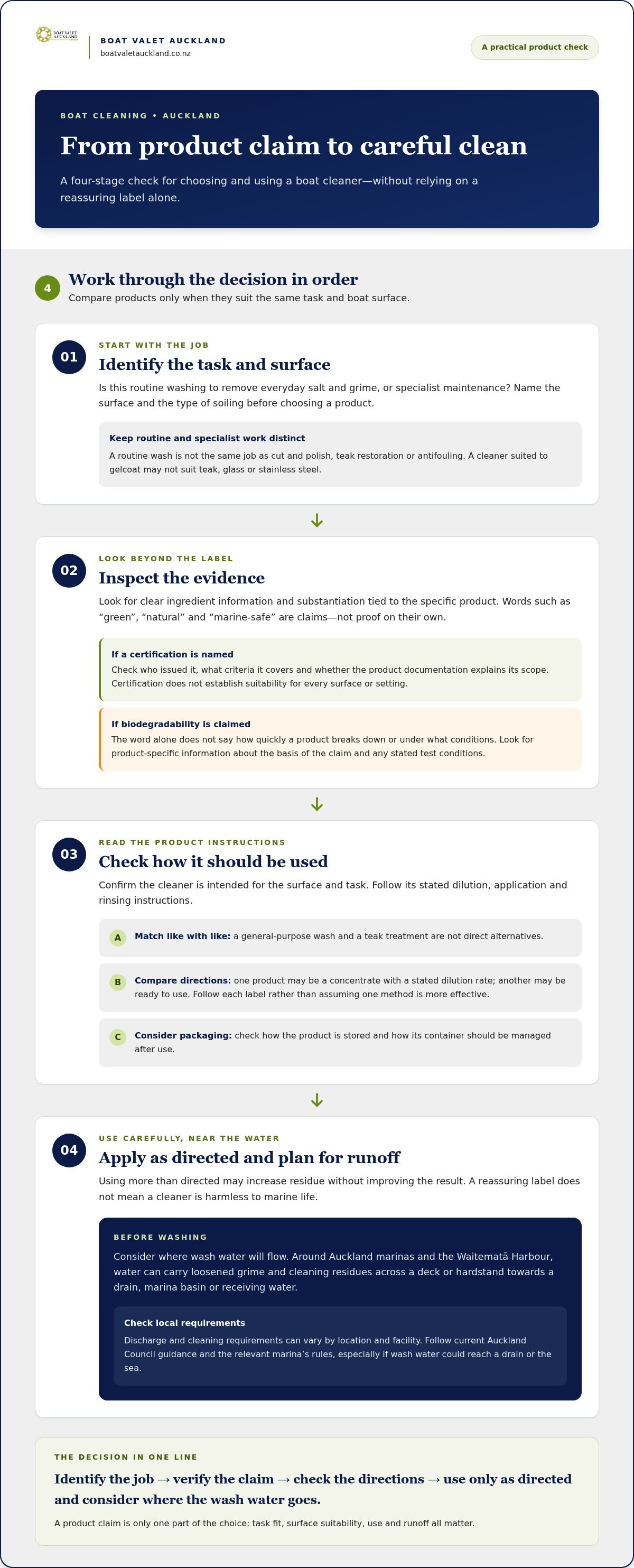
Use a simple sequence before choosing a cleaner: identify the job, inspect the evidence, read the directions, then use only the amount and method specified. This keeps a reassuring label from making the decision for you. For eco-friendly boat cleaning auckland, compare products only when they’re intended for the same task and boat surface. A general-purpose wash and a teak treatment, for example, aren’t direct alternatives.
Identify the task: Is it routine salt and grime, or specialist maintenance?
Inspect the evidence: Look for product-specific ingredient details and substantiation for environmental claims.
Check the directions: Note the suitable surfaces, dilution, application and rinsing instructions.
Use as directed: Don’t assume extra product will clean better or make a claim more meaningful.
This framework helps you judge what a label actually tells you, rather than treating a single phrase as a complete environmental assessment.
Which label details are worth comparing?
Start with clearly identified ingredients, instructions for applying the cleaner and supporting information tied to the specific product. Phrases such as “green”, “natural” or “marine-safe” are claims, not proof on their own. Check what evidence supports them and whether it applies to the product as sold and used. An environmental claim describes a benefit; independently verifiable evidence shows how that benefit has been assessed.
A certification can indicate that a product has been assessed against particular criteria. It doesn’t automatically show that the cleaner suits every surface, use or discharge setting. Check who issued the certification, what it covers and whether the product documentation identifies its scope. Don’t infer that a cleaner is harmless to marine life from a label alone.
How can you compare products without relying on green claims?
Biodegradability needs context. The term alone doesn’t tell you how quickly a product breaks down or under what conditions. Look for product-specific documentation explaining the basis of the claim, including any stated test conditions. Without that detail, treat the claim as incomplete rather than assuming it describes what will happen in a marina or coastal environment.
Compare the practical directions too. A concentrate may have a stated dilution rate, while another cleaner may be ready to use. Follow each label rather than comparing bottles by size or assuming one application method is more effective. Check whether the manufacturer provides supporting information, and compare only cleaners for the same surface and task. Without reliable, current comparative evidence, avoid declaring one brand the most environmentally responsible.
For marks or surface wear that routine washing won’t address, detailing may be more suitable than repeatedly applying a general cleaner. Boat Valet Auckland provides mobile grooming across greater Auckland, including boat cut and polish and exterior wash and wax, with care matched to the vessel and job.
Choose an Auckland boat cleaner for the surface and job
Start with the material, then define what you need to remove. Salt film on gelcoat is different from oxidation, water spots on windows or weathering on teak. A cleaner designed for one surface shouldn’t automatically be used on another. Check the product label for the intended material and task, then follow its directions.
Use this comparison as a starting point for eco-friendly boat cleaning auckland. It can help narrow your choice, but the product’s own instructions remain the guide for use.
For a broader view of how cleaning fits into ongoing vessel care, the marine detailing services guide explains how different maintenance tasks contribute to preserving a boat.
What should you consider for gelcoat, glass and stainless steel?
Routine gelcoat washing removes everyday grime; it won’t necessarily restore a dull or oxidised finish. Cut and polish is a separate restoration task, so don’t substitute an abrasive or polishing product for a routine cleaner. For more on that distinction, see the Auckland boat cut-and-polish guide. For windows and stainless steel, choose products explicitly suited to the surface and follow their application directions.
How should teak and interior cleaning differ?
Teak needs a product and method labelled for teak. Don’t assume a deck wash, harsh scrubbing or a home-made mixture is appropriate for weathered timber. Interior cleaning is also distinct from exterior washing: upholstery, trim and fittings may each need different care. For specialist context, the Auckland teak restoration guide covers teak care beyond a basic wash.
Keep the task in proportion. If routine cleaning isn’t addressing oxidation, weathering or a sensitive finish, repeated applications of a general cleaner may not be the right next step. Boat Valet Auckland’s detailing work includes cut and polish, teak restoration, window polishing and interior valet, with the approach matched to the surface and maintenance need.
Reduce product use and manage boat-cleaning runoff in Auckland
A good cleaning plan starts before you open the bottle. Around Auckland marinas and private berths, consider where wash water will flow, which surfaces need cleaning and how much product the job requires. Runoff prevention is a practical precaution, not a replacement for local or facility requirements.
Before starting, follow the current cleaning and discharge guidance for your location. Auckland Council information and marina rules may be relevant, and conditions can differ between berths and hardstands. This section offers general planning advice, not a statement of specific Auckland discharge rules.
What can owners do before cleaning at a marina?
Walk the work area first. Notice slopes, drains and the route water could take from the boat, then choose a suitable place to clean in line with the site’s guidance. Avoid letting wash water run unchecked towards a drain or the water. Keep the job contained and manageable, and have the product label available for its directions and disposal advice.
Prepare materials before mixing or applying cleaner. Keep containers closed when they’re not in use, and manage used cloths, empty packaging and residues according to the label and site guidance. Don’t pour leftover product or concentrated cleaner away unless its instructions and applicable requirements allow it. A tidy work area helps prevent spills and unnecessary product use.
How can you reduce unnecessary chemical use?
Begin with the least intensive method appropriate for the dirt and surface. Dry debris may need a different approach from salt film or ingrained grime. Avoid scrubbing hard or reaching for a stronger cleaner before considering whether that could damage the finish. If the task is restoration rather than routine washing, a general-purpose cleaner may not be the right tool.
Read the label first. Confirm that the cleaner suits the surface and job.
Measure as directed. Follow the specified dilution and application instructions rather than guessing.
Apply only what’s needed. Avoid pouring extra product onto a surface or reapplying without checking the directions.
Keep products separate. Don’t mix cleaners or transfer them into unlabelled containers.
Using less isn’t automatically better if the product is diluted incorrectly or applied against its instructions. The aim is to use the right amount for the task, not to under-dose and repeat the wash. Use this boat-cleaning checklist for New Zealand owners alongside the cleaner’s directions.
For larger grooming jobs, Boat Valet Auckland provides mobile vessel care across greater Auckland, including exterior wash and wax. Arrange professional boat grooming for help with your vessel’s cleaning and maintenance.
Choose professional eco-conscious boat cleaning in Auckland
Owner-led cleaning can suit straightforward jobs such as rinsing salt, removing light grime or wiping down familiar surfaces. It lets you work at your own pace and choose products carefully. Professional grooming is a practical option when the task is more involved, time is limited or a surface needs specialist attention. The decision is about matching the work to the right level of care, not assuming a professional service guarantees a particular environmental outcome.
For eco-friendly boat cleaning auckland, ask the same practical questions whether you clean the boat yourself or use experienced help: what needs doing, which surfaces are involved and how will the products be used? Being clear about the task helps distinguish a routine wash from restoration or detailing.
When might professional boat grooming be the practical choice?
A routine wash is usually manageable for owners with the time, suitable products and a straightforward job. Teak restoration and gelcoat cut and polish are different: they involve specialist maintenance rather than simply washing away everyday dirt. Professional grooming may suit you if you’re unsure how to approach the surface or want the work handled as a defined task.
Mobile service can also suit owners whose vessels are kept at an Auckland marina or on private property. It offers on-site care and convenience, not a promise of reduced environmental impact. Consider product evidence, directions and runoff arrangements for the location, whichever approach you choose.
What can Auckland owners expect from Boat Valet Auckland?
Boat Valet Auckland is an owner-operated mobile marine maintenance and grooming business serving marinas and private properties across the greater Auckland region. Owner-operator Steve Kellie has led the business since its establishment in 1998. Its work includes exterior wash and wax, interior valet, teak restoration and boat cut and polish, alongside other vessel grooming and maintenance services.
Each service addresses a different need. Exterior wash and wax is distinct from cut and polish, which focuses on the boat’s finish. Teak restoration is a specialist task for teak surfaces, while an interior valet addresses the vessel’s interior. Describing the job clearly helps define its scope and keeps routine cleaning separate from restoration.
Professional grooming can save owners time and bring experience to a complex or surface-sensitive job. It doesn’t remove the need to consider product claims and local cleaning guidance, or replace marina requirements. Choose the level of help that fits your vessel, the task and the time available.
Discuss your boat’s grooming needs with Boat Valet Auckland and identify the right care for your vessel.
Make your next boat-care decision with confidence
Your next clean is a chance to set a practical routine: decide what needs attention, identify the surface and plan the work before applying anything. Follow product directions and consider the cleaning location, especially if wash water could reach a drain or coastal water. These deliberate choices make eco-friendly boat cleaning auckland more thoughtful without relying on broad promises or expecting one product to do every job.
If the work goes beyond routine washing, a grooming specialist can help define the task and the right type of care for your vessel. Boat Valet Auckland, led by owner-operator Steve Kellie, provides mobile marine maintenance and grooming across greater Auckland.
For mobile grooming that suits your vessel and the work it needs, discuss your boat’s grooming needs with Boat Valet Auckland.
Frequently Asked Questions
Are eco-friendly boat-cleaning products safe for marine life?
Not necessarily. An environmental claim doesn’t prove a cleaner is harmless to marine life, especially if it enters the water in concentrated form. Look for product-specific evidence and follow the label’s use and disposal instructions. Even a product intended for marine use should be applied carefully. If you can’t establish what a claim means or how it was assessed, don’t treat it as proof of safety.
Are biodegradable boat cleaners always better for the environment?
No. “Biodegradable” on its own doesn’t explain how quickly a product breaks down, what conditions are needed or what the claim covers. Check the manufacturer’s documentation for the basis of the claim and any test conditions. Consider whether the product suits the job and how it will be used. A biodegradable claim doesn’t mean it should be allowed to run directly into marina or coastal water.
Can I use household cleaning products on my boat?
Only use a household cleaner if its label explicitly says it’s suitable for the boat material and task. A product intended for domestic sinks or benches may not be appropriate for gelcoat, teak, glazing, upholstery or metal finishes. For example, don’t use a kitchen cleaner on boat windows unless the directions include that type of surface. Keep products in their original labelled containers and never mix cleaners.
How do I choose a boat cleaner for gelcoat or teak?
Choose by both material and condition. For light grime on gelcoat, use a cleaner labelled for gelcoat; a dull or oxidised finish may need a separate restoration approach rather than repeated washing. For teak, select a product and method specifically intended for teak. Test an unfamiliar cleaner on a small, inconspicuous area if the label allows it, and stop if the finish changes unexpectedly.
What should I do with boat wash water at an Auckland marina?
Before washing, follow the marina’s current cleaning and discharge guidance and relevant Auckland Council information. Don’t assume wash water can go into a drain or directly into the harbour. If the site’s requirements aren’t clear, pause before starting and seek guidance from the marina or relevant authority. These precautions matter for eco-friendly boat cleaning auckland, particularly where runoff could reach coastal water.
Is professional boat cleaning more environmentally friendly than cleaning a boat yourself?
Not automatically. Environmental impact depends on the products selected, how they’re applied and how wash water and residues are managed. An owner who follows product directions and site guidance may handle a straightforward wash well. Professional help can be useful for complex detailing or sensitive surfaces, but the service itself isn’t proof of a lower-impact result. Compare the task and handling approach, not simply DIY versus professional.
Comments