
Catamaran antifouling in Auckland: timing and process

In Auckland waters, many boats are antifouled annually to help protect the hull. A catamaran antifouling service in Auckland can treat both hulls, but the right timing also depends on how the vessel is stored and used. Plan ahead, particularly if you need to coordinate the work with time out of the water.
Antifouling is not simply a matter of booking the same date every year. Storage conditions, hull condition and the state of the existing coating all affect when work is needed. Preparation and application requirements also shape the job, so checking these details helps you plan without relying on guesswork.
This guide covers how to plan antifouling, how storage can affect timing, what the work involves and what influences the schedule. It also explains practical considerations for arranging catamaran antifouling around Auckland.
Table of Contents
Antifouling frequency and storage conditions
In Auckland waters, many boats are antifouled annually. For a catamaran, inspect both hulls rather than judging the coating from one side alone. Treat the annual interval as a planning guide, not a substitute for assessing the existing coating and hull condition.
Storage affects when and how you inspect the hulls. A catamaran kept afloat remains exposed to marine growth, while one stored ashore spends time out of the water between trips. Record where the boat is kept and how often it returns to the water. This context helps explain why boats with the same last antifouling date may need different attention.
Before arranging work, look for visible growth and areas where the coating appears worn or damaged. Check the waterline, hull bottoms and corners where growth can collect. On a multihull, compare the port and starboard hulls, including surfaces that are harder to see from the marina berth. Note the last application date and any changes in storage or use.
How far ahead should I book catamaran antifouling in Auckland, especially before summer? Arrange it as soon as your summer boating dates are set, so the work can be planned around your launch and travel schedule. Seasonal demand and the time needed to prepare both hulls can affect appointment timing.
Use this simple planning sequence:
Write down the last antifouling date and where the catamaran has been stored.
Inspect both hulls for growth, worn coating or visible damage.
Set a target date that leaves room for the required work before your first planned summer trip.
If the boat has spent more time afloat than usual, or one hull shows clear wear, include that in your maintenance plan. Boat Valet Auckland can arrange catamaran antifouling in Auckland with the vessel’s storage history, condition and intended use in mind.
Antifouling job duration
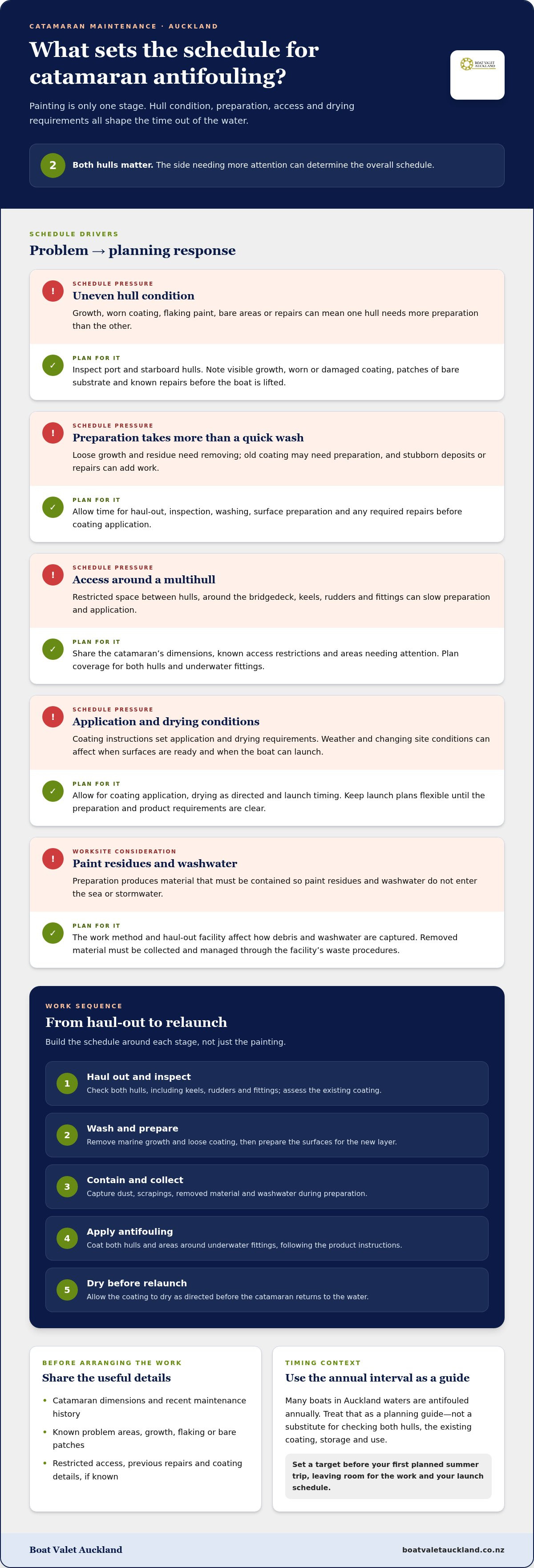
There is no single timeframe for every catamaran antifouling job. The schedule depends on both hulls, their condition, preparation needs and the coating’s application requirements. A straightforward refresh calls for a different plan from work involving worn or damaged areas.
Start with the work required before paint is applied. The catamaran needs to be out of the water, with both hulls accessible for inspection and preparation. Washing removes loose growth and residue, then the surfaces need suitable preparation before new antifouling is applied. Stubborn deposits, the condition of the old coating and any repairs can add work.
A multihull also brings practical access considerations. The team needs room to work along each hull, including the inner faces and areas around keels, rudders and fittings. Restricted access can slow preparation and application. If one hull needs more attention, the overall schedule may be determined by the more demanding side.
Application and drying requirements matter, too. The coating instructions set out the conditions for application and how long to wait before launching. Weather can affect when surfaces are ready and when paint can be applied. Changing conditions may shift the work sequence, especially when the hulls need to stay dry during preparation.
To plan your time out of the water, share the catamaran’s dimensions, recent maintenance history and known problem areas when arranging the work. Note any flaking, patches of bare substrate or heavy growth. These details help identify likely preparation stages before the boat is lifted.
Allow the schedule to account for each stage, rather than just the painting itself:
Haul-out, access and inspection of both hulls.
Cleaning, surface preparation and any required repairs.
Antifouling application, drying and launch timing.
Keep launch plans flexible until preparation and coating requirements are clear. For help organising the work around your boat’s condition, use this Auckland hull-maintenance planning resource.
Antifouling job process
Catamaran antifouling starts with access to both hulls. Once the boat is out of the water, inspect the port and starboard sides, including keels, rudders and fittings. This shows where growth has collected and whether the existing coating is sound, worn or lifting.
New Zealand environmental controls focus on containing paint residues and washwater so they do not enter the sea or stormwater. Removed material must be collected and managed through the haul-out facility’s waste procedures. The worksite and method affect how debris and washwater can be captured.
Preparation follows inspection. Remove marine growth and loose coating, then prepare the surface so the new layer can adhere. Peeling paint needs particular care, while intact coating may require a different level of preparation. Contain dust, scrapings and washwater throughout this stage.
Boat Valet Auckland provides mobile antifouling for catamarans across greater Auckland. Access between the hulls, around the bridgedeck and near underwater fittings affects how each area can be reached. Tell the team about restricted access or previous repairs so both hulls can be included in the work plan.
Apply antifouling in line with the coating manufacturer’s instructions. The selected product should be applied evenly to the prepared underwater surfaces, with care around edges, fittings and hull-to-keel joins. Allow it to dry as directed before launching. Product instructions and site conditions determine the timing.
A typical work sequence is:
Haul out the catamaran and inspect both hulls.
Wash, remove loose growth and prepare the surfaces.
Contain and collect residues produced during preparation.
Apply antifouling to both hulls and around underwater fittings.
Allow the coating to dry before relaunching.
Before the lift, clear access to the hulls and identify any fittings or repairs that need attention. Have the coating details available if you know them. This helps the team assess the surface, plan suitable preparation and work towards complete coverage across both hulls.
Auckland antifouling service locations
Boat Valet Auckland provides mobile marine services at marinas and private properties across greater Auckland. The work location depends on where the catamaran can be lifted, accessed safely and prepared. A berth may suit an inspection, while antifouling requires suitable out-of-water access to both hulls.
For a catamaran, location planning must account for its beam and the space between the hulls. Before arranging the lift, note the vessel’s dimensions, berth or property access and nearby obstacles. Clear access helps the team reach the port and starboard hulls, bridgedeck edges and underwater fittings.
When comparing Auckland antifouling services, ask how the work stages are planned and what determines the schedule for your catamaran. Look for reviews that describe relevant multihull work, and read any warranty terms carefully, including their scope, conditions and exclusions.
There is no single antifouling paint choice for every catamaran in Auckland waters. The appropriate product depends on the hull material, existing coating and intended use. Follow the manufacturer’s guidance for local water conditions and application.
Start by assessing the boat’s current berth or property. Work out how it will reach the work area, where it can be lifted and whether both hulls will be accessible once ashore. These practical details matter more than choosing a suburb in isolation.
Before scheduling, gather these details:
The catamaran’s current Auckland berth or private-property location.
Its dimensions and any access limits around the site.
The existing coating type, if known, and visible hull concerns.
Your preferred lift and relaunch arrangements.
For example, a catamaran at a marina may need its lift coordinated with the facility, while a private-property site may require clear equipment access. Share the location and vessel details when arranging Auckland catamaran antifouling, so the work plan accounts for both hulls and the site.
Boat Valet Auckland: Boat Cut and Polish
Boat Valet Auckland provides Antifouling for owners planning hull maintenance in Auckland. Arrange the service when your catamaran is due for a fresh protective coating or the existing finish needs attention. Share the vessel’s location, storage history and visible hull condition to help plan the work.
Boat Cut and Polish is a separate service for improving the boat’s exterior finish. For interior or timber care, Boat Valet Auckland also offers Interior Valet and Teak Restoration. Choose the work that addresses your boat’s current needs rather than adding tasks that do not.
To discuss catamaran antifouling or other suitable boat care in Auckland, contact Boat Valet Auckland for a free, no-obligation quote.
Plan your next step with confidence
Use the next maintenance visit to create a simple record for future planning. Note the coating applied, the work completed and any areas that may need attention later, then keep these details with your vessel records. Comparing them with the hull’s condition at its next inspection can make planning easier.
For catamaran antifouling in Auckland, Boat Valet Auckland provides Antifouling. Boat Cut and Polish can improve the exterior finish, while Teak Restoration is available for timber care. Choose the work that suits your boat’s condition and your priorities as its owner.
Share what you’ve observed and what you want to achieve. Contact Boat Valet Auckland today to discuss your boat care needs. A clear plan can help you move ahead with confidence and enjoy your time on the water.
Frequently Asked Questions
Which Auckland boatyards offer antifouling services for catamarans?
Boat Valet Auckland provides mobile antifouling at marinas and private properties across greater Auckland, with Hobsonville Marina as its primary hub. Other listed locations include Westhaven, Half Moon Bay, Pine Harbour and Gulf Harbour. The haul-out facility lifts and supports the vessel, while Boat Valet Auckland carries out the antifouling. Confirm that the chosen site can accommodate your catamaran’s dimensions.
How often should a catamaran be antifouled in Auckland?
In Auckland waters, many boats are antifouled annually. Use that as a planning interval, then compare the coating’s condition with your maintenance records. Note where the catamaran was kept and any visible changes on each hull at inspection. This record can help you spot wear and plan the next maintenance window.
What is included in an Auckland catamaran antifouling service, such as pressure washing and hull preparation?
A typical job involves removing marine growth, preparing the underwater surfaces and applying antifouling paint. Washing can clear loose growth and residue before closer surface preparation. The work depends on the existing coating and hull condition, and loose or damaged paint may need extra attention. Ask for a clear outline of the preparation and coating application included in the job.
Where can catamarans be hauled out for antifouling in Auckland, and what are the yard requirements?
Catamarans need a suitable Auckland haul-out facility with the lifting capacity and space to accommodate the vessel’s beam, weight and hull configuration. Hobsonville Marina is Boat Valet Auckland’s primary hub, and the business contributes towards haul-out fees there. Have the vessel’s dimensions and lifting details ready when organising the lift, and make sure both hulls can be accessed for the work.
How do Auckland antifouling providers compare on turnaround time, reviews, and warranty?
Compare each provider’s stated work stages and turnaround estimate, and check reviews for relevant catamaran examples. Read warranty terms for their scope, conditions and exclusions, which can differ between providers and jobs.
Comments