
Boat Antifouling Cost NZ: The 2026 Pricing and Maintenance Guide

The cheapest boat antifouling cost nz isn't found on the lowest invoice. It's found in the job you only have to do once every two years. Many New Zealand boaties find themselves stuck in a cycle of annual haul-outs because they prioritised a bargain over the right technical specifications. It's a frustrating waste of time and money when your hull starts showing growth just months after a fresh coat.
We understand the headache of calculating hidden marina fees and the fear of accidentally choosing a paint that's been banned by the EPA. This guide breaks down exactly what you'll pay in 2026, covering everything from the latest chemical regulations to the actual time commitment of a DIY project. You'll gain the confidence to choose between doing the hard graft yourself or hiring a professional specialist. We'll show you how to secure a finish that protects your vessel for 12 to 24 months, ensuring your high-value asset stays efficient and clean.
Key Takeaways
Learn how to calculate the four primary cost centres, including facilities and compliance fees, to understand the total boat antifouling cost nz.
Evaluate the true expense of a DIY project by factoring in equipment hire and the value of your own time against an all-in professional service.
Understand how Auckland’s strict biosecurity regulations and haul-out availability at locations like Westhaven influence your maintenance budget.
Discover how professional preparation prevents delamination and improves fuel efficiency by significantly reducing hull drag.
Determine how your vessel’s length and beam width dictate paint volume requirements to ensure you follow the essential two-coat rule.
Table of Contents
What Makes Up the Total Boat Antifouling Cost in NZ?
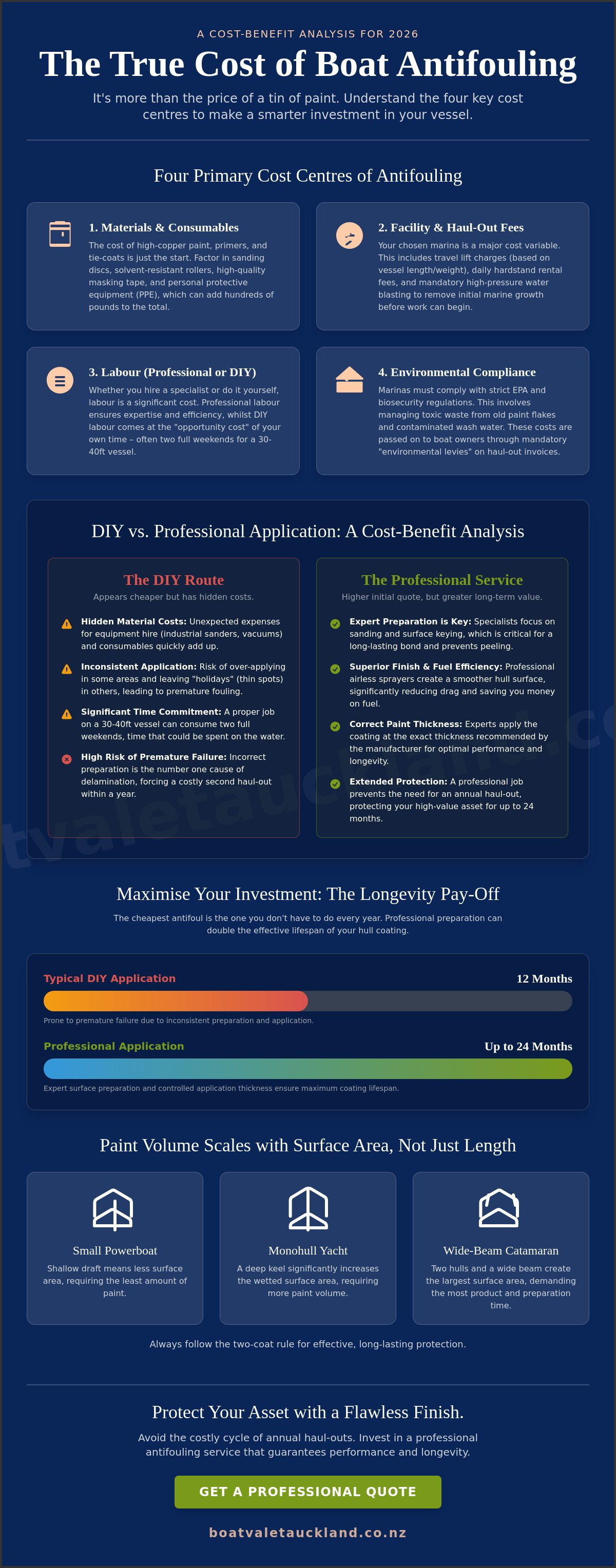
Many boaties make the mistake of looking only at the price of a 4-litre tin of paint when budgeting for the season. In reality, the retail price of your coating is often less than half of the total investment. The true boat antifouling cost nz is a combination of four distinct cost centres: materials, labour, facilities, and compliance. If you ignore any of these, your budget will likely blow out before the boat even leaves the travel lift.
Paint volume requirements scale with the total surface area of your hull, not just its length. A wide-beam catamaran or a deep-keeled yacht requires significantly more product than a shallow-draft powerboat of the same length. You also need to account for consumables that disappear quickly during a DIY job. Sanding discs, high-quality masking tape, solvent-resistant rollers, and protective suits are essential. These small items can easily add hundreds of dollars to a project if you haven't accounted for them in your initial planning.
Environmental compliance is another non-negotiable factor in 2026. New Zealand marinas now operate under strict EPA regulations regarding biosecurity and heavy metal runoff. Marinas must manage waste disposal for old paint flakes and contaminated wash water, which has led to standard "environmental levies" on most haul-out invoices. These fees ensure that toxic residues don't end up back in our coastal waters.
The Material Component: Paint and Primers
Understanding what antifouling paint is and how it interacts with the water is vital for cost management. You'll choose between ablative coatings that wear away, hard paints for high-speed vessels, or hybrid options. High-copper content paints generally command a premium price because they offer superior protection in high-fouling areas like the Hauraki Gulf. Don't forget the primer; it's a critical expense if you're switching paint brands or working on a bare hull. Without the correct tie-coat, your expensive topcoat may simply peel off within months.
Facility Fees: Haul-out and Hardstand
Your choice of marina significantly impacts your bottom line. Travel lift fees are usually calculated based on your vessel's overall length or weight, covering the move from the water to the cradle. Once you're on the hardstand, you'll pay a daily rental rate. This is where project duration becomes your biggest cost variable. Professional application is often faster, reducing the number of days you spend paying for a spot on the concrete. Most facilities also charge for an initial high-pressure water blast to remove slime and barnacles, which is a mandatory first step before any sanding or painting can begin.
DIY vs Professional Antifouling: A Cost-Benefit Analysis
Deciding whether to tackle your own hull or hire a specialist is the most significant choice affecting your total boat antifouling cost nz. On paper, the DIY route looks like a massive saving. You avoid the labour line item on a professional quote. However, this calculation often ignores the sheer volume of invisible expenses that accrue the moment you step onto the hardstand. From hiring industrial sanders and vacuum systems to the fuel spent driving back and forth to the marine chandlery, these costs chip away at your perceived savings.
Professional application often uses less paint whilst achieving superior coverage. We use high-pressure airless sprayers or specialised rollers that apply the coating at the exact thickness recommended by the manufacturer. DIYers frequently over-apply in some areas and leave "holidays" or thin spots in others. This inconsistency leads to premature fouling. If your DIY job fails and the paint begins to peel or delaminate, you'll face the high cost of hauling out a second time. Meeting New Zealand's biofouling requirements is much harder when your coating isn't performing as intended.
The Professional Advantage with Boat Valet Auckland
The secret to a long-lasting antifoul job isn't the paint; it's the preparation. Our team focuses heavily on the sanding and masking phases. We ensure the old layers are stable and the surface is keyed perfectly for the new bond. This expert prep work can extend the life of the coating by up to 24 months. You get access to professional-grade equipment that ensures a smoother finish. This isn't just about looks. A smooth hull reduces drag and saves you money on fuel every time you're out on the water. It's about protecting your high-value asset with precision.
Opportunity Cost: What is Your Weekend Worth?
Be realistic about the timeline. For a 30-40ft vessel, a proper DIY job usually consumes two full weekends or four consecutive days. This includes the wash, prep, masking, and two full coats with drying time. You must also consider the health and safety risks. Dealing with toxic dust and fumes requires high-grade respirators and protective gear that most boaties don't have in their garage. Instead of spending your precious spare time covered in blue dust, you can organise a professional service and keep your weekends for sailing. If you want to ensure your vessel is ready for the season without the stress, a professional valet or grooming service is often the smarter financial move.
Estimating Your Costs: Pricing by Vessel Size and Paint Type
Estimating the total boat antifouling cost nz requires more than a glance at your vessel's length. Your hull's beam width and draft play equally critical roles in determining how many litres of paint you'll need. A 12-metre yacht with a deep fin keel has a significantly larger surface area than a 12-metre shallow-draft powerboat. Skimping on the volume of paint is a false economy. We always recommend the "two-coat" rule, with a third coat applied to high-wear areas. If you apply the coating too thin, it will exhaust its biocides prematurely, forcing you back onto the hardstand months ahead of schedule.
Your boating behaviour dictates whether you should choose ablative or hard paint. Ablative coatings are self-polishing; they wear away slowly to reveal fresh biocides whilst the boat is moving. These are excellent for cruisers who use their boats regularly. Hard paints are better suited for high-speed vessels or racing yachts that require a scrubbable finish. You must also account for specialised treatments for your propeller and running gear. Products like Propspeed are separate from your hull paint costs but are essential for maintaining speed and fuel efficiency.
Calculating Paint Volume for Your Hull
To get a realistic estimate, you need to calculate the wetted surface area. For a standard monohull, a common formula is length overall multiplied by beam, then multiplied by a factor of 0.75 for yachts or 0.85 for powerboats. Catamarans are more complex, as you must calculate two separate hulls and the bridge deck area. Pay close attention to the waterline and leading edges of rudders and keels. These areas face the most turbulence and require extra material to prevent "burn-through." It is helpful to review what is boat antifouling to ensure you're selecting a system compatible with your existing substrate.
Choosing the Right Product for NZ Waters
Auckland’s coastal conditions are unique. The warmer water temperatures in the Hauraki Gulf encourage rapid biofouling growth compared to cooler southern regions. This environment makes adherence to New Zealand's marine biosecurity rules even more critical. Many marinas now enforce the "6 or 1" rule, meaning your hull must have been cleaned within one month or antifouled within the last six months to enter. Consulting with a specialist ensures you don't face "paint incompatibility" issues, where a new coating fails to bond with the old one. We help you match the high-spec treatments required for Auckland waters to your specific vessel type, ensuring your boat antifouling cost nz provides the best possible long-term value.
Auckland-Specific Factors Affecting Your Antifouling Budget
Auckland is the hub of New Zealand's boating community. This makes the boat antifouling cost nz in this region subject to unique local pressures. Haul-out availability at major centres like Westhaven, the Viaduct, and Gulf Harbour fluctuates significantly based on the season. During the spring rush, booking a travel lift becomes a competitive exercise. Prices for haul-out services at these central facilities are influenced by their specific infrastructure and weight capacities. Choosing a yard slightly further afield can sometimes reduce your facility fees, though you must factor in the extra steaming time and fuel spent on the delivery trip.
Clean Hull certificates are now a standard requirement for moving amongst different New Zealand regions. If you plan to cruise from Auckland to the Bay of Islands or the Coromandel, authorities often require proof that your hull is free of invasive species. This is where a professional application pays for itself. A certified, high-quality finish serves as your passport to restricted marine zones. Local mobile services play a vital role here. We coordinate directly with your chosen boatyard to ensure the work is completed within your booked hardstand window, providing a seamless experience that avoids costly overstay fines.
Marina and Boatyard Variables
Environmental levies amongst Auckland boatyards are not uniform. Each facility has its own system for capturing and treating wash water; these costs are passed on to the boat owner. You can often find better value by timing your maintenance for the off-peak winter months. Whilst the weather is less predictable, marinas are often more flexible with hardstand durations. Using a mobile grooming service that comes to your preferred yard allows you to maintain control over the quality of the finish whilst utilising the most cost-effective local facility.
Biosecurity and the "6-Month Rule"
Compliance costs are a reality for any vessel heading north. Many marinas in Northland enforce strict entry rules based on when your boat was last antifouled or cleaned. A high-quality job reduces the need for expensive mid-season diver scrubs, which can quickly inflate your annual maintenance budget. It's worth checking the essential maintenance guide to time your haul-out perfectly for the summer cruising season. If you want to ensure your vessel meets all regional biosecurity standards without the stress, contact our Auckland team to schedule a professional application that keeps you compliant and moving.
Maximising Your Investment: Why Professional Application Saves Money
Professional application is not merely an expense; it is a strategic hedge against future maintenance failures. The most common cause of a blown boat antifouling cost nz is delamination, where new paint detaches from the hull because of poor preparation. DIY projects often fail at the sanding stage, leaving old, unstable layers that eventually flake off. When this happens, you face the massive expense of a full strip-back and re-application. Our team ensures the substrate is perfectly keyed and cleaned, preventing premature failure and ensuring your coating lasts for its intended lifespan.
Documenting a professional maintenance history also preserves the resale value of your vessel. Potential buyers look for records that show a high-value asset has been cared for by specialists rather than amateur hands. It provides them with the confidence that the hull is sound and the protection is current. Boat Valet Auckland’s mobile service offers the perfect balance of quality and convenience, coordinating with your chosen yard to deliver a result that meets professional standards without you having to lift a finger.
The Link Between Hull Smoothness and Fuel Economy
Slime and barnacles create immense turbulence, forcing your engines to work harder to maintain cruising speed. Even a "thick and patchy" DIY coat, often characterised by heavy texture and uneven thickness, can create significant drag. A professional finish is faster through the water because it is applied with uniform precision using specialised equipment. This reduces engine strain and lowers your temperature gauges during long summer runs. Maintaining a clean, smooth hull can save up to 10% in fuel costs annually.
Long-Term Protection Strategies
To get the best return on your investment, consider combining your hull work with a professional boat cut and polish. Protecting the topsides whilst the boat is on the hardstand ensures total vessel care and prevents salt degradation from reaching the gelcoat. We recommend developing a multi-year maintenance plan with Steve Kellie to track your vessel’s needs across different seasons. This proactive approach avoids emergency haul-outs and keeps your boat antifouling cost nz predictable. The "middle ground" of professional application is the smartest financial move because it delivers a finish that stays clean for 12 to 24 months, keeping your boat in the water where it belongs.
Secure Your Vessel's Performance for the Season Ahead
Managing your boat antifouling cost nz effectively comes down to precise preparation and deep local knowledge. By choosing the right technical specifications for Auckland's warmer waters and ensuring your biosecurity compliance is up to scratch, you protect both your hull and your cruising freedom. A professional finish isn't just about aesthetics; it's about fuel efficiency and long-term asset protection that keeps your vessel performing at its peak.
We've been serving Auckland boaties since 1998, providing a responsive mobile service that meets you at your preferred yard or marina. Steve Kellie understands the specific biosecurity requirements of the Hauraki Gulf and knows exactly how to get the most out of every litre of paint. Get a professional antifouling quote from Steve Kellie today to ensure your high-value asset is in safe hands. Let's get your boat back in the water with a finish that looks great and truly protects.
Frequently Asked Questions
How much does it cost to antifoul a 40ft boat in NZ?
The total investment for a 40ft vessel typically exceeds the averages seen for smaller boats because of the significantly larger surface area and paint volume required. You'll need to account for specific travel lift fees, hardstand days, and several tins of high-spec marine coating. Whilst specific quotes vary based on your hull's current condition, owners should budget for a comprehensive service that covers meticulous preparation, quality materials, and local facility charges.
Is it cheaper to antifoul a boat myself?
DIY application appears cheaper initially because you aren't paying for professional labour. However, once you calculate the cost of industrial sander hire, vacuum systems, protective gear, and your own time, the gap closes quickly. A DIY failure that leads to delamination can double your boat antifouling cost nz by requiring an immediate second haul-out. Professional application often uses product more efficiently, providing better value over the coating's lifespan.
How often do I need to pay for antifouling in Auckland?
Most Auckland boaties haul out every 12 to 18 months to maintain optimum protection in our high-fouling waters. If you use a high-spec hybrid or ablative paint and the vessel is used regularly, you might extend this interval to 24 months. Auckland’s warmer sea temperatures encourage rapid biofouling, making regular inspections vital. Keeping to a consistent schedule prevents heavy barnacle growth from damaging your hull's efficiency and speed.
What are the typical haul-out fees in Auckland marinas?
Haul-out fees in Auckland are generally calculated based on the vessel's length overall or total weight. Facilities like Pine Harbour Marina or Seaview have specific price lists that include the travel lift operation and an initial high-pressure water blast. You should also check for environmental levies which are now standard across most yards. These fees cover the collection and treatment of contaminated wash water and old paint residues.
Does the type of antifouling paint significantly change the total cost?
The choice of coating is a major variable in your overall boat antifouling cost nz. High-copper paints and advanced hybrid systems command a premium price because they offer superior protection in aggressive environments like the Hauraki Gulf. Whilst budget-friendly options exist, they often require more frequent re-application. Investing in a higher-spec product usually pays for itself by extending the time between haul-outs and reducing the need for mid-season cleaning.
Are there hidden environmental fees when antifouling in NZ?
Environmental fees are no longer hidden; they're a standard part of doing business in New Zealand marinas. Under EPA regulations, yards must provide Controlled Work Areas to capture toxic dust and runoff. You'll likely see charges for waste disposal and biosecurity compliance on your final invoice. These levies ensure that heavy metals from old coatings don't contaminate the local marine ecosystem, keeping our coastal waters healthy for everyone.
Can I save money by just cleaning the hull underwater?
Underwater scrubbing is a useful maintenance tool but it isn't a replacement for a fresh antifoul coating. Frequent aggressive cleaning can actually strip away the active biocides in your paint, shortening its effective life. Whilst it might save you a haul-out in the short term, it won't stop the eventual need for a full re-application. Professional application provides the smooth, toxin-rich barrier that underwater cleaning simply cannot replicate.
How long does a professional antifoul job take to complete?
A standard professional job usually requires three to five days on the hardstand. This timeline allows for the initial water blast, thorough drying, mechanical sanding, masking, and the application of at least two full coats. Weather conditions in Auckland can influence drying times, especially during the humid spring months. Coordinating with a mobile team ensures the work stays on track, minimising your daily hardstand fees and getting you back sailing sooner.
Comments