
What is Boat Antifouling? The Complete Hull Protection Guide for 2026

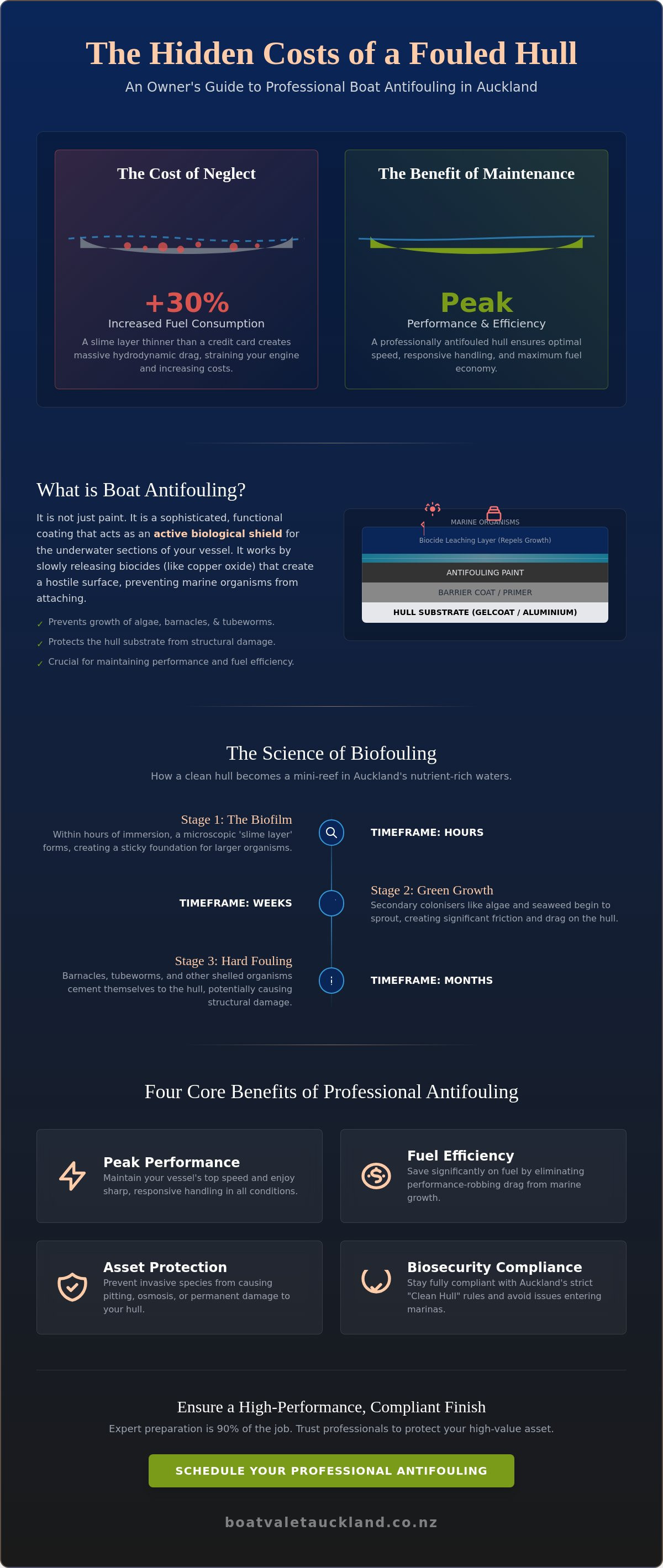
Did you know that a layer of slime and barnacles thinner than a credit card can increase your fuel consumption by up to 30%? For many Auckland boat owners, the rising cost of diesel is enough of a headache without the added drag of a fouled hull. Understanding what is boat antifouling is no longer just a matter of maintenance; it's a critical financial decision for anyone keeping a vessel in New Zealand waters. You likely already know that a clean hull is essential for speed, but the shifting landscape of EPA regulations and biosecurity rules can make the selection process feel overwhelming.
We're here to clear up that confusion and help you protect your high-value asset. You'll discover the essential science behind modern coatings, the latest 2026 biosecurity requirements for local marinas, and the practical steps needed to ensure peak performance. We will walk you through everything from choosing the right paint type to meeting the strict "6 or 1" marina entry rules. This guide provides the clarity you need to maintain a fast, efficient vessel whilst staying fully compliant with New Zealand’s environmental standards.
Key Takeaways
Understand what is boat antifouling as a functional barrier designed to stop biofouling before it compromises your vessel's performance.
Learn how the warm coastal conditions in Auckland accelerate biological growth, requiring specific protection strategies for your hull.
Determine if hard or eroding paints are the right choice based on your boat's cruising speed and typical usage patterns.
Spot the early signs of paint degradation, such as chalking or slime, to ensure you maintain a reliable 12-18 month service schedule.
Discover why expert preparation is 90% of the job and how mobile services can streamline your next haul-out at an Auckland marina.
Table of Contents
Defining Antifouling: More Than Just a Coat of Paint
When boat owners ask what is boat antifouling, they are often looking for a simple maintenance answer. In reality, it is a sophisticated functional coating applied to the underwater sections of your vessel. Unlike the high-gloss paint used on your topsides, which focuses on UV resistance and aesthetics, antifouling is a chemical barrier engineered for the harsh, submerged environment. Specifically, antifouling is a biocide-releasing layer designed to deter marine hitchhikers. This protective skin is vital for both fibreglass and aluminium hulls, as it prevents "biofouling"-the relentless accumulation of marine organisms like algae, barnacles, and tubeworms. For a comprehensive overview of antifouling paint, it is helpful to view it as an active biological shield rather than a static finish.
The Core Function of Antifouling Coatings
These coatings work by slowly releasing active ingredients, typically biocides like copper or zinc oxide. These substances create a hostile surface that prevents larvae from settling on your hull. The speed at which these chemicals are released is known as the "leaching rate". If the rate is too high, the paint wears out too fast. If it's too low, the growth takes hold. Regular household paint or standard marine varnish lacks these active biocides. Without them, a clean hull in Auckland's Hauraki Gulf would be covered in a thick layer of slime within weeks. Standard paints provide a perfect substrate for marine life to grip, whereas specialised antifouling keeps the surface repellent.
Why Antifouling is Essential for Performance
A fouled hull is a massive drag on your vessel's efficiency. Even a light layer of weed or a few clusters of barnacles creates significant hydrodynamic drag. This isn't just about losing a few knots of top speed; it's a direct hit to your fuel budget. A dirty hull can force your engine to work harder, consuming significantly more fuel to maintain the same pace. Beyond performance, antifouling acts as a sacrificial barrier. Invasive species like tubeworms can actually bore into gelcoat or cause pitting in aluminium if left unchecked. By maintaining a professional antifouling layer, you prevent permanent structural damage to your substrate. It ensures your boat remains a high-performance asset that is easy to handle and cheap to run. Keeping the hull clean also ensures you stay compliant with local marina rules, making your weekend getaways much smoother.
The Science of Biofouling: Why Your Hull Needs Protection
Biofouling begins the moment your hull is submerged. In Auckland, our nutrient-rich and relatively warm coastal waters create a perfect breeding ground for marine life. Understanding the biological timeline helps clarify what is boat antifouling and why it serves as your first line of defence. It starts with a microscopic biofilm or "slime layer". This biofilm acts as a foundation, providing a sticky surface for larger organisms to latch onto. Once that foundation is set, macro-fouling like weed and barnacles takes over, creating massive drag at cruising speeds.
The Biological Process of Hull Colonisation
The progression from a clean hull to a mini-reef happens in distinct stages. After the initial slime layer forms, secondary colonisers like green algae and kelp begin to sprout. These organisms create significant friction, forcing your engine to work harder. The final stage involves "hard" fouling, where barnacles and tubeworms cement themselves to your substrate. Some of these species have a physical boring action that can actually damage your gelcoat or aluminium over time. If you want to ensure your boat is ready for the season, it's worth looking into professional antifouling before the summer rush hits the haul-out yards.
This growth doesn't just sit on the flat surfaces of your hull. Barnacles and tubeworms love to settle inside engine cooling intakes and through-hull fittings. A clogged intake leads to overheating, whilst fouled seacocks can become impossible to operate in an emergency. Beyond the mechanics, heavy growth ruins your vessel's handling. You'll notice a sluggish response to the helm and increased vibration through the steering. This isn't just a performance issue; it's a safety concern that makes docking and manoeuvring in tight Auckland marinas much more difficult.
Environmental Impact and Biosecurity in NZ
Invasive species like Undaria (Asian kelp) and the Mediterranean fanworm are major concerns in New Zealand. These marine hitchhikers threaten our local ecosystems and are the primary reason for Auckland Council’s strict "Clean Hull" rules. Most marinas now adhere to the "6 or 1" rule, requiring proof of antifouling within the last six months or a wash within the last month before you can berth. The International Convention on the Control of Harmful Anti-fouling Systems provides the global framework for managing these biosecurity risks safely. For a holistic approach to hull health, our guide on Marine Detailing Services NZ explains how antifouling fits into a total vessel preservation plan.
Hard vs. Eroding: Choosing the Right Protection for Your Vessel
Deciding between hard and eroding paint is the most critical stage of vessel maintenance. The right choice depends on your boat's speed and how often you get out on the water. If you choose a paint that doesn't match your usage, you'll end up with either excessive paint build-up or a hull that loses its protection far too early. Understanding what is boat antifouling involves recognising that these two categories serve very different purposes in New Zealand's varied marine environments. We see many owners struggle with this choice, but the decision usually boils down to your typical cruising speed and maintenance schedule.
Eroding (Ablative) Antifouling
These paints are designed to wear away slowly as the boat moves through the water. Think of it like a bar of soap. As the outer layer dissolves, it reveals a fresh, active layer of biocide. This "self-polishing" action is the favourite choice for many Auckland yacht owners and cruising sailors. It prevents the heavy accumulation of old paint layers over several seasons, which makes the eventual job of stripping the hull much easier. These coatings are most effective for vessels that spend significant time at anchor or move at slower cruising speeds. Because the paint wears away, you won't have to deal with the thick, cracking layers of old material that often plague older vessels.
Hard Antifouling for High-Performance
If you own a fast powerboat or a racing yacht that regularly exceeds 25-30 knots, eroding paint will likely wash off too quickly. Hard antifouling is the standard for high-performance vessels. The paint film remains intact whilst the biocide leaches out through microscopic pores in the surface. A major advantage for racers is the ability to "burnish" or wet-sand the surface to a glassy, competitive finish. However, keep in mind that hard paints require more aggressive preparation. You'll need thorough sanding before each re-application to ensure the new layer bonds properly to the old substrate. Without this mechanical key, the new paint will simply flake off within months.
Your hull isn't the only thing that needs protection. Propellers, shafts, and rudders are subject to extreme turbulence that standard hull paint can't handle. For these areas, we recommend specialised foul-release coatings like Propspeed. These systems don't rely on biocides; they use an ultra-slick silicone surface that marine life simply cannot grip. When you combine a professional hull coating with running gear protection, you ensure your entire drivetrain remains efficient and vibration-free. This total-vessel approach is what is boat antifouling at its most effective, keeping you fast and fuel-efficient in any conditions.
When to Antifoul: Identifying the Signs of Hull Degradation
Most owners wait for their annual haul-out to check the condition of their hull. This is often a mistake. Whilst a 12-18 month cycle is standard for many vessels in New Zealand, local factors like water temperature and your boat's location can drastically change that timeline. Understanding what is boat antifouling includes knowing how to spot the moment the coating stops working. If you wait until you see large clusters of barnacles, the damage to your performance and fuel economy is already done. You need to be proactive with your inspections to avoid the high costs of heavy scraping and substrate repair.
Stationary time is often more damaging to your paint than engine hours. If your boat sits in a marina for months without moving, the biocide leaches out without the "refreshing" action of water flow. This leads to a stagnant layer where larvae can easily settle. For a more detailed breakdown of these timelines, check our guide on How Often to Antifoul a Boat to ensure your maintenance schedule matches your actual usage.
Signs Your Antifoul is Failing
Visual cues are your best indicator. Look for "chalking", where the paint looks dull and releases a cloud of colour when rubbed. This means the resin binder is breaking down and the biocide is nearly exhausted. You might also notice visible patches where the primer is showing through, especially on high-wear areas like the bow or water line. A sudden, unexplained drop in top speed or a 10-15% increase in fuel consumption usually points to a fouled hull. If you see hard fouling like small shells appearing despite regular use, your protection has failed.
The Auckland Maintenance Cycle
The transition from winter to spring is the busiest time for Auckland marinas. As the water in the Hauraki Gulf warms up, biological growth rates skyrocket. This seasonal shift is the ideal time to refresh your coating before the summer cruising season begins. Higher salinity levels in certain parts of the gulf can also accelerate the depletion of your biocides. During your haul-out, it is vital to check your sacrificial anodes and through-hull fittings. These components often degrade at the same rate as your paint. If you've noticed any of these signs, it's time to book your next antifouling service to keep your vessel in peak condition.
Professional Antifouling in Auckland: Ensuring a High-Performance Finish
While you now understand what is boat antifouling and how it functions, the actual application is where your vessel's performance is won or lost. Preparation is 90% of a professional result. We don't just apply paint over a dirty surface. The process begins with high-pressure water blasting to strip away loose debris and biological film. This is followed by meticulous sanding to create a mechanical "key" for the new coating. Professional applicators in New Zealand carry a heavy burden of environmental responsibility. We operate within strict biosecurity frameworks, ensuring all waste and runoff is contained and disposed of according to EPA regulations. This protects the Hauraki Gulf whilst keeping your vessel compliant with local marina rules.
The Professional Application Process
Precision is vital during the application phase. We start by masking off all running gear, transducers, and depth sounders to prevent overspray or chemical interference. Achieving the correct film thickness, measured in microns, is essential for maximum longevity. If the coating is too thin, it won't last the season; if it's too thick, it can lead to cracking and eventual delamination. Our final inspection ensures your vessel is marina-ready and meets the strict biosecurity standards required for entry into Auckland and Northland facilities. For a total restoration, many owners pair their hull work with a Professional Boat Cut and Polish to ensure the topsides look as fast as the hull performs.
Why Experience Matters: Boat Valet Auckland
Experience is the difference between a standard maintenance job and a high-end specialist finish. Steve Kellie brings over 25 years of industry tenure to the Auckland marine scene. He understands the specific challenges of our local waters and the unique requirements of different hull substrates. We operate as a mobile service, which means we can coordinate directly with your preferred Auckland marina or haul-out yard. This saves you the logistical headache of managing multiple contractors whilst ensuring your high-value asset is in safe hands. We focus on practical results that drive your boat toward peak efficiency and long-term protection.
Choosing a professional service means you aren't just buying a coat of paint. You're investing in a partnership that values precision and proactive care. We take pride in the final result, ensuring your vessel is ready for the summer season without the fear of biosecurity rejections or performance loss. Don't leave your hull protection to chance. Ready for a cleaner, faster hull? Contact Steve at Boat Valet Auckland today to discuss your requirements and secure your spot in the spring maintenance schedule.
Secure Your Vessel's Performance for the Season Ahead
Mastering what is boat antifouling means moving beyond basic maintenance to a strategic protection plan. You now understand how the right choice between hard and eroding coatings directly impacts your fuel efficiency and how local biosecurity rules protect our Hauraki Gulf. A clean hull isn't just about speed; it's about preserving your investment and ensuring hassle-free marina access throughout Auckland. Professional preparation remains the most critical factor in achieving a finish that lasts the full 18-month cycle.
Since 1998, we've helped local boat owners maintain their high-value assets with precision and care. Steve Kellie provides an expert mobile service that brings specialist hull protection and high-end marine detailing directly to your local yard or marina. We focus on the practical, high-performance results that keep your vessel fast and fully compliant with New Zealand regulations. Don't leave your hull health to chance this spring.
Get a Professional Antifouling Quote from Steve Kellie today. Let's get your boat ready for the best cruising season yet.
Frequently Asked Questions
What is the main difference between antifouling and regular marine paint?
Antifouling contains active biocides designed to prevent marine growth, whereas regular marine paint is for topsides and focuses on UV protection and colour. Regular paint lacks the chemical leaching needed to deter barnacles and algae. Understanding what is boat antifouling requires seeing it as a sacrificial, active layer rather than a static aesthetic finish. It is specifically formulated to withstand constant immersion whilst remaining chemically active.
Can I antifoul my boat myself in an Auckland marina?
Most Auckland marinas require you to use a "Controlled Work Area" for any hull maintenance involving sanding or painting. DIY work is often restricted due to strict environmental regulations regarding the containment of toxic dust and runoff. You must check with your specific marina manager before starting any work. Many owners find that professional mobile services are more efficient as they handle all compliance and waste disposal requirements on-site.
How much does boat antifouling typically cost in New Zealand?
Professional antifouling costs are determined by the vessel's length, the current state of the hull, and the specific paint technology selected. Factors such as haul-out fees, hard-stand daily rates, and the number of coats required all influence the total. Because every boat has unique requirements, most specialists provide a tailored estimate after an initial assessment. This ensures you only pay for the specific protection your vessel needs for its typical cruising speed.
Is antifouling paint toxic to the marine environment?
Traditional paints use biocides to deter growth, but the industry is moving toward more eco-friendly options. As of August 1, 2023, the New Zealand EPA has banned substances like thiram and diuron to protect our local ecosystems. Modern formulations focus on controlled leaching rates or biocide-free silicone technologies. These advancements ensure you can protect your hull whilst minimising the impact on New Zealand’s unique marine biodiversity and sensitive coastal habitats.
What happens if I don’t antifoul my boat for two years?
Skipping maintenance for two years leads to heavy macro-fouling that can increase fuel consumption by up to 30% due to hydrodynamic drag. You also risk being denied entry to Auckland marinas under the "Clean Hull" biosecurity rules. Beyond performance, invasive species like tubeworms can cause permanent pitting in the substrate. The cost of a heavy scrape and hull restoration after two years of neglect usually far exceeds the cost of a standard annual service.
Do I need different antifouling for an aluminium hull?
Yes, aluminium hulls require copper-free antifouling to prevent catastrophic galvanic corrosion. Standard copper-based paints will cause the aluminium to pit and degrade rapidly through an intense electrochemical reaction. You must use specialised coatings, often based on zinc or organic biocides, designed specifically for alloy vessels. Always verify the paint's compatibility with your hull material to avoid expensive structural damage that can compromise the safety of your vessel.
How long does the antifouling process usually take?
Most professional applications are completed within a three to five-day window, provided the weather remains favourable for drying. This timeline covers the essential stages of water blasting, mechanical sanding, masking, and the application of the antifouling layers. Rushing this process can compromise the bond between the paint and the hull. We coordinate with haul-out yards to ensure the schedule is as efficient as possible, getting you back on the water quickly.
Does antifouling affect the resale value of my vessel?
Regular antifouling significantly protects the resale value of your vessel by proving a history of proactive maintenance. A well-documented log showing annual hull care reassures buyers that the substrate is free from invasive damage or corrosion. When considering what is boat antifouling for a new purchase, buyers look for evidence of professional care. Conversely, a fouled hull is often seen as a red flag for hidden structural issues or engine strain during sea trials.
Comments