
The Ultimate Guide to Fibreglass Boat Polish: Restore Your Vessel’s Shine in 2026

What if that dull, chalky haze on your hull isn't just an eyesore, but a countdown to permanent gelcoat failure? For many Auckland boaties, watching a vibrant hull turn into a matte, white mess is a source of genuine frustration. You likely worry that taking a machine to your vessel might do more harm than good, or perhaps you're simply confused by the endless rows of products at the local chandlery. It is a common struggle, but achieving a mirror-like finish is entirely possible with the right approach.
By mastering the use of a high-quality fibreglass boat polish, you can strip away years of oxidation and restore the deep lustre of your resin. This guide provides a professional-grade roadmap to choosing and applying the perfect products for the New Zealand climate. We will explore the unique UV challenges facing vessels in the Hauraki Gulf, explain the difference between cutting and polishing, and provide a clear, step-by-step method to ensure your boat looks its absolute best for the season ahead.
Key Takeaways
Understand the vital relationship between your protective gelcoat and structural fibreglass to prevent unnecessary wear during restoration.
Identify how New Zealand's intense UV levels cause "chalking" and how to effectively reverse this oxidation for a deeper colour.
Learn to distinguish between heavy rubbing compounds and a fine fibreglass boat polish to select the perfect abrasive for your vessel's condition.
Master a professional step-by-step restoration method that ensures a mirror-like finish whilst protecting your vessel’s long-term value.
Establish a tailored maintenance routine to keep your vessel compliant with Auckland's strict biofouling regulations and looking its best year-round.
Table of Contents
Understanding Fibreglass Boat Polish and Gelcoat Health
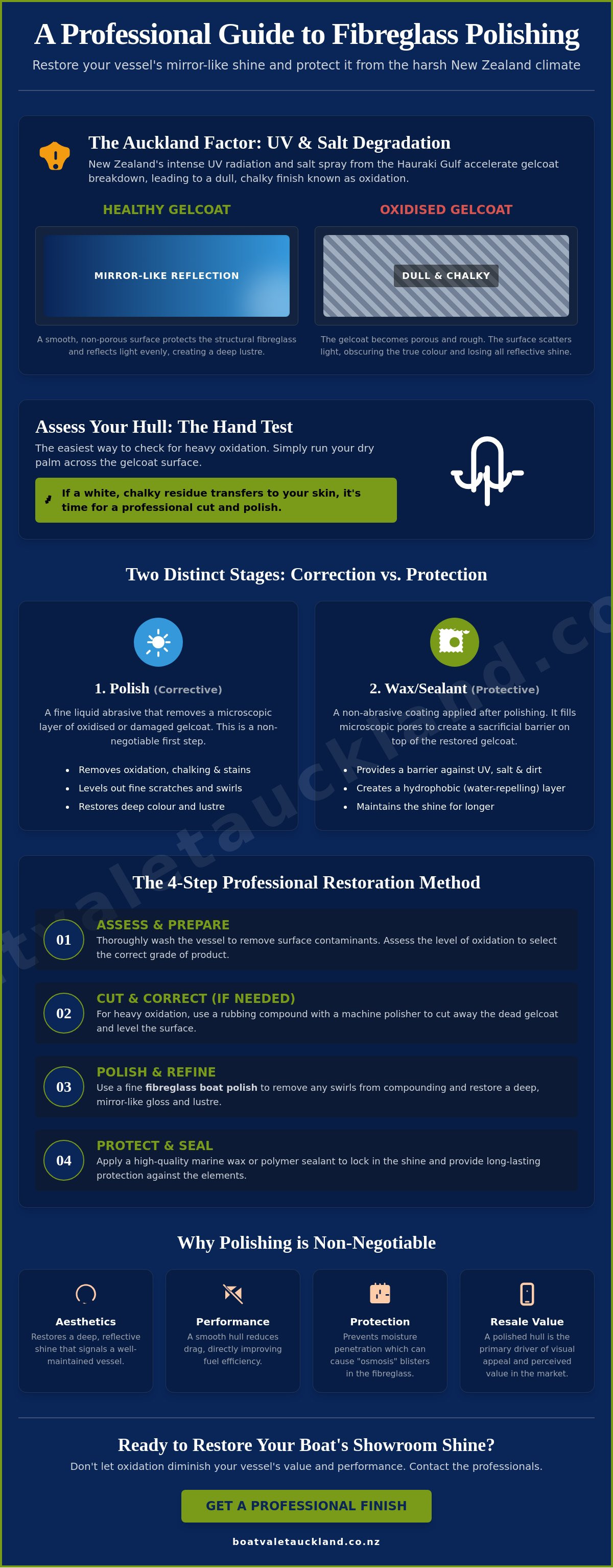
A boat’s hull is a complex sandwich of materials. The outer layer, known as the gelcoat, serves as your vessel's first line of defence. It is a specialised resin designed to protect the structural fibreglass laminate underneath from water and UV degradation. A high-quality fibreglass boat polish is not a simple cleaning agent; it is a fine liquid abrasive. Its purpose is to level the gelcoat surface by removing a microscopic layer of material, effectively refining the finish to a mirror-like shine.
Many owners confuse polishing with waxing, but they are distinct stages of maintenance. Polishing is a corrective process that uses abrasives to fix surface defects. Waxing or sealing is a protective process that adds a sacrificial layer over the top. You would not paint a house without sanding the old timber first; similarly, you should not apply wax to a boat without first using a polish to restore the surface. Regular polishing ensures that the gelcoat remains dense and smooth, which is essential for the long-term health of the hull.
The Difference at a Glance:
Polish: Uses abrasives to remove oxidation, scratches, and stains. It restores the deep colour and lustre of the resin.
Wax/Sealant: Fills the microscopic pores of the gelcoat to provide a barrier against salt, bird droppings, and UV rays.
The Anatomy of Marine Gelcoat
Gelcoat is far more porous than it appears to the naked eye. Over time, it naturally loses essential oils and resins, especially when exposed to the harsh New Zealand sun. This loss leads to oxidation, which creates that dull, chalky appearance boaties dread. Polishing acts as a necessary exfoliant. It strips away the dead, oxidised resin to reveal the fresh, vibrant material beneath. You must remember that gelcoat thickness is finite. Most vessels only have a few millimetres of gelcoat to work with, so you should avoid over-aggressive sanding or excessive compounding that could eventually strike through to the structural fibreglass.
Why Fibreglass Polishing is Non-Negotiable
Keeping your hull smooth is a matter of performance as much as aesthetics. A polished surface reduces hydrodynamic drag, which directly improves fuel efficiency during your runs out to the Hauraki Gulf. Beyond speed, a healthy gelcoat prevents "osmosis." This occurs when moisture penetrates the porous resin and creates structural blisters in the laminate. In the Auckland market, the visual condition of your boat is a primary driver of resale value. A yellowed, chalky hull suggests neglect, whilst a deep, reflective shine signals a well-maintained asset that is ready for the water.
Oxidation, Chalking, and UV Damage: The Auckland Factor
The Auckland sun is notoriously brutal on marine surfaces. New Zealand’s UV levels are significantly higher than many other parts of the world, which creates a harsh environment for any vessel docked at Westhaven or the Viaduct. This intense radiation targets the polymers within your boat's gelcoat. Over time, the sun effectively "cooks" the resin, causing it to break down at a molecular level. This chemical degradation results in a phenomenon known as chalking. It leaves your hull looking dull, lifeless, and covered in a fine white powder that obscures the original colour of the vessel.
Salt spray from the Hauraki Gulf accelerates this surface degradation. When salt water evaporates on your hull, it leaves behind abrasive crystals that trap heat and moisture against the gelcoat. This process speeds up the transition from light oxidation to heavy oxidation. Light oxidation usually appears as a slight fade or a loss of deep lustre. Heavy oxidation, however, creates a rough, porous texture that feels like fine sandpaper. At this stage, a standard wash is no longer enough. You need a high-quality fibreglass boat polish to physically level the surface and remove the damaged material.
Signs Your Boat Needs a Professional Cut and Polish
The Hand Test is the easiest way to assess your hull's health. Simply run your dry palm across the gelcoat. If a white, chalky residue transfers to your skin, you are dealing with heavy oxidation. Another clear sign is the loss of reflection. If your boat looks matte even after a thorough scrub, the surface has become too porous to reflect light. On white boats, UV damage often manifests as yellowing. This pigment shift indicates that the UV rays have penetrated deep into the resin, necessitating a more intensive restoration process.
Auckland’s Marine Environment vs. Your Hull
Boats kept in Auckland face unique atmospheric challenges. Beyond the sun and salt, vessels in central marinas are exposed to industrial pollutants and soot that can bond to an unpolished hull. Using a fibreglass boat polish with specific UV inhibitors is essential for the New Zealand climate. These products don't just restore the shine; they provide a chemical shield against our specific environmental stressors. Many local owners find that specialised boat cut and polish Auckland services are the only way to truly combat these conditions. If your hull has lost its bite, a professional exterior wash and wax can help maintain the finish after a deep restoration.
Choosing the Best Marine Polish: Compounds vs. Waxes vs. Sealants
Selecting the right chemicals is about matching the product to the specific condition of your gelcoat. Not all bottles on the shelf serve the same purpose. You must understand the hierarchy of marine detailing products to avoid wasting time and money. For heavy lifting, rubbing compounds are the industry standard. These contain aggressive abrasives designed to level the rough, white texture of heavy oxidation mentioned previously. If your hull only has light fading, a dedicated fibreglass boat polish is the better choice. It uses finer abrasives to refine the surface and restore that deep, reflective lustre without removing too much material.
Modern boaties often turn to "All-in-One" (AIO) products for routine maintenance. These formulas combine a light polish with a small amount of sealant. They work well for vessels that are already in good condition and only need a quick seasonal refresh. However, for a full restoration, you should use separate stages. Polymer sealants have largely replaced traditional carnauba wax in professional Auckland circles. These synthetic coatings offer superior durability against the high UV index of the Hauraki Gulf, often lasting six months compared to the few weeks provided by natural waxes.
The Difference Between Polishing and Waxing
Polishing is a corrective process; waxing is a protective one. Polishing creates a mechanical bond by physically smoothing the microscopic peaks and valleys of the gelcoat. In contrast, a sealant or wax creates a chemical bond, or a physical film, that sits on top of the restored surface. Applying wax directly over oxidation is a common mistake. The wax cannot bond to the chalky residue, meaning it will wash off within days. You must fix the surface with a fibreglass boat polish before you even think about adding protection.
Criteria for Selecting a Fibreglass Polish
Your choice depends on three main factors. First, consider the abrasive grade. Match the grit to the level of chalking on your hull; starting with a polish that is too fine will result in endless, ineffective buffing. Second, check the application method. Some professional compounds require a high-speed rotary polisher to break down the abrasives, whilst others are formulated for easier hand application. Finally, prioritise eco-friendliness. Auckland’s strict environmental regulations mean that any runoff from your cleaning process enters our sensitive waterways. Choose biodegradable, phosphate-free polishes to ensure your maintenance routine doesn't harm the local marine ecosystem.
How to Polish Your Fibreglass Boat: A Step-by-Step Professional Method
Restoring a weather-beaten hull requires a systematic approach. You cannot simply smear product on the gelcoat and expect a professional result. The process begins with a deep clean and decontamination. Use a dedicated marine soap to strip away salt, bird droppings, and organic growth. Once the hull is dry, assess the damage. Refer back to the Hand Test to decide your starting point. If the oxidation is heavy, you will need a coarse rubbing compound. For lighter fading, a fine fibreglass boat polish will suffice to bring back the shine.
Machine polishing is where the transformation happens. Professionals typically use a rotary polisher for the initial "cut" because it generates the heat necessary to level hard gelcoat. For the final finishing stage, a Dual Action (DA) polisher is safer. It uses an orbital motion to prevent "holograms" or swirl marks. After polishing a section, wipe away the residue with a clean microfibre cloth. Inspect your work using a high-intensity LED light held at an angle. This reveals any remaining scratches or dull spots that the naked eye might miss in flat harbour lighting. Finally, seal the open pores of the gelcoat with a polymer sealant or ceramic coating to lock in the lustre.
Preparation: The Key to a Mirror Finish
Skipping the prep work is the fastest way to ruin a restoration. You must remove all traces of old, degraded wax before you start. If you don't, your pads will clog instantly, and you'll just be moving dirt around the hull. Take the time to mask off rubber rub rails, vinyl decals, and stainless steel fittings with blue painters' tape. Polishing compounds can permanently stain porous plastics and create a mess on metalwork. For a deeper look at the equipment and chemicals required, read our guide on what is a boat cut and polish before you pick up the machine.
Mastering the Buffer: Tips from the Pros
Control the machine; don't let it control you. Work in small sections, roughly 60cm by 60cm, using a "cross-hatch" pattern. This involves moving the buffer horizontally and then vertically with a 50% overlap to ensure even coverage. Keep your speed settings low, especially if you are new to the tools. High speeds create excessive heat that can "burn" or discolour the resin. Clean your foam or wool pads every few sections using a pad spur or stiff brush. A clogged pad won't cut effectively and will leave a poor finish. If the physical labour of a full restoration feels daunting, you can always book a professional Boat Cut and Polish to handle the heavy lifting for you.
Maintaining that Showroom Shine: Long-term Protection Strategies
Once you have finished using your fibreglass boat polish to restore the hull, the focus shifts to preservation. The hard work of cutting and refining the gelcoat is wasted if you don't implement a strict maintenance routine. The most critical step is your washing technique. Always use pH-neutral marine soaps specifically formulated for gelcoat. Avoid household detergents or harsh cleaners; these will strip away your protective wax or sealant in a single wash, leaving the pores open to salt and UV damage once again.
In the Auckland climate, protection is not a "set and forget" task. Our high UV index means that even premium polymer sealants require re-application every three to six months. If your vessel is kept at a marina like Pine Harbour or Westpark without a cover, you should aim for the shorter end of that window. Whenever possible, use a high-quality boat cover or seek a berth with shade to significantly extend the life of your finish. This proactive approach keeps the resin hydrated and prevents the return of the chalky oxidation you just worked so hard to remove.
The Seasonal Maintenance Schedule
Timing your maintenance with the seasons ensures your vessel is always protected against the elements. In Spring, perform a full detail and apply a fresh layer of protection before the summer boating season begins. This shields the hull during the months of peak sun exposure. In Autumn, focus on a deep clean and sealing to protect against the damp winter moisture and grime that can settle on the surface. For a more detailed breakdown of year-round care, see our guide on marine detailing services NZ.
When DIY is Not Enough
Some hull issues go beyond the reach of a standard fibreglass boat polish. If you notice "crazing", those fine, spider-web cracks in the gelcoat, or deep scratches that have penetrated the resin, you need professional intervention. These defects often require specialised gelcoat repair rather than just a buff. For owners of large vessels or those who simply don't have the time for a multi-day restoration, a professional mobile service is the most efficient choice. Steve Kellie’s Boat Valet Auckland provides the expertise and industrial equipment needed for heavy restoration projects. Get a professional quote for your boat grooming today to ensure your vessel receives the high-end treatment it deserves.
Reclaim Your Hull's Reflection Today
Restoring your vessel is a multi-stage commitment that pays dividends in both performance and resale value. It's about more than looks. You now understand that a high-quality fibreglass boat polish does more than just shine; it restores the deep lustre and removes years of Auckland's harsh UV damage. Follow the professional method. Commit to a seasonal maintenance schedule. These steps ensure your gelcoat remains healthy and vibrant for years to come.
If the restoration project feels overwhelming or your vessel requires specialised care, professional help is just a phone call away. We bring over 25 years of local experience to every job. Our team are specialists in gelcoat restoration and antifouling across all major Auckland marinas. This mobile service brings the expertise directly to your berth, ensuring a flawless finish without the hassle. Let Steve and the team at Boat Valet Auckland restore your boat to its former glory. Your vessel deserves to stand out on the Hauraki Gulf.
Frequently Asked Questions
Can I use car polish on my fibreglass boat?
You shouldn't use car polish on a boat because gelcoat is significantly harder and more porous than automotive paint. Marine surfaces require specialised abrasives that can level the tough resin. Car products often contain fillers that temporarily hide dullness but won't provide the long-term restoration needed for a vessel. Stick to products designed for marine use to ensure the abrasives actually work against the oxidation without clogging the surface.
How much fibreglass boat polish do I need for a 6-metre trailer boat?
For a 6-metre trailer boat, you will typically need between 500ml and 1 litre of fibreglass boat polish. This quantity varies based on the condition of your gelcoat. If the hull is heavily oxidised, you'll likely use more product as the porous surface absorbs the liquid and requires more frequent pad loading. It's always safer to have a second bottle on hand to ensure you don't run out halfway through the job.
Is it better to polish a boat by hand or with a machine?
Using a machine is significantly better for achieving a professional, swirl-free finish. Hand polishing is exhausting and rarely generates the consistent heat required to break down the abrasives in the polish. A rotary polisher is ideal for removing heavy oxidation, whilst a dual-action polisher is perfect for the final finishing stage. Reserve hand polishing for tight corners or around delicate fittings where a machine cannot safely reach.
What is the best temperature for applying fibreglass boat polish?
The ideal temperature range for polishing is between 15°C and 25°C. You should avoid working in the direct Auckland midday sun, as the heat causes the product to dry prematurely on the hull. This leads to difficult removal and unsightly streaking. Aim for a cool, overcast day or work under a shade sail. This gives the chemicals enough "open time" to work effectively into the gelcoat resin.
How do I remove heavy oxidation from a gelcoat hull?
Removing heavy oxidation requires a multi-stage approach starting with an aggressive rubbing compound and a wool pad. This combination provides the "cut" needed to strip away the dead, chalky resin. Once the surface is level, you must follow up with a finer fibreglass boat polish and a foam pad to refine the finish. This two-step process is the only way to restore a deep, reflective lustre to a severely weathered hull.
Will polishing my boat remove deep scratches?
Polishing will not remove deep scratches that have penetrated through the gelcoat layer. Whilst it can round off the edges of light surface marks to make them less visible, deep gouges or "crazing" cracks require a structural repair or a gelcoat filler. If you can catch your fingernail in the scratch, it's too deep for a polish to fix. In these cases, a professional assessment is recommended to prevent moisture intrusion.
How long does a professional boat cut and polish last in Auckland?
A professional cut and polish typically lasts between three and six months in the Auckland marine environment. The longevity depends heavily on whether the boat is stored under cover and how frequently it is washed with pH-neutral soaps. Because New Zealand's UV levels are so high, the protective sealants break down faster than they would in other climates. Regular maintenance is essential to prevent the oxidation from returning.
Can I polish my boat whilst it is in the water?
You can polish the topsides whilst the boat is in the water, but it's not recommended due to Auckland Council regulations. These rules prohibit contaminants and debris from entering the marine environment during cleaning. It's much safer and more effective to perform this work on a hardstand or trailer. This allows you to capture any runoff and ensures you can reach the entire hull surface, including the area just above the waterline, without environmental risk.
Comments