
Stainless Steel Polishing for Boats: The Ultimate Professional How-to Guide (2026)
- Steve Kellie

- May 30
- 12 min read
Most boat owners believe that marine-grade stainless steel is a fit-and-forget material. In reality, it is a reactive surface that's constantly fighting a losing battle against Auckland’s harsh salt air. If you've noticed unsightly brown tea staining creeping across your rails or rust bleeding onto your white gelcoat, you aren't alone. It's frustrating to spend your weekend scrubbing hardware only to see the shine vanish after one trip to the Hauraki Gulf. Professional stainless steel polishing for boats requires more than just elbow grease; it demands the correct chemical approach to stop the rot at its source.
I understand the pride you take in your vessel's appearance. You want a mirror-like finish that doesn't just look good for a day, but stands up to constant salt spray. In this guide, I'll show you the professional secrets to removing stubborn oxidation and achieving long-term protection. We'll look at why passivation is the missing link in your maintenance routine and which specific products, like Star brite Chrome & Stainless Polish currently retailing for $49.99 NZD, can help you maintain that showroom glow. From restoring rough handrails to navigating Auckland’s strict 2026 haul-out regulations, you'll learn everything needed to keep your hardware in peak condition.
Key Takeaways
Identify the true cause of unsightly brown tea staining and why simple wiping often fails to stop the spread of corrosion.
Learn how the professional passivation process creates a microscopic shield during stainless steel polishing for boats to provide lasting protection against salt spray.
Gain insights into the essential tools and compounds used by specialists to achieve a high-lustre, mirror-like finish on weathered hardware.
Follow a structured sequence to restore your metalwork safely while ensuring your boat's delicate gelcoat remains completely protected from abrasive residues.
Discover how regular stainless maintenance integrates with pre-sale grooming to maximise your vessel's market value and aesthetic appeal.
Table of Contents
Understanding Marine Stainless Steel and the "Tea Staining" Problem
Stainless steel isn't actually stain-proof. It is a common misconception that often leads to disappointment when a boat owner sees brown streaks appearing on their expensive bow rails or cleats. In the marine industry, we call this "tea staining." It is a localised discolouration that makes high-end hardware look neglected and aged. While it doesn't usually compromise the structural integrity of the metal immediately, it serves as a warning sign. It is the first step toward deep-seated pitting corrosion, which creates permanent physical craters in the metal. If you've spent time at Westhaven or Viaduct Harbour, you'll know that a dull, stained rail can instantly lower the aesthetic value of a luxury vessel. Professional stainless steel polishing for boats is about more than just looks; it's about stopping this chemical reaction before the metal is ruined.
What Causes Tea Staining on Boats?
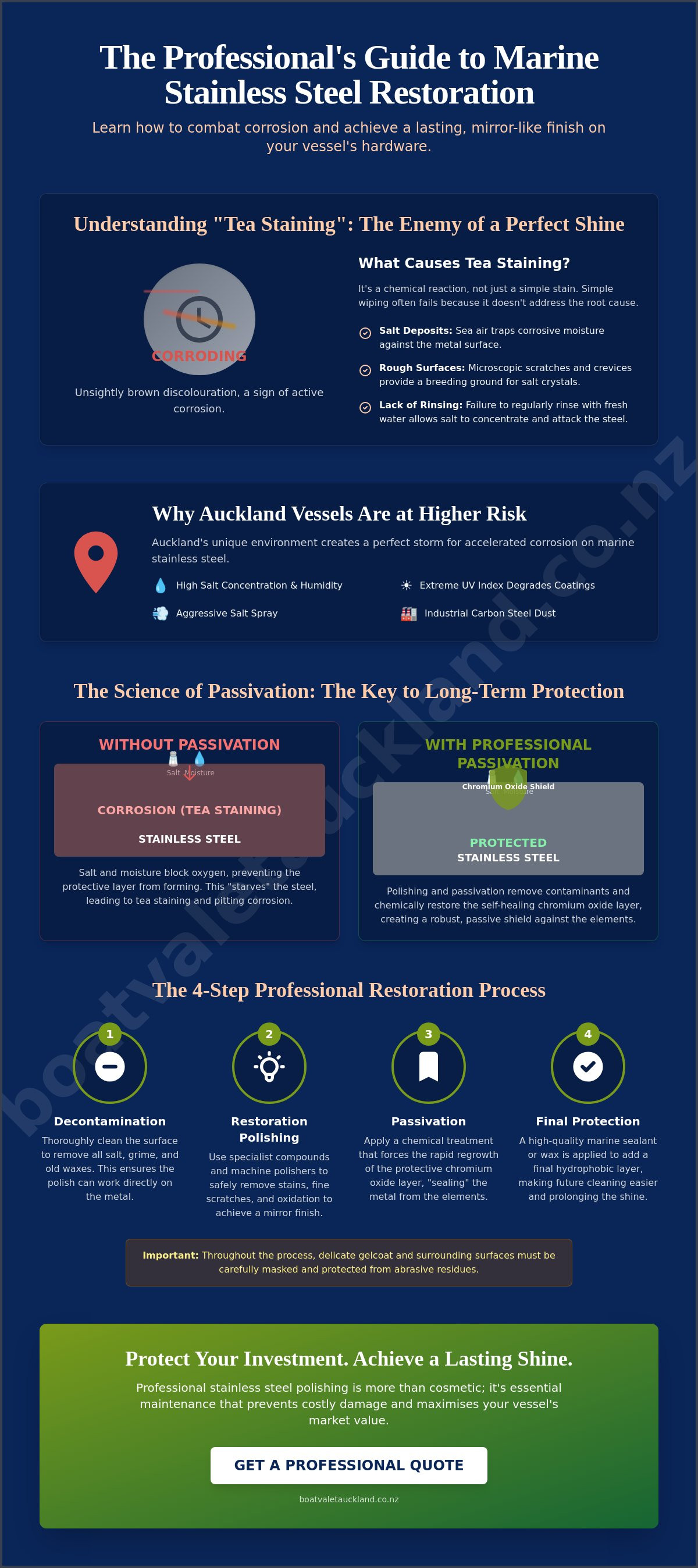
Tea staining occurs when salt deposits from the sea air trap moisture against the metal surface. This creates a highly corrosive environment. Rough surface finishes are the biggest culprit because they provide microscopic nooks where salt crystals can hide and fester. Even a tiny scratch from a rogue fishing hook can become a breeding ground for rust. The absolute number one reason for this buildup is a simple lack of regular fresh-water rinsing. Without a rinse, the salt concentrates and eats through the protective surface. Understanding The Science of Passivation helps explain why this happens; the metal needs constant oxygen exposure to maintain its protective chromium oxide film. When salt blocks that oxygen, the staining begins.
Why Auckland Vessels are at Higher Risk
Auckland boat owners face unique environmental challenges. The Waitematā Harbour and Hauraki Gulf have high salt concentrations, and our local air is notoriously humid. This humidity keeps the salt "wet" for longer, which accelerates the oxidisation process. New Zealand's extreme UV index also plays a role. It can degrade temporary waxes or low-quality coatings meant to protect the metal, leaving the stainless vulnerable. If your boat is moored near industrial zones or busy ports, you might also deal with carbon steel dust. These tiny iron particles land on your stainless and act as a "seed" for rust. Regular stainless steel polishing for boats is essential in this region because our environment is simply more aggressive than many other international boating hubs. Proper maintenance ensures that your hardware remains a highlight of your boat rather than an eyesore.
The Science of Passivation: Why Simple Wiping Is Not Enough
You might think a quick wipe with a damp cloth keeps your hardware safe. It doesn't. Stainless steel stays "stainless" because of a microscopic, transparent film called chromium oxide. This is the "passive layer." It's incredibly thin but acts as a robust shield. When you perform stainless steel polishing for boats, you aren't just making it shiny. You're stripping away the contaminated, oxygen-starved surface to let a fresh, protective layer grow back. This chemical reset is what keeps the metal healthy in the long run.
Be careful with aggressive scrubbing. Using a green scourer or coarse sandpaper might remove the rust, but it leaves deep scratches. These scratches increase the surface area of the metal. They create new, microscopic "pockets" where salt can hide and moisture can linger. You want a smooth, high-lustre finish. A mirror finish isn't just for vanity; it's the most corrosion-resistant surface possible because there's nowhere for the salt to stick. If your hardware is already showing signs of neglect, a specialist stainless steel polishing service can often reverse the damage and reset the clock on corrosion.
The Role of Chromium Oxide
Chromium is the key. It reacts instantly with oxygen in the air to create a self-healing barrier. If you scratch the metal, it heals. However, when salt crystals sit on the surface, they act like a physical wall. They block oxygen from reaching the metal. This "starves" the steel, leading to the tea staining we discussed earlier. Passivation is the chemical restoration of this oxide layer. For the best results, following professional polishing and maintenance tips ensures you don't skip this critical chemical step.
316 vs 304 Grade: The Marine Standard
Not all stainless is created equal. Grade 304 is fine for your kitchen sink, but it will fail quickly on the Waitematā. Grade 316 contains molybdenum. This specific element provides superior resistance to chloride-induced corrosion, making it the only real choice for salt-heavy environments. Some builders cut corners with after-market fittings. You can often spot these because they stain faster or have a slightly "yellow" cast compared to high-quality 316.
Never use steel wool to clean your boat's hardware. Steel wool leaves tiny carbon particles embedded in the surface. These particles rust almost instantly. They cause "bleeding" rust streaks that can even stain your gelcoat. Stick to bronze wool or non-metallic pads to keep the surface pure. This prevents cross-contamination and keeps your 316 grade hardware performing exactly as it was designed to do.
Essential Tools and Compounds for Marine Metal Restoration
Achieving a showroom shine requires more than a bottle of generic metal cleaner. At Boat Valet Auckland, we use a specific hierarchy of professional-grade compounds to tackle different levels of oxidation. The right kit makes the difference between a temporary glow and a lasting restoration. High-quality stainless steel polishing for boats relies on selecting the correct abrasive grade for the specific condition of your hardware.
Cheap rags are the enemy of a mirror finish. Always use clean, high-GSM microfibre cloths. These fibres trap microscopic contaminants rather than dragging them across the surface. This prevents micro-scratching, which otherwise creates new homes for salt crystals to settle. If you use old t-shirts or shop towels, you're likely adding more scratches than you're removing.
Once the metal is clear, you must lock in the result. Metal sealants are synthetic polymers that bond to the surface. They provide a sacrificial barrier against the Waitematā’s salt spray. This is vital for Auckland vessels moored year-round. It extends the life of your polish by months, keeping the chromium oxide layer active and healthy. Without a sealant, the raw metal is immediately vulnerable to the next high-tide spray.
Choosing the Right Marine Polish
Don't confuse cleaners with polishes. Acid-based cleaners are excellent for "melting" away tea staining without much scrubbing, but they don't restore the surface lustre. Abrasive polishes actually level the metal to remove pits. If your rails feel rough like sandpaper, you'll need a heavy-cut compound. This aggressive approach is only for deep restoration and is a critical step in stainless steel polishing for boats that have been neglected. For routine upkeep, stick to pH-neutral soaps. These won't strip away the expensive sealants you've just applied to protect the finish.
Manual vs. Machine Polishing
Hand-polishing is your best bet for intricate areas. Winches, cleats, and hinges have tight corners that a machine simply can't reach. However, for long stretches of bow rail, a rotary tool is essential. It provides the consistent speed and pressure needed for a true mirror finish. We typically use variable speed polishers set to a low RPM. Just watch your heat levels. Overheating the metal during machine buffing can actually damage the structure of the steel. It can even cause discolouration that is difficult to reverse. Keep the tool moving and let the compound do the work. Understanding The Science of Passivation ensures you know when the chemical reaction is complete and the metal is ready for sealing.
Step-by-Step Guide: Polishing Your Boat Stainless Like a Professional
Restoring your hardware is a systematic process. It isn't just about rubbing until it shines. Professional stainless steel polishing for boats involves a three-stage approach that ensures the metal is clean, corrected, and sealed. This sequence is a core part of our wider marine detailing services NZ programme. Before you start, protect your boat. Metal polish often contains abrasives that turn black when worked. If this drips onto your porous white gelcoat, it can leave a nasty stain. Use high-quality masking tape around stanchion bases and cleats to save yourself a massive cleanup job later.
Stage 1: Deep Cleaning and Preparation
Start by washing the hardware with fresh water and a dedicated marine soap. You must remove every salt crystal before you touch the metal with a cloth. If you don't, those crystals act like sandpaper and ruin the finish. For active rust spots, apply a specialised de-rusting gel. These gels use mild acids to neutralise oxidisation in pitted areas that a cloth cannot reach. Let the gel dwell for the manufacturer's recommended time, then rinse thoroughly. Ensure the surface is bone dry. Any lingering water will cause spotting and interfere with the chemical bond of your polish.
Stage 2: The Polishing and Buffing Process
Apply a pea-sized amount of marine polish to a foam applicator pad. Less is more. Work in small sections, roughly 30cm at a time, to maintain total control over the heat and product spread. Use firm, circular motions if working by hand, or a slow-speed setting on a machine buffer. You'll notice the polish start to turn dark; this is the oxidised metal being lifted away. Buff off the residue with a fresh microfibre cloth immediately. Don't let the polish dry on the rail, as it becomes incredibly difficult to remove without re-scratching the surface. I always use the Steve Kellie method for the final check. Use a bright LED torch held at an angle to the metal. This reveals any hidden streaks or oily residue that the naked eye might miss in flat light.
Stage 3: Sealing and Protection
The final step is the most important for longevity. Apply a high-quality polymer sealant or a dedicated marine ceramic coating for metal. This layer locks out oxygen and prevents salt from reaching the raw steel. It effectively "shuts the door" on the tea staining process for several months. Pay close attention to the base of stanchions and bolt heads. These are the most common areas for "bleeding" rust to start. A thorough final inspection ensures every square centimetre is sealed and ready for the Hauraki Gulf. If you'd rather spend your weekend on the water than scrubbing rails, you can book a professional stainless steel polishing service today.
Maintaining the Shine: Protection Strategies for Auckland Vessels
Auckland’s maritime environment is one of the toughest in the world. Once you’ve achieved that mirror finish through stainless steel polishing for boats, the clock starts ticking. Without a consistent plan, the salt spray from the Hauraki Gulf will begin its work immediately. Maintaining your hardware isn't just about vanity; it's about protecting your investment. If you are planning to move your vessel soon, gleaming metal is a cornerstone of pre-sale boat grooming NZ. It signals to a buyer that the boat has been loved and meticulously maintained. A dull rail suggests a neglected hull, but a brilliant shine builds immediate confidence in the vessel's overall condition.
The most important habit you can develop is the fresh water flush. Salt is a hygroscopic material, meaning it pulls moisture directly out of the air. Even on a dry day, salt crystals on your rails are creating a corrosive brine. By rinsing your hardware regularly, you remove the catalyst for tea staining before it can take hold. It's the simplest and most cost-effective way to keep your boat looking showroom-ready between professional grooming sessions.
The 2-Week Maintenance Rule
The most effective tool in your arsenal is a simple fresh water rinse. If your boat is moored in an Auckland marina, you should aim for a thorough wash-down every fortnight. This 10-minute habit prevents 90% of tea staining by washing away salt crystals before they can trap moisture. Don't just spray the top of the rails. Focus on the hidden areas where salt crust builds up, such as the underside of handrails and around bimini frames. High-wear "hot spots" like cleats and anchor rollers need extra attention because they are constantly exposed to salt water and physical abrasion. A quick blast of fresh water here makes a massive difference to the longevity of your polish.
When to Call Boat Valet Auckland
DIY care has its limits. If you notice deep pits that feel like pinpricks in the metal, the oxidation has moved beyond the surface. At this stage, simple hand-wiping won't fix the problem. You need a professional boat cut and polish Auckland service to resurface the steel and restore the passive layer. We understand that your time is valuable. That’s why we provide a fully mobile on-site service at Westhaven, Orakei, and Half Moon Bay. We bring the restoration directly to your berth, saving you the hassle of moving the boat for minor aesthetic work.
If your stainless steel is looking tired or the tea staining is becoming unmanageable, don't let it deteriorate further. I can help you restore that mirror finish and set up a protection plan that actually works for our local conditions. Contact Steve Kellie today for a professional restoration quote and let’s get your vessel back to its best.
Secure Your Hardware Against the Hauraki Gulf
Protecting your boat’s hardware from the aggressive Auckland environment requires more than a quick wipe. You now understand that maintaining the chromium oxide layer through proper passivation is the only way to stop tea staining for good. By combining a regular fortnightly fresh water rinse with the correct chemical sealants, you can prevent the vast majority of surface corrosion. When the pitting goes deep and the finish turns dull, it's time to move beyond DIY methods to ensure your investment remains protected.
Professional stainless steel polishing for boats is a specialised task that demands the right equipment and a steady hand. With over 25 years of experience in New Zealand marine grooming, I provide an expert mobile service at all major Auckland marinas. I use specialised equipment designed for high-mirror finish restoration to ensure your vessel looks its absolute best. Contact Steve at Boat Valet Auckland for a Professional Stainless Restoration Quote and let's get your boat ready for another season on the water. Your hardware deserves a finish that reflects the pride you take in your vessel.
Frequently Asked Questions
Is stainless steel polishing for boats different from car chrome polishing?
Yes, it's significantly different. Car chrome is usually a thin decorative plating over a base metal, but marine hardware is a solid stainless alloy. Stainless steel polishing for boats focuses on 316-grade alloys that require chemical passivation to survive constant salt exposure. Car products often lack the specific acid cleaners needed to neutralise the deep tea staining found in the Hauraki Gulf.
How often should I polish the stainless steel on my boat in Auckland?
You should perform a deep polish at least once or twice a year. However, Auckland's high humidity means you need to rinse your hardware with fresh water every fortnight to prevent salt buildup. If your vessel is moored year-round at Westhaven or Orakei, a quarterly application of a high-quality metal sealant will keep the lustre alive between major restoration sessions.
Can I use steel wool to remove rust from my boat railings?
Never use steel wool on your boat's railings. It leaves behind microscopic carbon steel particles that embed themselves into the stainless surface. These particles will rust almost immediately, creating "bleeding" streaks that are even harder to remove. Always stick to bronze wool, non-metallic abrasive pads, or clean microfibre cloths to avoid cross-contamination and permanent surface damage.
What is the best way to remove "tea staining" from marine stainless?
The most effective method involves a two-step chemical and mechanical approach. First, apply a specialised de-rusting gel to neutralise the active oxidisation without heavy scrubbing. Once the staining is lifted, follow up with a fine-cut stainless steel polishing for boats compound to restore the mirror finish. This process resets the passive layer and makes the metal more resistant to future salt attacks.
Why does my "stainless" steel keep getting rust spots?
Your stainless steel rusts because salt crystals and grime are "starving" the metal of oxygen. Stainless steel relies on a microscopic chromium oxide film to stay protected. When salt blocks oxygen from reaching the surface, this film can't self-heal. This leads to the brown discolouration known as tea staining, which is particularly aggressive in the humid, salt-heavy air surrounding Auckland's harbours.
Will polishing my stainless steel damage the surrounding gelcoat?
Polishing can stain your gelcoat if you don't mask the area correctly. As the abrasive compound works, it turns black with removed metal and oxidisation. This slurry is incredibly messy and can soak into the porous surface of your white gelcoat, leaving stubborn grey or black marks. Always use high-quality masking tape to protect the area around your stanchion bases and cleats before you begin.
Do I need to wax my stainless steel after polishing it?
Yes, applying a protective layer is essential after you finish polishing. A raw, polished surface is quite vulnerable until the passive layer fully reforms. Using a dedicated marine metal wax or a synthetic polymer sealant provides a sacrificial barrier against salt spray. This extra step locks out the elements and can extend the life of your shine by several months.
Can professional polishing fix pitted stainless steel?
Professional polishing can definitely repair pitted stainless steel, provided the damage hasn't compromised the structural integrity. It involves using aggressive machine buffing and heavy-cut compounds to physically level the surface of the metal. This removes the microscopic craters where rust likes to hide. For deep restoration, a rotary tool is necessary to generate the friction required to achieve a smooth result again.
Comments