
Professional Boat Cut and Polish Auckland: The 2026 Restoration Guide

Is your boat's faded hull just an eyesore, or is it a $100,000 liability waiting to happen? With Auckland Council's strict biosecurity rules and NIWA reporting some of the world's highest UV levels, a chalky gelcoat is more than a cosmetic fail; it's a magnet for invasive pests and deep structural degradation. Most local boaties realise that once the shine goes, the resale value quickly follows it down the drain. You want that mirror-finish "bling" back, but you shouldn't have to risk a botched DIY job or spend your entire weekend scrubbing on the hardstand.
This 2026 guide reveals how a professional boat cut and polish Auckland service transforms tired, oxidised surfaces back into showroom masterpieces. You'll discover the mechanical restoration secrets that protect your hull from the Hauraki Gulf's harsh salt spray and learn how to avoid massive repainting costs. We will walk through the essential steps to achieve long-term UV protection and explain why Steve's "straight-talk" approach remains the trusted choice for Auckland's most prestigious vessels.
Key Takeaways
Learn why Auckland’s high UV levels cause rapid gelcoat chalking and how to stop the damage before it’s too late.
Discover the exact 3-step professional boat cut and polish Auckland process used to strip away oxidation and lock in a high-gloss finish.
Understand the "Straight-Talk" risks of DIY machine polishing and why you shouldn’t risk burning through your gelcoat on tricky corners.
Get the "Gold Standard" maintenance schedule, including why using neutral soaps every four weeks is essential for local boaties.
Find out why 25 years of local experience matters when you need to organise a pre-sale groom or prep for the summer season.
Table of Contents
Understanding Boat Cut and Polishing in Auckland’s Harsh Climate
The 3-Step Marine Detailing Process: Cut, Polish, and Protect
Professional Machine Polishing vs DIY: Is it Worth the Effort?
How to Maintain Your Boat’s Shine Between Professional Grooms
Mobile Boat Grooming: Why Auckland Owners Trust Steve Kellie
Understanding Boat Cut and Polishing in Auckland’s Harsh Climate
Auckland’s marine environment is notoriously unforgiving. Between the intense South Pacific sun and the constant salt spray of the Hauraki Gulf, your vessel’s exterior is under permanent attack. Many local owners mistake a dull, faded hull for simple surface dirt, but the reality is usually much deeper. A professional boat cut and polish Auckland service isn't just a high-end cleaning job; it's a mechanical restoration of the vessel's skin. It involves the precise, controlled removal of the top layer of dead, oxidised gelcoat to reveal the fresh, vibrant pigment trapped underneath. If you don't strip away that dead layer, no amount of wax will ever make the hull shine.
The Science of Gelcoat Oxidation
To understand why your boat looks tired, you first need to understand the surface. What is Gelcoat? It's the specialised resin used to provide a high-quality finish on the visible surface of a fibre-reinforced composite. Over time, high UV radiation breaks down the chemical bonds in this resin. This creates a porous surface that effectively traps salt, minerals, and airborne pollutants. The result is "chalking," that white, powdery residue that wipes off on your hand when you lean against the hull. Once this happens, the protective barrier is failing. A standard wash won't restore the original colour because the damage is structural within the resin, not just surface-level grime.
Why Auckland Boats Need Annual Care
Our local conditions accelerate this decay significantly. NIWA data confirms that New Zealand experiences peak UV levels at least 40 per cent higher than similar latitudes in the Northern Hemisphere. Whether you're moored at Westhaven, Orams, or Gulf Harbour, the salt-heavy air acts as a constant abrasive. This environment makes a regular boat cut and polish Auckland essential for two main reasons. First, it seals the pores of the gelcoat to prevent deep, permanent staining. Second, it protects your financial investment.
A well-maintained vessel is a high-value asset, but neglect is expensive. If the gelcoat oxidation is left too long, it can become so deep that a standard cut and polish won't be enough to save it. At that point, you're looking at a full respray, which can cost tens of thousands of New Zealand dollars. In the competitive Auckland marine market, a boat that looks brand new sells faster and commands a much better price. Organising a professional groom before the summer season ensures your "bling" lasts through the harshest months of the year, keeping your boat protected and your resale value high.
The 3-Step Marine Detailing Process: Cut, Polish, and Protect
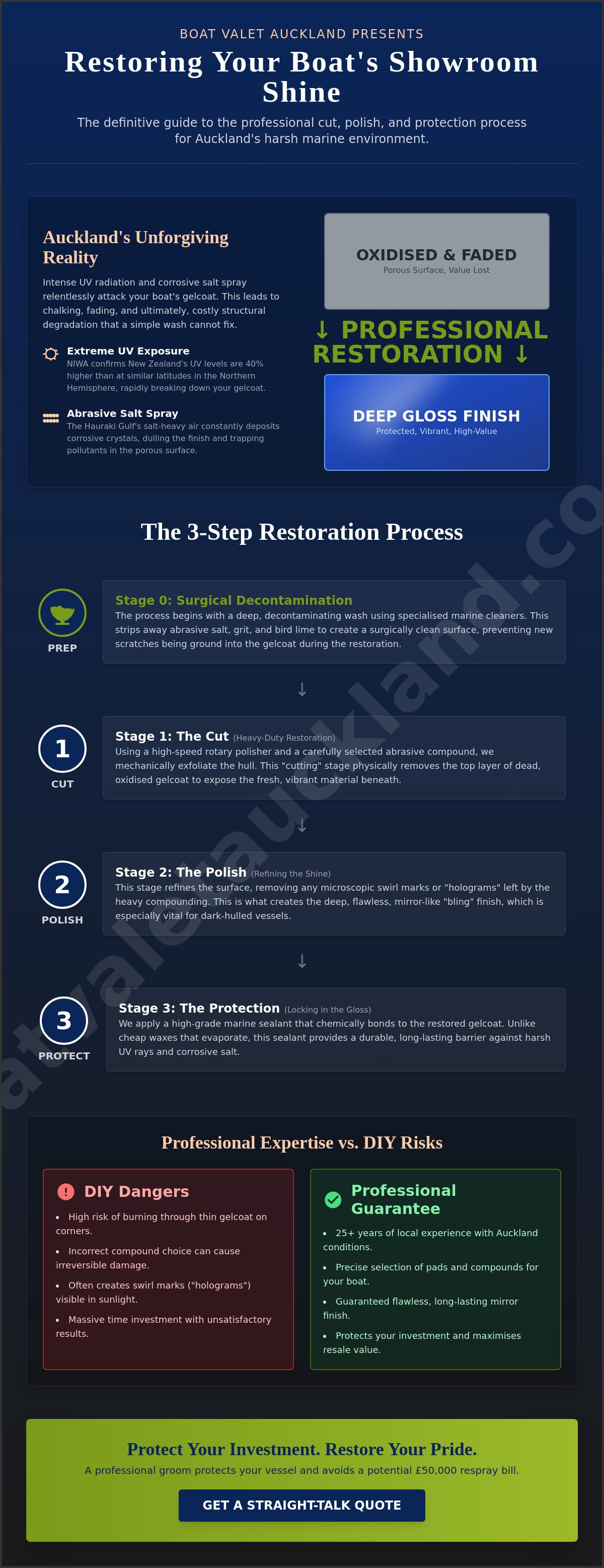
Restoring a vessel to its former glory requires more than just elbow grease; it requires a systematic approach. A professional boat cut and polish Auckland begins long before a machine touches the hull. The first essential step is a deep decontaminating wash. We use specialised marine cleaners to strip away salt, grit, and stubborn bird lime. If you try to polish a boat that hasn't been properly decontaminated, you'll simply grind abrasive salt crystals into the gelcoat. This creates deep scratches that are difficult and expensive to fix. We ensure the surface is surgically clean so the restoration can begin on a blank canvas.
Compounding: The "Heavy Lifting" Phase
This stage is where the actual restoration happens. We use high-speed rotary polishers and heavy-duty abrasive compounds to level the surface and remove the damaged material. You can think of the "cutting" phase as mechanical exfoliation for your hull. By selecting the correct grit level based on the severity of the fade, we can strip away years of oxidation in a single pass. A heavily chalked launch might require a coarse compound to reach the fresh pigment, while a newer boat may only need a light "finesse" cut. It's a high-stakes process that requires a steady hand and years of experience to get right without damaging the underlying structure.
Refining the Shine: Polishing vs Waxing
Many boat owners use these terms interchangeably, but they serve very different purposes in a professional groom. Polishing is the refining step that follows the heavy cut. It removes any tiny swirl marks or "holograms" left behind by the compounding stage. This is what creates that deep, mirror-like "bling" finish, which is particularly vital for dark-hulled boats that show every minor imperfection. Once the shine is perfected, we move to the final protection phase.
We avoid cheap hardware-store waxes that evaporate in the New Zealand heat. Instead, we apply high-grade marine sealants that bond to the gelcoat. These sealants provide a durable UV shield and make future washdowns much easier by preventing salt from sticking. If you want to see what a professional finish looks like on your own vessel, you can chat with Steve for a professional assessment of your hull's current condition. This 3-step process doesn't just make the boat look better; it seals the surface against the elements for the season ahead.
Professional Machine Polishing vs DIY: Is it Worth the Effort?
Many Auckland boaties consider tackling their own hull restoration to save a few dollars. While the idea of a weekend project at the marina sounds appealing, the reality is often a frustrating wake-up call. A professional boat cut and polish Auckland requires specialised equipment and a level of patience that most owners simply don't have. It's not just about the physical effort. It's about the precision required to handle high-value gelcoat without causing permanent, expensive damage. Most DIY attempts end with a finish that looks "okay" in the shade but reveals every mistake once the boat hits the bright Hauraki Gulf sun.
The Risks of Inexperienced Machine Use
The biggest danger is the "straight-talk" risk of burning through your gelcoat. This typically happens on corners, strakes, or tight edges where friction heat builds up in a split second. Once you've burnt through the pigment to the fibreglass underneath, you're looking at a professional repair bill that far exceeds the cost of a groom. Inexperienced users also frequently leave behind "holograms" or unsightly swirl marks. These occur because they haven't mastered the correct RPM settings for the specific surface. Painted hulls and gelcoat react differently to heat; using the wrong speed can ruin a finish instantly. Reaching tricky spots on flybridges or duckboards while balancing on a ladder only adds to the risk of a botched job.
Equipment Matters: Industrial vs Consumer Grade
There is a massive gap between a NZ$50 "buffer" from a local hardware store and a NZ$800 industrial rotary polisher. Consumer-grade machines lack the torque to maintain consistent speeds under pressure. This results in an uneven, patchy finish. Professionals use a curated selection of wool and foam pads, matching the pad density to the specific hardness of your boat's hull. We often find that Stainless Steel Polishing is a necessary companion service here. There's no point having a mirror-finish hull if your cleats and rails are covered in tea-staining.
Time is the final hurdle. A standard 30ft launch doesn't take a few hours. It takes a professional several days of focused labour to achieve a true showroom "bling" finish. Hand-applied waxes simply cannot compete with the deep, reflective shine generated by a high-speed machine. If you value your time and your vessel's resale value, the professional route is the only way to ensure the job is done right the first time.
How to Maintain Your Boat’s Shine Between Professional Grooms
Once you've invested in a professional boat cut and polish Auckland, the goal is to make that mirror-finish last as long as possible. Neglecting the hull for months will only lead to a faster return of that dreaded chalky oxidation. We recommend a full exterior washdown every four weeks as the bare minimum for boats kept in local marinas. This prevents salt crystals and industrial fallout from etching back into the fresh gelcoat. Think of it as an insurance policy for your vessel's aesthetic value.
Always use pH-neutral marine soaps for your regular cleaning. Many owners reach for common household dish soap, but this is a massive mistake. Dish soap is specifically designed to strip grease and oil; it will eat through your expensive protective wax or sealant in just one or two washes. A dedicated marine soap cleans the surface without removing the chemical barrier that keeps your hull shining. It's a simple switch that can double the lifespan of your professional groom.
The Daily Washdown Routine
Salt is the primary enemy of your boat's "bling". After every trip out on the Hauraki Gulf, you must rinse the entire vessel with fresh water immediately. If you leave salt spray to dry in the sun, it acts like a magnifying glass for UV rays, which accelerates surface damage. For dark-hulled boats, drying the hull with a high-quality microfibre towel is essential. This prevents unsightly water spotting caused by the mineral content in our local water supply. Keeping your windows and stainless steel clear of salt also prevents permanent tea-staining and glass etching that ruins the overall look of the boat.
When to Re-apply Protection
How do you know if your protection is still working? Use the "beading" test. When you wash the boat, the water should roll off in tight, round beads. If the water "sheets" or sits flat against the gelcoat, your wax has likely worn off. Auckland's high UV index means even the best sealants need a mid-season top-up to maintain that deep colour. A quick mid-season wax is much more affordable than a full boat cut and polish Auckland restoration later in the year.
It's often smart to plan these maintenance grooms alongside your antifouling schedule. By coordinating your hull maintenance, you ensure the boat is protected from the waterline to the flybridge in one efficient session. If you're short on time, talk to Steve about a monthly valet plan to keep your boat looking its best year-round.
Mobile Boat Grooming: Why Auckland Owners Trust Steve Kellie
Steve Kellie has been a fixture in the Auckland marine scene for over 25 years. Since 1998, he has built a reputation for excellence across the city’s premier marinas, including Westhaven, Orams, and Hobsonville. This isn't a faceless corporation. When you book a boat cut and polish Auckland, you're dealing with an owner-operator who takes personal pride in every hull. Steve looks at every vessel personally. This ensures that the high standards he’s known for are met on every single job. You get a "straight-talk" assessment of what your boat needs without the corporate fluff.
Mobile convenience is at the heart of the service. We bring a fully equipped professional workshop directly to your marina or driveway. Moving a large vessel is a logistical headache; we eliminate that stress by coming to you. We service all major boatyards across Greater Auckland. For those who choose to use Hobsonville Marina, we offer a unique signature benefit. We contribute 10% toward your haul-out fees to help offset the costs of your annual maintenance. It’s our way of supporting the local boating community whilst ensuring your vessel gets the care it deserves.
A Personalised Approach to Every Vessel
Steve prefers to meet boat owners for a free consultation before any machines are turned on. No two boats age in the same way. A thirty-year-old launch requires a vastly different abrasive compound and pad selection than a late-model yacht with minor fading. We tailor the entire restoration process to your specific gelcoat condition and boat type. Our mission is simple: "We bring the bling!" We don't just stop at the hull. We ensure every stainless fitting and gelcoat surface reflects the pride you take in your vessel.
Booking Your Auckland Cut and Polish
Getting a no-obligation quote for your launch or yacht is a hassle-free process. Whether you are prepping for a summer of cruising the Hauraki Gulf or getting a pre-sale groom to maximise your resale value, we provide a clear and transparent price. We understand the local market conditions and the regulatory pressures of keeping a clean hull in Auckland. Don't let the harsh New Zealand sun devalue your asset. Call Steve now to book your free consultation and discover how we can restore your boat's showroom shine.
Get Your Vessel Ready for the Hauraki Gulf
Your boat is a significant asset, but Auckland’s extreme UV levels and salt-heavy air are relentless. A professional boat cut and polish Auckland is the only way to reverse the damage of oxidation and provide a durable shield for the seasons ahead. We've explored the technical 3-step process and the risks of DIY mistakes; now it's about taking the next step to protect your vessel's resale value and aesthetic "bling."
Steve Kellie offers a fully mobile service across all Auckland marinas, bringing over 25 years of local expertise directly to your dock. As a hands-on owner-operator, Steve ensures every hull meets his exacting standards. If you're hauling out at Hobsonville Marina, take advantage of our 10% contribution toward your fees to make your annual maintenance even more affordable. We don't just clean boats; we restore them to showroom condition with a "straight-talk" approach you can trust.
Get a Free Quote from Steve Today and let's get your boat looking its absolute best for your next adventure on the water. We look forward to helping you bring back the shine.
Frequently Asked Questions
How much does a boat cut and polish cost in Auckland?
Prices vary depending on the size of your vessel and the current condition of the gelcoat. Professional grooming services in the Auckland region generally start at NZ$70 per hour plus the cost of materials and GST. A small trailer boat might only cost a few hundred dollars. However, a large launch with heavy oxidation requires significantly more labour. Boat Valet Auckland provides a direct, personalised quote after a physical inspection to ensure you get an accurate price.
How long does the shine last after a professional cut and polish?
A professional finish typically lasts between 6 and 12 months, though this depends heavily on your storage conditions and maintenance habits. Auckland's high UV levels mean that unprotected hulls can start to fade quickly. If you perform regular washdowns with pH-neutral soaps and apply a mid-season top-up wax, you can maintain that showroom "bling" for the full year. Salt removal after every trip is the most effective way to preserve the sealant.
Can you restore a boat that has been badly faded for years?
Most heavily oxidised boats can be successfully restored through a multi-stage mechanical process. We use heavy-duty abrasive compounds to strip away the "chalky" dead layers and reveal the vibrant pigment underneath. However, if the oxidation has penetrated through to the fibreglass matting, a boat cut and polish Auckland might not be sufficient. Boat Valet Auckland can assess your hull to determine if a restoration groom will work or if a full respray is necessary.
What is the difference between a wash and a full detail?
A standard wash only removes surface salt and grime, whereas a full detail involves deep decontamination and surface correction. Our full detail includes a boat cut and polish Auckland, stainless steel polishing, and window treatment to restore the entire exterior. While a wash keeps the boat tidy, a detail mechanically restores the surface and adds a durable UV sealant. It is the difference between a basic rinse and a complete showroom-ready restoration.
Do you provide mobile services at Westhaven Marina?
We provide a comprehensive mobile service to Westhaven Marina and all other major Auckland marinas. We bring the professional workshop to your berth or hardstand, which saves you the hassle and expense of moving the vessel. Whether you are at Orams, Viaduct Harbour, or Pine Harbour, we handle the entire grooming process on-site. This allows you to focus on your next trip while we take care of the hard work.
Is it better to cut and polish before or after antifouling?
It is generally more efficient to perform the cut and polish while the boat is hauled out for antifouling. This allows us to work on the hull from the waterline up without the risk of getting compound in the water. Completing both services together ensures your vessel is fully protected and looking its best before it returns to the sea. It is the most practical way to manage your annual maintenance schedule.
Can you remove rust stains from the gelcoat during the process?
Rust stains, often called "tea-staining," are easily removed during our decontamination and polishing phases. We use specialised marine-grade cleaners to dissolve the iron oxide without damaging the underlying gelcoat. Once the stain is gone, we polish and seal the area to prevent the rust from returning. This is a standard part of our exterior valet and stainless steel polishing service, ensuring every fitting looks brand new.
Will a cut and polish remove deep scratches in the fibreglass?
A cut and polish will remove fine surface scratches and swirl marks, but it cannot fix deep gouges that penetrate the gelcoat. If you can feel the scratch with your fingernail, it likely requires a gelcoat repair or filler before we can polish it. We can buff the edges of deeper scratches to make them less visible, but structural repairs fall outside the scope of a standard restoration groom.
Comments