
DIY vs Professional Antifouling in NZ: Which is Best for Your Boat?

Updated: Aug 31
What if the weekend you spent scrubbing your hull ended up costing you more in fines and fuel than a professional service ever would? Every Kiwi boat owner takes pride in a clean vessel, and the temptation to tackle the job yourself is always strong. However, when weighing up diy vs professional antifouling nz, the decision is no longer just about the price of a tin of paint. With New Zealand's biofouling regulations becoming increasingly strict, a simple mistake in application or disposal can lead to more than just a patchy finish.
We understand the satisfaction of maintaining your own boat, but we also know the physical toll and the hidden expenses that come with haul-outs and specialised safety gear. This guide breaks down the true costs, legal requirements, and performance gaps between doing it yourself and hiring an expert. You will discover how to ensure your boat remains compliant with marina rules whilst achieving a finish that lasts the entire season. We will compare the manual labour involved against the precision of professional application to help you make the best choice for your pride and joy.
Table of Contents
The Antifouling Dilemma: Why Hull Protection Matters in NZ
Antifouling is a specialized category of coatings applied to a boat's hull to prevent biofouling. In New Zealand, this isn't just about aesthetics or keeping the boat pretty. Our waters are under threat from invasive species like the Mediterranean fanworm. If these hitchhikers take hold, they don't just slow you down; they can destroy local marine ecosystems. This makes the choice between diy vs professional antifouling nz a matter of environmental responsibility as much as it is about maintenance.
A clean hull is the foundation of vessel performance. Marine growth creates significant drag, which forces your engine to work harder and consumes more fuel. To combat this, boaties typically choose between two types of paint. Ablative, or self-polishing, paints wear away slowly to reveal fresh biocide as the boat moves. Hard antifouling paints stay on the hull and leach biocides through a porous surface. The right choice depends on your boat's speed and how often you get out on the water.
NZ Biofouling Regulations and Your Responsibilities
New Zealand has some of the world's toughest biosecurity laws. Regional councils, particularly in Auckland and Northland, now enforce strict "Clean Hull" rules to stop the spread of pests. If you plan to cruise into the Bay of Islands or the Hauraki Gulf, you must prove your hull is free of excessive growth. Marinas are tightening entry requirements and often demand proof of professional antifouling or a recent haul-out. Failing an inspection can lead to hefty fines or being ordered to leave the region immediately.
The Real Cost of Neglect: Beyond Just Slow Speed
Ignoring your hull protection leads to more than a drop in knots. Barnacles and tube worms can physically damage your gelcoat and score underwater hardware like prop shafts and rudders. When debating diy vs professional antifouling nz, consider the long-term health of your vessel. The extra drag increases engine wear and can lead to cooling system failures. Perhaps most seriously, failing paint allows water to sit against the hull, increasing the risk of osmosis. These expensive blisters in the laminate can require a full, costly strip-back to repair.
The DIY Antifouling Reality: Costs, Equipment, and Compliance
Deciding between diy vs professional antifouling nz often comes down to how much you value your free time versus the cost of labour. Many boaties think buying a few tins of paint is the only major expense. This is a mistake. You must account for haul-out fees, hardstand daily rates, and the cost of professional-grade tools. A proper job requires orbital sanders with vacuum extraction, specialised rollers, and high-quality masking tape. These items add up quickly before you even open a paint lid.
The physical reality of the work is often a shock. You'll spend hours in a cramped, overhead position, scraping and sanding through layers of old biocide. Safety is non-negotiable. Because these paints are toxic, you need a high-spec respirator, chemical-resistant gloves, and full-body coveralls. Skimping on PPE is not an option when you're dealing with hazardous materials. If the labour sounds too intense, a professional antifouling service can handle the heavy lifting for you.
Environmental Compliance for the DIY Boatie
Auckland marinas operate under strict environmental permits. You can't simply sand your hull and let the dust blow into the wind. Every flake and grain of dust must be captured at the source. Washing residue into marina drains is a serious offence that attracts significant fines. Staying compliant with New Zealand's biofouling requirements involves more than just a clean hull; it requires responsible waste management. Hazardous waste must be taken to approved disposal centres, which often involves additional disposal levies and logistics.
Common DIY Pitfalls That Lead to Premature Failure
Preparation is everything. If the surface isn't perfectly keyed and cleaned, the new paint will peel away within months. Auckland's humidity is another hurdle. If the air is too damp, the paint won't cure correctly, leading to a soft finish that washes off too easily. You also need to check paint compatibility. Applying hard antifoul over an old ablative layer usually results in the coating falling off in sheets. Understanding the nuances of diy vs professional antifouling nz means recognising that a professional application often pays for itself through longevity and peace of mind.
The Professional Edge: Why Expert Application Outperforms DIY
While some boaties believe professionals simply use the same tins available at local chandleries, the real value lies in the application and preparation. In the debate of diy vs professional antifouling nz, the finish quality is determined by mechanical precision. Professionals use industrial-grade orbital sanders with vacuum extraction systems. This creates a surface profile that hand-scraping simply cannot match. A perfectly keyed surface ensures the paint bonds at a molecular level, preventing the "flaking" often seen in amateur jobs.
Understanding paint chemistry is equally vital. We often see owners tempted by "dockside folklore"—adding substances like chilli powder or unapproved antibiotics to their paint. Not only are these mixtures ineffective, but they are also strictly illegal under current rules around antifouling paints. These additives can ruin the paint's ability to leach biocides correctly, leading to total coating failure. A professional ensures a consistent, even film thickness. This is the only way to guarantee your protection lasts the full season without wearing thin in high-friction areas.
Steve Kellie’s 25+ Years of Auckland Marine Expertise
Experience matters in Auckland's unique maritime conditions. Steve Kellie has led Boat Valet Auckland since 1998, bringing over 25 years of local knowledge to every hull. An owner-operator understands which products thrive in the Hauraki Gulf versus those that struggle in warmer, shallower inlets. This tenure means your high-value asset isn't a test subject; it's in safe, experienced hands. We prioritise precision and long-term results over quick, cut-price applications. You get the peace of mind that comes from a specialist who stands by their workmanship.
Advanced Protection for Underwater Hardware
Antifouling isn't just for the hull. Your props, shafts, and rudders require specialised coatings to prevent growth without affecting mechanical performance. As part of our marine detailing services nz, we inspect these critical components thoroughly. We also check and replace sacrificial anodes. If these aren't managed correctly, electrolysis can eat away at your underwater hardware, leading to catastrophic metal loss. Professional care ensures every inch of your vessel's underside is protected against both corrosion and fouling.
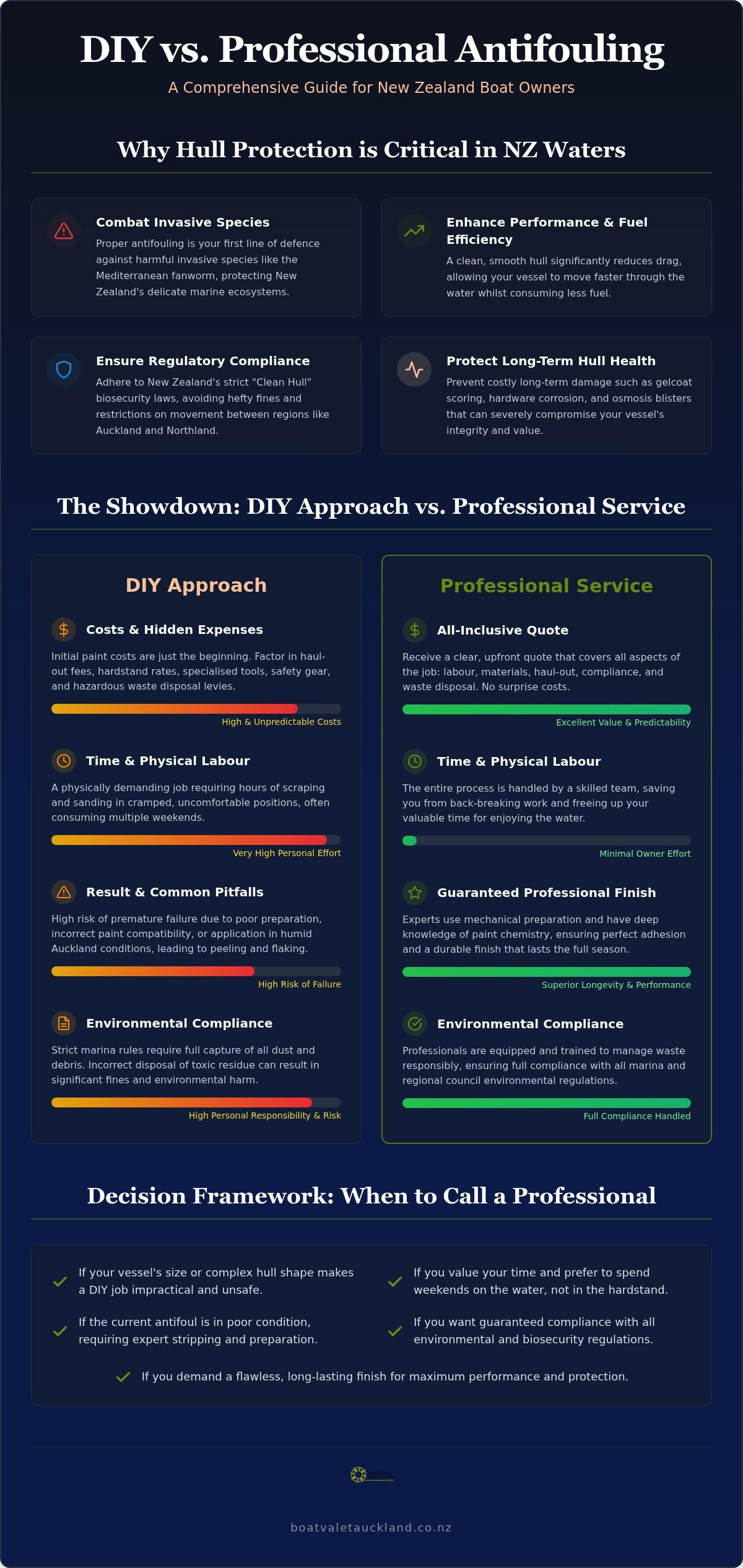
Decision Framework: When to DIY and When to Call a Pro
Choosing between diy vs professional antifouling nz requires an honest look at your vessel and your schedule. For a small trailer boat, a weekend in the driveway is often practical. However, for anything over 28 feet, the scale of the task changes dramatically. The surface area increases exponentially. The time spent on your back under a cradle becomes a gruelling marathon rather than a quick chore. You must decide if the physical toll is worth the perceived savings.
Hull condition is your next filter. If you are simply applying a fresh coat over a well-maintained, known surface, DIY is feasible. But if the paint is flaking or you see signs of osmosis, you need professional diagnostic expertise. A messy finish can also hurt your wallet when it is time to sell. High-quality pre-sale boat grooming nz starts with a smooth, professionally applied bottom. Buyers and surveyors immediately notice a patchy DIY effort, which can signal a lack of care in other areas of maintenance.
Calculating the true cost is essential. Many owners forget to factor in the price of high-quality rollers, trays, masking tape, and protective suits. Every extra day you spend on the hardstand because of a slow DIY pace increases your total bill. When you add up the paint, the gear, the haul-out fees, and your own lost weekend, the gap between diy vs professional antifouling nz often narrows significantly. If you value your time, contact Steve today for a mobile antifouling quote tailored to your vessel.
A 5-Step Checklist for Your Next Antifoul Season
Step 1: Inspect the hull thoroughly for signs of blistering, star cracks, or significant paint loss that might indicate a need for a full strip-back.
Step 2: Check your marina’s current environmental and DIY policies, as some Auckland facilities now restrict certain types of maintenance on the hardstand.
Step 3: Get a professional quote to establish a baseline for comparison. This helps you see exactly what you are paying for in terms of labour and expertise.
Step 4: Perform an honest self-assessment of your tools, time, and physical ability to spend two days in a respirator and coveralls.
Step 5: Verify the weather forecast for Auckland. High humidity or sudden rain can ruin a DIY application, whereas professionals have the experience to manage these variables.
When Professional Intervention is Non-Negotiable
There are times when doing it yourself is simply too risky. If you are dealing with unknown previous coatings, you risk a chemical reaction that could cause the new paint to slide off. Preparing a vessel for a major offshore voyage also requires the certainty of an expert application. If your schedule is packed, a mobile service is the most efficient choice. We come to your preferred Auckland marina and handle the entire process while you focus on your work or family. This ensures your boat is back in the water and ready for the season without you ever having to pick up a scraper.
Mobile Antifouling Auckland: The Boat Valet Advantage
Choosing the right partner for your vessel maintenance shouldn't be a gamble. At Boat Valet Auckland, we remove the stress of coordinating multiple contractors. Our mobile team operates across all major Auckland marinas, bringing professional-grade equipment directly to your boat. When you weigh up diy vs professional antifouling nz, the biggest factor often isn't the paint itself, but the convenience of a turnkey solution. You don't need to waste your weekends at the hardstand. Instead, you get a clean, protected hull without ever lifting a finger.
We offer more than just a single service. Our comprehensive approach allows you to combine antifouling with a boat cut and polish auckland. This ensures your vessel performs as well as it looks. You deal directly with Steve Kellie for every project. This personal accountability is rare in the marine industry. It ensures that every detail, from the waterline to the keel, meets our high standards. With nearly three decades of experience, we have seen every type of hull and every type of fouling. This tenure allows us to provide a level of reliability that a DIY project simply cannot match.
Tailored Maintenance for Auckland Marinas
Auckland's marinas each have their own unique operating procedures and environmental permits. We are deeply familiar with the specific requirements at Westhaven, the Viaduct, and Gulf Harbour. Our mobile boat grooming auckland saves you time by managing the logistics of your maintenance schedule. We act as your single, trusted point of contact. This means we can help you organise your haul-out and ensure the antifoul is applied precisely within the marina's timeframes. It is a seamless process designed to get you back on the water faster while ensuring you remain compliant with all local biofouling rules.
Ready for the Water: Your Next Steps
Preparation is the key to a successful boating season. As the warmer months approach, the demand for haul-outs and professional services spikes. Booking your slot early is essential to avoid the busy summer rush. When considering diy vs professional antifouling nz, remember that a professional booking guarantees your vessel is ready when the weather turns. To get started, simply request an accurate mobile antifouling quote for your vessel. We assess your boat's specific needs to provide a transparent, results-oriented plan. Ensuring your boat is protected for the 2026 season gives you the freedom to explore the Hauraki Gulf with confidence. Don't leave your hull protection to chance. Partner with a specialist who values your boat as much as you do.
Protect Your Investment for the Season Ahead
The choice between diy vs professional antifouling nz isn't just about saving a few dollars. It's about the longevity of your vessel and staying on the right side of New Zealand's strict biosecurity laws. A clean hull means better speed, lower fuel costs, and full access to regional marinas without the fear of failed inspections. You have seen the physical reality of the hardstand; now it's time to choose the solution that fits your lifestyle.
With over 25 years of local maritime experience, Steve Kellie provides a mobile service that brings expert care directly to your berth. You get the peace of mind that comes from direct owner-operator accountability and a finish that stands the test of time. Don't spend your weekends scrubbing or worrying about peeling paint. Contact Steve Kellie today for a professional Auckland antifouling quote and ensure your boat is ready for the water. We look forward to helping you get the best out of your time on the Hauraki Gulf.
Frequently Asked Questions
Is it illegal to add my own additives to antifouling paint in New Zealand?
Yes, it's illegal. Under the Environmental Protection Authority rules, you cannot add unapproved substances to antifouling paint. Some boaties try mixtures like chilli powder or antibiotics, but these are strictly banned. These additives can interfere with the paint's chemical balance and harm the marine environment. Using a professional service ensures your coating is compliant with current NZ regulations and that the biocide leaches at the correct rate for maximum protection.
How much does professional antifouling cost compared to DIY in Auckland?
When comparing diy vs professional antifouling nz, the initial price of professional work is higher because it includes expert labour. However, DIYers often overlook hidden costs like haul-out fees, hardstand daily rates, and specialised safety equipment. A professional application often lasts longer due to superior preparation, potentially saving money over several seasons. While DIY seems cheaper at the shop counter, the total expense of a lost weekend and potential re-application often narrows the gap.
How often should I antifoul my boat if it is kept in an Auckland marina?
Most vessels kept in Auckland marinas require a fresh coat every 12 to 18 months. The high nutrient levels in the Hauraki Gulf encourage rapid marine growth, especially during the warmer summer months. If you notice a significant drop in your top speed or a spike in fuel consumption, it's likely time for a haul-out. Regular maintenance prevents invasive species from taking hold and protects your hull's gelcoat from long-term damage.
Can I antifoul my boat while it is on a trailer or does it need to be hauled out?
The most obvious sign is visible marine growth, such as barnacles or slime, appearing on the waterline. You might also notice the paint "chalking" or rubbing off easily when touched. A drop in performance is a key indicator; if your boat feels sluggish or uses more fuel to maintain cruising speed, the hull is likely fouled. Inspecting the hull during a mid-season wash can help you spot flaking or thinning areas early.
Will professional antifouling help my boat pass NZ biofouling inspections?
Yes, professional application significantly improves your chances of passing strict biofouling inspections. Experts ensure even film thickness and use products tailored for local Auckland conditions. This prevents the patchy growth often seen with DIY jobs. Many marinas in Northland and the Bay of Islands now require proof of professional maintenance or a recent clean hull certificate before allowing entry. A professional finish provides the documented evidence needed for these regional authorities.
How long does a professional antifouling job typically take to complete?
A typical professional job takes between two and four days to complete. This timeframe includes the initial water blast, mechanical sanding, masking, and the application of multiple coats. Drying times are critical and vary based on Auckland's humidity levels. We don't rush the process because the paint needs to cure correctly before the boat is relaunched. Larger vessels or those requiring a full strip-back of old layers will naturally take longer.
What is the best time of year to organise antifouling in Auckland?
Late winter or early spring is the ideal time to organise your maintenance. Booking in August or September ensures your boat is ready before the busy summer cruising season begins. Hardstand spaces in Auckland marinas fill up quickly from October onwards, so planning ahead is vital. Avoiding the peak rush also means you won't be competing for haul-out slots when the weather is perfect for being out on the Hauraki Gulf.
Comments