
DIY Boat Polish vs Professional: Which is Best for Your Vessel?

Spending your entire weekend with a manual buffer might be the most expensive "saving" you ever make for your vessel. Many Auckland boat owners assume the diy boat polish vs professional debate is a simple matter of saving a few dollars, but the reality is often etched into the swirl marks left behind on a Sunday afternoon. You want your boat to gleam with a mirror-like finish that reflects the Hauraki Gulf, not look like a faded, chalky relic. It is frustrating to put in hours of back-breaking labour only to see the shine vanish after just a few weeks of exposure to our harsh UV rays.
This article reveals the genuine differences in cost, physical effort, and long-term protection between a home job and hiring an Auckland specialist. You'll discover why the right specialised tools and high-quality compounds are essential for a result that lasts the whole season. We will break down the actual requirements of a professional-grade cut and polish, helping you decide if you want a short-term aesthetic fix or a structural preservation of your gelcoat that maintains your boat's high resale value.
Key Takeaways
Auckland's intense UV levels break down gelcoat polymers rapidly, making the right protection choice critical for your boat's longevity.
Evaluate the diy boat polish vs professional debate by comparing the "man-hours" required against the superior depth of industrial-grade compounds.
Identify the high-stakes risks of manual polishing, including how to avoid burning through to the fibreglass with high-speed tools.
Realise the financial benefit of professional marine grooming as an investment that adds thousands to your vessel's eventual resale value.
Compare the longevity of retail products versus specialist applications to ensure your mirror-like finish lasts the entire boating season.
Table of Contents
The Challenge of Maintaining Gelcoat in the Auckland Environment
Auckland boat owners operate in one of the most demanding maritime environments on the planet. Whilst owners in the Mediterranean or the Caribbean might worry about heat, New Zealand boaties face a unique combination of high-intensity UV radiation and aggressive coastal salt. To understand why the diy boat polish vs professional debate is so relevant here, you first need to understand what gelcoat is and how it behaves. Unlike the thick, multi-layered paint systems found on cars, gelcoat is a relatively thin, porous "skin" of resin. It's designed to be durable, but it's highly susceptible to the elements found in the Hauraki Gulf.
Oxidation is the primary enemy. It begins when the polymers in your boat's surface start to break down, leading to a phenomenon known as "chalking." If you've ever rubbed your hand across your hull and ended up with a white, powdery residue on your palms, your finish is already in a state of advanced decay. This chalking signals that the resin binder has been destroyed, leaving the pigments exposed. At this stage, a simple wash is never enough. Rinsing the boat might remove surface dust, but it won't stop the chemical process of oxidation that's eating into your vessel's appearance and value.
Why NZ UV Levels Demand Superior Protection
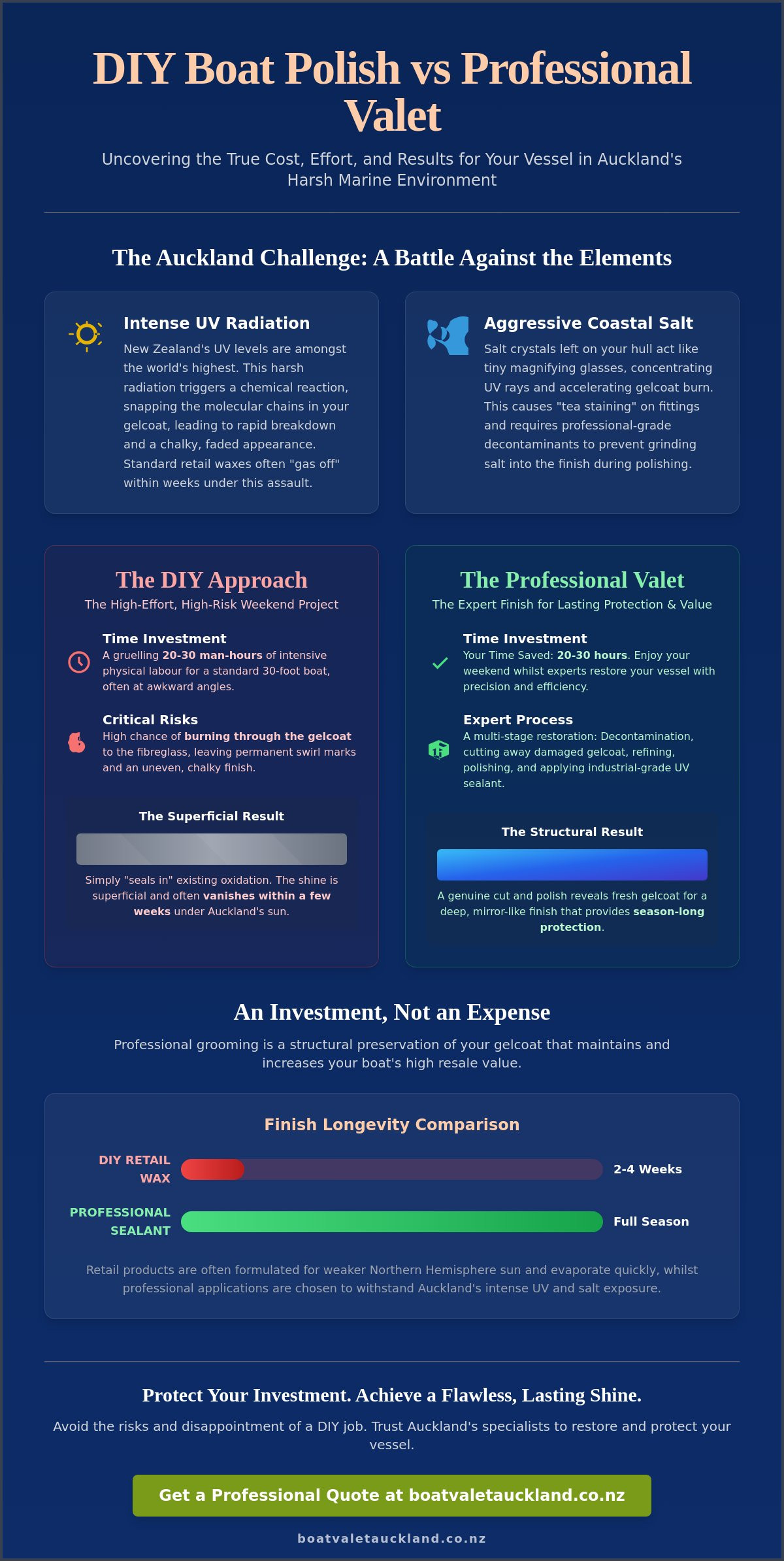
New Zealand's UV levels are amongst the highest in the world. This intense radiation triggers a chemical reaction that literally snaps the molecular chains within the gelcoat. Because the sun is so much harsher here, standard retail waxes often evaporate or "gas off" within just a few weeks. These products are frequently formulated for northern hemisphere conditions and simply cannot withstand the heat and radiation found in a typical Auckland summer. When you choose a professional diy boat polish vs professional approach, you're often choosing between a superficial shine and a deep-level chemical restoration that can actually resist these UV-B rays.
The Impact of Salt and Harbour Grime
Salt is more than just a nuisance; it's a catalyst for destruction. When salt water dries on your hull, the resulting crystals act like tiny magnifying glasses, concentrating UV rays and accelerating the burning of the gelcoat. In coastal environments like Auckland, "tea staining" on stainless steel fittings can also occur quickly, as warned by the Australian Stainless Steel Development Association (ASSDA). These rust-coloured streaks aren't just ugly; they're difficult to remove manually without the right equipment. Professional-grade decontaminants are essential to strip away this harbour grime and salt before any polishing begins, ensuring that you aren't just grinding salt crystals into your finish during the buffing process.
The DIY Boat Polishing Reality: Tools, Time, and Technique
Tackling a boat polish yourself is often seen as a rite of passage for Auckland boaties. However, the diy boat polish vs professional choice becomes clearer when you calculate the actual time and equipment required. For a standard 30-foot vessel, you aren't looking at a casual Saturday afternoon. A proper restoration requires between 20 and 30 man-hours of intensive physical labour. This includes the strain of working at awkward angles whilst the boat is on a trailer or, more difficult still, whilst leaning over the gunwales in a marina pen. It's a gruelling process that many owners underestimate until they're halfway through the first side.
There's also a fundamental difference between "waxing" and a true "cut and polish." Waxing simply applies a protective layer over the existing surface. If that surface is already chalky or oxidized, you're essentially just sealing in the damage. A professional-grade restoration involves cutting away the damaged material to reveal the fresh gelcoat underneath. This requires a level of technique and physical endurance that manual hand-polishing simply cannot replicate.
Essential DIY Equipment Checklist
Choosing the right machine is your first hurdle. Beginners should opt for a Dual Action (DA) polisher. These are much safer and less likely to damage the gelcoat, though they take twice as long as a professional rotary buffer. You'll also need a stack of high-quality wool pads and microfibre cloths. Retail prices for premium products add up quickly. For instance, 3M Perfect-It Boat Wax costs around $93.90, and a 473ml bottle of heavy cutting compound is roughly $59.99. When you add the cost of a decent machine and pads, your "cheap" DIY project can quickly approach the cost of a professional service.
The Multi-Stage Process: More Than Just Buffing
A true boat cut and polish is a scientific process, not just a quick wipe. Part of a comprehensive boat maintenance routine involves these four critical stages:
Step 1: Decontamination. Removing the "Auckland film" of salt, exhaust soot, and industrial fallout.
Step 2: Heavy Cutting. Using aggressive compounds to strip away the dead, chalky layers of gelcoat.
Step 3: Refining. Using a finer polish to remove swirl marks and bring back the deep colour.
Step 4: Sealing. Applying a marine-grade sealant to lock in the shine and provide UV protection.
Many "all-in-one" products from local hardware stores try to combine these steps. They rarely work. They might look good for a week, but they lack the staying power to handle the Hauraki Gulf's conditions. If you're looking for a result that lasts, skipping these stages isn't an option.
DIY vs Professional Boat Polishing: A Head-to-Head Comparison
The diy boat polish vs professional debate often settles on the quality of the chemistry involved. Retail products found in Auckland marine shops are designed to be user-friendly. They often contain high oil content to mask imperfections temporarily. This provides a shine that looks great on the trailer but often fades within three months as the oils wash away. Industrial-grade compounds used by specialists are different. They physically level the surface of the gelcoat to remove oxidation entirely. This professional approach, followed by high-grade sealants, offers protection for up to 12 months.
Specialists also identify issues that a weekend warrior might miss. We look for thin spots in the gelcoat and stress fractures. Buffing over these areas without caution can cause permanent damage. Following a professional program of gelcoat maintenance ensures your vessel stays structurally sound. It is about preservation, not just a quick clean. You want a result that stands up to the Hauraki Gulf conditions.
Comparing Results: The "Mirror Test"
DIY attempts often result in "swirl marks" or "holograms." These are fine scratches left by incorrect pad choice or inconsistent machine speed. They are particularly visible under the bright Auckland sun. A professional multi-stage restoration achieves a deep "wet look" finish that retail products cannot match. It creates a surface so smooth that grime and salt struggle to bond to it. For a closer look at the technical steps involved in this transformation, check out our guide on what is a boat cut and polish.
Time and Opportunity Cost
Your time has a specific value. A 30-foot vessel requires roughly 25 hours of intensive labour to polish correctly. That is three full weekends of work. Mobile grooming services operate at Auckland marinas like Westhaven or the Viaduct whilst you are at work or home. You arrive on Friday to a pristine vessel ready for the water. When you add up the costs of a machine, pads, and materials like 3M Perfect-It Boat Wax ($93.90) or Meguiar's Flagship Marine Wax ($50.99), the DIY route is rarely the bargain it appears to be. Spend your weekends enjoying the Hauraki Gulf instead of scrubbing it.
Critical Risks: When DIY Polishing Goes Wrong
The most significant danger in the diy boat polish vs professional debate is the high-speed rotary buffer. In the hands of an amateur, a machine spinning at 2,500 RPM is a liability. It generates immense heat through friction. If you linger too long on a corner or a chine, you can "burn" through the gelcoat in seconds. This exposes the raw fibreglass underneath, leading to a permanent repair bill that far exceeds the cost of a professional service. Once the gelcoat is gone, it cannot be polished back; it must be physically repaired and colour-matched by a shipwright.
Another common mistake is "locking in" oxidation. If you apply a high-quality wax over a surface that hasn't been properly decontaminated or cut, you are essentially sealing the damage. The boat might look shiny whilst it's in the shade, but the Auckland sun will quickly reveal the truth. Within weeks, the wax will fail, and the chalky, faded appearance will return. This creates a frustrating cycle of wasted effort and expense. Beyond the boat itself, you must consider the environment. Auckland Council has strict rules about biofouling and chemical runoff in our harbours. Improperly managing polishing compounds or cleaning agents can lead to significant fines if chemicals enter the Hauraki Gulf ecosystem.
Permanent Gelcoat Damage
Heat friction from a buffer doesn't just strip material; it can discolour the resin. This often results in "ghosting," where a hazy, uneven patch remains visible regardless of how much wax you apply. Achieving a consistent result with fibreglass boat polish requires precise temperature control and an understanding of how different resins react to friction. Professionals monitor the surface temperature constantly. We ensure the compound is working into the pores without melting the delicate top layer. If you're unsure about your technique, it's safer to book a professional boat cut and polish to avoid these irreversible errors.
Inconsistent Finish and Swirl Marks
The Auckland sun is a harsh critic. It highlights every swirl mark and hologram left by a poor DIY attempt. These marks are caused by using the wrong pad, incorrect pressure, or contaminated cloths. Achieving a uniform shine across a large hull is incredibly difficult for a novice. You might get the bow looking perfect, only to find the stern looks patchy and dull. This inconsistency is often what separates a "tidy" boat from one that commands a premium price on the resale market. Don't let a weekend of hard work end in a result that makes you want to keep the covers on.
Why Professional Marine Grooming is a Long-Term Investment
Choosing a professional service isn't just about avoiding a sore back. It's about shifting your mindset from maintenance to asset protection. When you weigh up the diy boat polish vs professional options, remember that a specialist brings more than just a machine to the dock. Steve Kellie offers over 25 years of hands-on experience in Auckland marine care. This tenure means he understands the specific quirks of different gelcoat brands and how they react to the local climate. He knows exactly how much material can be safely removed and which areas require a lighter touch to avoid structural thinning.
Professionals also have access to high-solid sealants and trade-only ceramic coatings that aren't available on retail shelves. These advanced chemicals create a harder, more durable barrier against the elements than any standard wax. They bond at a molecular level to provide a finish that stays slick, making your regular wash-downs much faster. You aren't just paying for a clean boat; you're investing in a chemical shield that preserves the underlying resin for years to come.
Boosting Resale Value in the Auckland Market
First impressions are everything in the Auckland maritime community. Whether your vessel is moored at Westhaven or sitting on a trailer in the driveway, a faded hull sends a signal of neglect to potential buyers. A mirror-like shine suggests the mechanical systems have been equally well-maintained. This psychological impact often allows sellers to command a premium price and close deals faster. Professional grooming can literally add thousands of dollars to your final sale figure by restoring that "new boat" showroom appeal. If you're preparing to list your vessel, prioritise pre-sale boat grooming nz to maximise your return.
The Mobile Advantage with Boat Valet Auckland
The greatest luxury of professional grooming is the convenience. Our mobile service comes directly to your marina or private residence. You don't need to coordinate transport or lose your weekends to manual labour. Whilst we are on-site, we provide an expert assessment of your vessel's overall condition. We can identify if it's time for fresh antifouling or if your teak decks require specialised restoration. This proactive approach catches small issues before they become expensive repairs. It's about total peace of mind and keeping your vessel in peak condition with zero effort on your part. Contact Steve Kellie today for a professional boat cut and polish Auckland and let us restore the pride in your pride and joy.
Secure Your Vessel's Future on the Hauraki Gulf
Auckland's marine environment doesn't offer many second chances for your gelcoat. Deciding on the diy boat polish vs professional route is about more than just a weekend project; it's a choice between a temporary shine and long-term structural preservation. You've seen how the intense UV levels can turn a vibrant hull into a chalky mess, and how the wrong tool in inexperienced hands can lead to permanent damage. By choosing a specialist, you aren't just saving yourself 25 hours of back-breaking labour; you're ensuring your vessel maintains its maximum resale value whilst benefiting from the deepest possible protection.
Since 1998, Boat Valet Auckland has provided a high-end mobile service across all Auckland marinas. Steve Kellie operates as a trusted local specialist, bringing decades of precision to every hull he touches. Whether you need a full restoration or a pre-sale groom, we ensure your asset is in safe hands. Get a Professional Quote from Steve at Boat Valet Auckland today to restore your vessel's mirror-like finish. Let's get your boat looking its absolute best for the next season on the water.
Frequently Asked Questions
Is it cheaper to polish a boat yourself?
Initially, DIY polishing seems cheaper, but the cost of entry is higher than most owners expect. You must purchase a machine polisher, specific wool pads, and premium materials like 3M Perfect-It Boat Wax ($93.90) or Meguiar's Flagship Marine Wax ($50.99). When you add the 25 to 30 hours of labour required for a 30-foot vessel, the diy boat polish vs professional cost gap narrows significantly. Many owners find that their personal time is better spent on the water than on a ladder.
Can I use a car polisher on my boat?
No, car polishers generally lack the torque and power needed to work on marine gelcoat. Gelcoat is much harder and more porous than automotive paint, requiring high-speed rotary buffers and aggressive compounds to level the surface. Using a standard car polisher often results in a patchy finish and fails to remove the deep oxidation common in the Auckland environment. It is a recipe for frustration and a substandard shine.
How long does a professional boat polish last compared to DIY?
A professional application typically provides protection for up to 12 months, whilst a DIY job using retail products often begins to fade within three. Specialists use high-solid sealants and industrial-grade compounds that bond more effectively to the gelcoat. This durability is essential in New Zealand, where our extreme UV levels quickly break down the lighter oils found in many hardware-store waxes.
What is the best month in Auckland to get my boat polished?
Late spring, specifically September and October, is the ideal time to organise your polishing before the peak summer UV radiation hits. Polishing during the cooler months prevents compounds from drying too quickly on the hull, which allows for a more consistent finish. Getting the work done early ensures your vessel is protected and looking its best for the busy Hauraki Gulf boating season.
Will polishing my boat remove deep scratches?
Polishing will remove light surface scratches and swirl marks, but it cannot fix deep gouges that penetrate the gelcoat. If a scratch is deep enough to catch your fingernail, it likely requires a specific gelcoat repair or filling before the polishing process begins. A professional assessment can determine if your hull needs structural attention or if a heavy machine cut will be sufficient to restore the surface.
Can I polish my boat whilst it is in the water?
You can polish the topsides and cabin house whilst afloat, but the hull itself requires a haul-out. Polishing the hull in the water is physically difficult and risks introducing chemical runoff into the harbour, which violates Auckland Council environmental regulations. For a comprehensive result, most owners choose to combine their polishing with their annual antifouling at a local boatyard or haul-out facility.
How do I know if my gelcoat is too far gone for a DIY polish?
Perform the "chalk test" by rubbing your hand across the dry hull; if a thick white powder covers your palm, the oxidation is likely too deep for retail products. When gelcoat becomes extremely porous, it requires a heavy multi-stage machine cut that can easily "burn" the surface if attempted by an amateur. If the finish looks dull even when wet, it’s a clear sign you need a specialist's intervention to save the resin.
What happens if I don’t polish my boat every year?
Neglecting your annual polish allows UV rays to permanently degrade the gelcoat polymers, leading to irreversible "yellowing" and deep pitting. Once the surface becomes severely oxidised, it attracts salt and grime more easily, making the boat much harder to clean. Over time, this neglect significantly reduces the resale value and eventually requires a far more expensive restoration process than a simple yearly maintenance buff.
Comments